Nowadays companies are obliged to overcome a long and expensive distance in order to obtain license for trust management activities. Conscientious companies have to incorporate complex and costly reporting and auditing systems as well as to impose serious restrictions for investors. Obviously, neither companies nor investors benefit from all of the factors that eventually lead to serious limitations on the potential of market participants, lack of usability and lack of trust.
However, despite the visibility of the existing problems in the industry, the mechanisms of interaction between investors and brokers have not undergone any significant changes yet. This indicates the special need to introduce new technologies that will dramatically change the current situation.
has developed a unique solution that successfully addresses the nascent issues. It represents a decentralized trust management platform that is built in mind with blockchain technology and smart contracts. In the wake of numerous implementations, blockchain has proven to be the best router for indispensable advantages, such as openness, immutability, and censorship-resistance of all recorded information, whereas smart contracts, which will be carrying out investment and profit distribution, make these processes completely clear and secure.
From manager’s point of view, the trade process within Genesis Vision ecosystem remains almost the same: the manager will continue to operate on the exchange or through a convenient broker. Nevertheless, a vital element of the Genesis Vision project bases on underlying manager tokens that each manager can issue and then utilize for all spectrum of investment operations.
In the meantime, investors seamlessly access managers from around the world by buying a manager’s cryptocurrency, which size of the issue directly depends on verifiable trade statistics, and private managers can attract more investors and benefit from fair competition.
Genesis Vision, in turn, combines a common open source of reliable information about the statistics of the network participants’ activities with an absolutely transparent system of investment, profit distribution and, importantly, “manager token” trading.
According to , Genesis Vision has launched the alpha version of its GV platform where users will be able to make transactions with crypto and fiat currencies, CFDs, metals and commodities, join the brokers’ community, and choose the role of manager, investor or broker of Genesis Vision ecosystem.
Additionally on April 1, the licensed global broker Just2Trade (branded in Russia as Finam) and Genesis Vision signed a partnership deal that opens major opportunities for the participants in this cooperation. Terms of agreement empower the Genesis Vision managers to trade while enjoying the wide array of Just2Trade’s top-notch services.
Genesis Vision decided to roll out the Alfa version of GV platform in a demo mode for the users to learn the profit distribution mechanics and get familiar with the manager ranking system. By now, anyone can join the Alpha version and try it free of charge since all of the funds will be of virtual value. The demo state will go on for as long as it is necessary to carry out all the testing and honing.
Alexey Kutsenko, CBDO of Genesis Vision, explains:
“We consider it necessary for users to test the platform and understand the way it functions, and only after that they will be able to start trading operations with real funds. The opportunity to test platform without any risk to lose money is a huge advantage for all the participants. We also consider demo mode to be a helpful tool to discover the possible errors and to correct them before the launch of real version.”
Alpha version in demo mode will be available until the project team decides to launch the real account mode. Besides the aspiring fact that the Alpha version is designed to prevent all possible errors that may occur due to the lack of user’s experience and eventually result in funds loss, Genesis Vision has also promised to reward participant with the best performance at the end of demo mode.
The post appeared first on .
On April 6 the privacy-centric cryptocurrency monero (XMR) forked the protocol in order to make the digital asset’s mining ecosystem egalitarian. However, the hard fork has led to the birth of four monero-based blockchain branches all claiming to be the “original monero.”
Also read:
The ‘ASIC Scare’ Creates Four Separate Monero Projects
The digital currency (XMR) is a public blockchain network created in April of 2014. Unlike litecoin and many other altcoins, XMR is not a clone of the original bitcoin codebase. Monero was built using the Cryptonote protocol; a codebase designed by a cryptographer who called himself Nicolas van Saberhagen. Saberhagen’s proof of concept turned into a slew of Cryptonote coins that utilized the Cryptonight proof-of-work hash algorithm like bytecoin, boolberry, and monero. However, just recently the Chinese mining operation Bitmain Technologies launched its Antminer X3 series, which hashes the mining protocol Cryptonight. A few other mining manufacturers such as Halong Mining and Baikal revealed ASICs that process the algorithm as well.
In light of this situation, the monero developers and community decided it was best to hard fork the chain in order to render these machines useless against the network. Monero (XMR) planned to upgrade to the version 12 codebase, which changed the consensus rules making its Cryptonight PoW more secure against ASIC technology. Although a significant portion of the monero community did not favor the idea and this issue has split the community into multiple subsets. This has eventually led to four projects relying on the original version 11 monero codebase.
All Four Monero’s Believe They Are the ‘Original’
 Following the April 6 fork, there are now four different moneros that have decided to keep the original branch going. Two of the projects call themselves ‘Monero Classic’ with one team deriving from Singapore, and the other a developer who calls himself ‘PZ.’ Both of these projects claim changing monero’s PoW is not a well thought out decision, and both project leaders think they should keep the ‘original’ codebase alive. The Singapore team working on explains that the XMR developers have declared “unilateral control over monero” by being able to change the consensus algorithm on a whim. Moreover, the developer ‘PK’ and his project, which is described in both English and Chinese, agrees with this sentiment and doesn’t think the algorithm should have been changed.
“We believe that the two ideas of ’embrace ASIC mining machines’ and ‘against ASIC mining machines’ both have their own strengths and weakness,” .
Therefore, we believe that these two thoughts should be given equal opportunities for development. We will make our best efforts to maintain the Monero system before this algorithm change, thereby preserving the fire that gives the ecology more potential for development.
‘A Trojan Horse Designed to Compromise the Effectiveness of Proof-of-Work’
Following the two teams that refer to themselves as ‘classic,’ there is also the ‘monero original’ project. Monero original (XMO) revealed its intentions when it sent press releases to multiple cryptocurrency journalists and publications. , and the lead developer is a person called ‘Xman.’
“We are contacting you on behalf of the development team behind the monero original project. Monero original (XMO) is the original monero chain that we will keep up and running after the monero hard fork scheduled for the 28th of March 2018 at block #1,539,500,” explains the developer’s message to the press.
Monero has always been about freedom of choice, about diversity and about the strong community behind it. We are providing the Monero fans a possibility to support the iconic coin and stay on the original chain. Monero original team stands for diversity, which is a logical marker of evolution.
Lastly, there is a development team that believes monero’s (XMR) strategy to hard fork is no longer “a stable and sane strategy.” The lead developer is a pseudonym who seems to firmly believe that forking protocol to avoid ASICs is not consensus. The monero 0 (XMZ) project states on its website:
We believe that Satoshi’s proof-of-work is the only mechanism for decentralized consensus. The so-called “network upgrades” that are centrally mandated by the monero project are a trojan horse designed to compromise the effectiveness of Proof of Work in the monero network. Monero 0 is not a fork, it is the original Monero.
Proceed With Caution: These Forks May Not be Stable or Survive
As of right now, it’s not certain how reliable any of these forks will be and how long they will last. This includes being supported by cryptocurrency infrastructure providers and maintaining continuous active development. A few of these monero forks have indicated support from exchanges and mining pools so far which will help them get started. However last year there were a ton of bitcoin ‘forks’ or cloned snapshots that produced absolutely nothing weeks later, as many of the BTC snapshots don’t have working blockchains, development is non-existent, and the network looks like a ghost town.
What do you think about the four moneros? Let us know what you think about this situation in the comments below.
Images via Pixabay, Wiki Commons, and the Monero XMR project logo.
At .com all comments containing links are automatically held up for moderation in the Disqus system. That means an editor has to take a look at the comment to approve it. This is due to the many, repetitive, spam and scam links people post under our articles. We do not censor any comment content based on politics or personal opinions. So, please be patient. Your comment will be published.
The post appeared first on .

South Korean cryptocurrency exchange Bithumb is launching a P2P payment platform for social media including social networking sites and blogs. The exchange is also preparing to sell 12,500 kinds of mobile vouchers from 600 brands.
Also read:
Social Media Crypto Payment System
 The second largest crypto exchange in South Korea, Bithumb, recently announced that it is launching a “social media optimization payment platform.” Tentatively called SNS Pay, this P2P platform supports payments on social media including social networking sites (SNS) and blogs, the exchange detailed, adding that:
SNS Pay is a service that integrates support for sharing, billing, and marketing products registered on social media. In particular, [we are] implementing a system to allow payments with the same UI/UX and social media.
Bithumb explained that customers can use its new platform to buy goods that are popular on social media without having to search for an online store that sells the products. “By utilizing SNS Pay [for] shopping on social media, the conversion rate leading to the actual purchase is expected to be significantly improved,” a Bithumb official said, adding that “SNS Pay increases the payment convenience to lower transaction costs.”
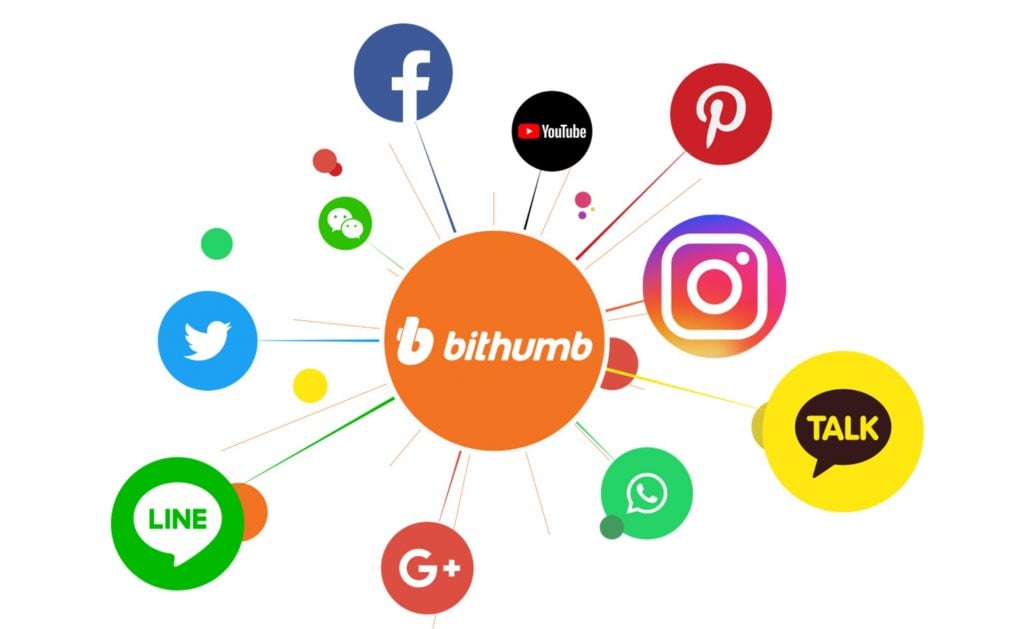 Illustration provided by Bithumb.
South Korea is among the countries with the highest proportion of active social media users. Its current population is 51,118,262 as of March 31, based on the latest United Nations’ estimate. According to data from Statista, 84% of the population are active social media users as of the third quarter of last year, with almost 43 million people actively using Kakao Talk in the second quarter of last year.
Partnership with Wincube Marketing
Last week, Bithumb also announced that it has formed a strategic partnership with Wincube Marketing, a Korean e-commerce site offering coupon services.

“Under the partnership with Wincube Marketing, Bithumb will sell 12,500 kinds of mobile vouchers from 600 brands through gift certificates,” the exchange wrote, adding that customers can use their cryptocurrencies held at the exchange or Korean won to purchase gift certificates and gifts. Bithumb currently offers trading of 15 cryptocurrencies: bitcoin, ripple, ether, eos, icon, qtum, tron, ethereum classic, vechain, bitcoin cash, litecoin, bitcoin gold, monero, dash, and zcash. The exchange elaborated:
Cryptocurrency is now out of the investment vehicle only [phase]. [It] started to play a function of real money.
What do you think of Bithumb’s social media payment system and partnership to sell gift vouchers? Let us know in the comments section below.
Images courtesy of Shutterstock and Bithumb.
Need to calculate your bitcoin holdings? Check our section.
The post appeared first on .

Global decentralized health platform, ™ has announced the launch of its tokenized equity offering. The company intends to raise up to $24 million pursuant to Regulation D of the U.S. Securities Act of 1933. The decentralized health platform-as-a-service aligns health plans, provider groups, and wellness brands around patient engagement, improved clinical outcomes, and lower healthcare costs. The platform will enable the patient to manage their own self-sovereign health identity and record, secured via blockchain, and engages the ecosystem to drive healthy patient behaviour through the Vidamint™ token.
The Company’s Regulation D, Rule 506(c) offering is open to accredited domestic and international (under Regulation S) investors. MintHealth recently announced it will release both a security and utility token (see 3/15 MintHealth Updates Toward Security Token Structure release). MintHealth will offer investors a security token (MHST) in this Regulation D offering under the United States Securities Act of 1933. Vidamints™ (VIDA) are loyalty/utility rewards that are sold at a fixed price directly by MintHealth. Operating as the rewards and incentive system on the MintHealth platform, VIDA will be used to engage patients with daily, highly personalized activities that improve health and lower insurance costs. The MHST token is expected to entitle holders to a 10% royalty percentage of revenues generated through the sale of Vidamints by MintHealth, subject to certain adjustments and offsets, and also to equity ownership in MintHealth.
READ

