Since the bitcoin Cash (BCH) fork occurred recently, it’s a good time to discuss the difference between custodial and noncustodial cryptocurrency services. Newcomers to the digital asset economy often get confused when they hear about a blockchain split and may wonder how they should handle the outcome. Individuals should note that the best solution depends greatly on how they prefer to store their cryptocurrencies – in a custodial or noncustodial wallet.
Also read:
Third Party and Sovereign Control Over Private Keys
If you have just joined the cryptocurrency space, you might find some parts of the ecosystem confusing. One of the most important lessons to learn is the best way to keep your assets safe and secure because no one likes to lose money. In the early days, around eight years ago, there were very few service providers offering wallets and exchanges. But now there are hundreds of wallets and exchanges offering a storage solution for cryptocurrencies. What some digital currency newcomers may not understand is that there is a big difference between custodial and noncustodial services. The recent bitcoin Cash fork is a good example of why people should understand the differences between both systems.
Custodial Wallet Services
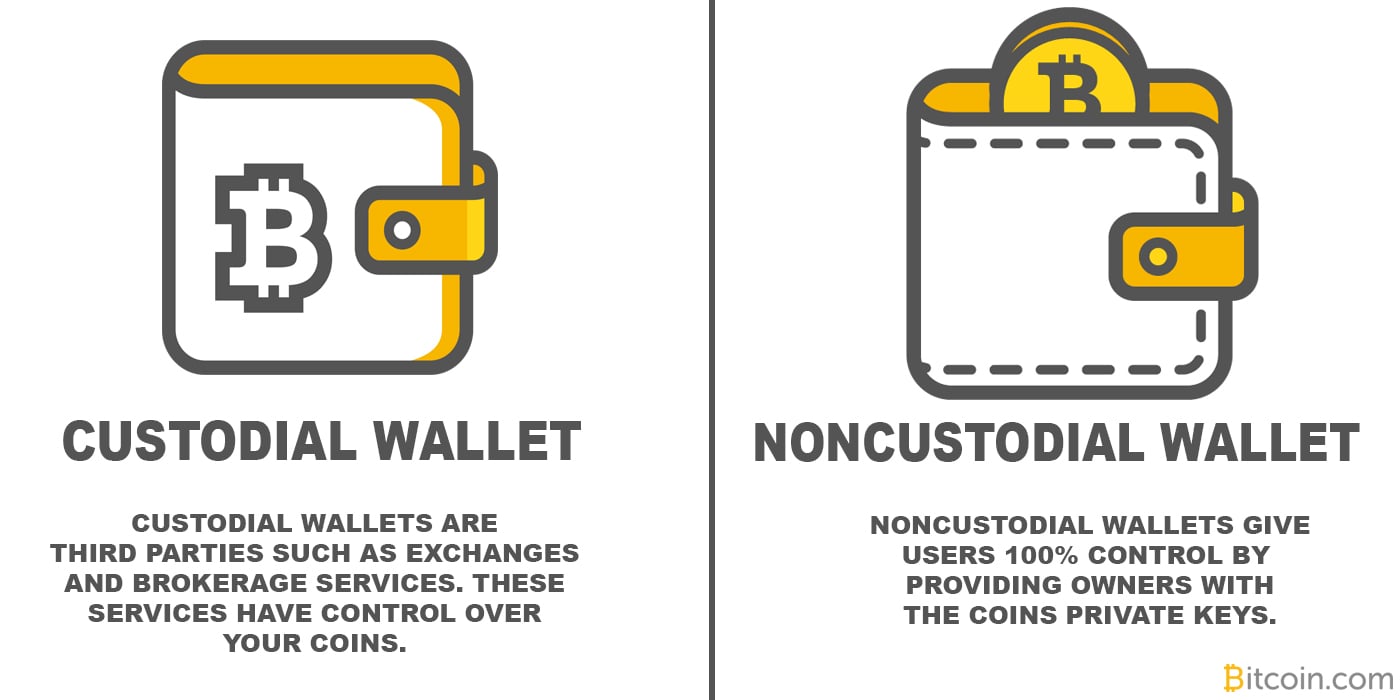
Custodial cryptocurrency services include most exchanges, brokerage services, and platforms that allow you to buy, sell, and store digital assets. A custodial business is basically a third party that offers to protect your assets within their system. People who store digital assets with a third party need to understand that they are not 100% in control of their cryptocurrencies. Coinbase is a great example of an exchange and brokerage service that also allows people to store digital assets within their wallet system. When you download the that allows purchases and sales, you’ll note that it is described as “the world’s most popular cryptocurrency wallet.” Therefore it’s safe to assume some users may think the application is a noncustodial wallet, but that isn’t the case.
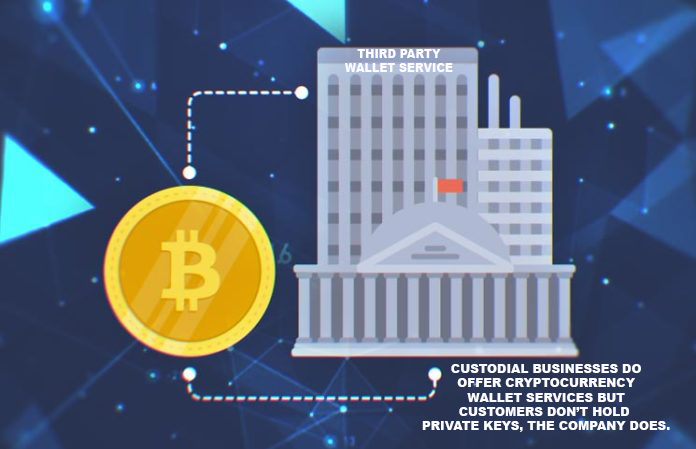
For example, with the last hard fork, Coinbase and a multitude of other third-party services paused customers from sending and receiving BCH to their wallets. Noncustodial wallets were 100% operational before, during, and after the hard fork, because these kinds of wallets are not controlled by a third party. In another instance, Coinbase to their customers that BCH wallets had been recently enabled and that in the future they will disperse BSV funds. In essence, this means that if you stored BCH on Coinbase before the fork you must wait for them to allow you access to the BSV tokens that were once tethered to your BCH.
So the third party services that have re-enabled BCH transactions have split the coins stored there already, enabling you to transact once again with BCH without worrying about a replay attack or sending two types of coins.
However, one of the most important slogans within the cryptocurrency community is “If you don’t possess your private keys you don’t own bitcoin.” And this is true for any cryptocurrency held on an exchange or custodial wallet, as that third-party service is in control of your coins to a large degree. Examples of include Kraken, Coinex, Bitstamp, Poloniex, Bittrex, Bitfinex, Binance, and the myriad of other trading and brokerage service platforms that also offer storage.
Noncustodial Wallet Services That Give the User 100% Control
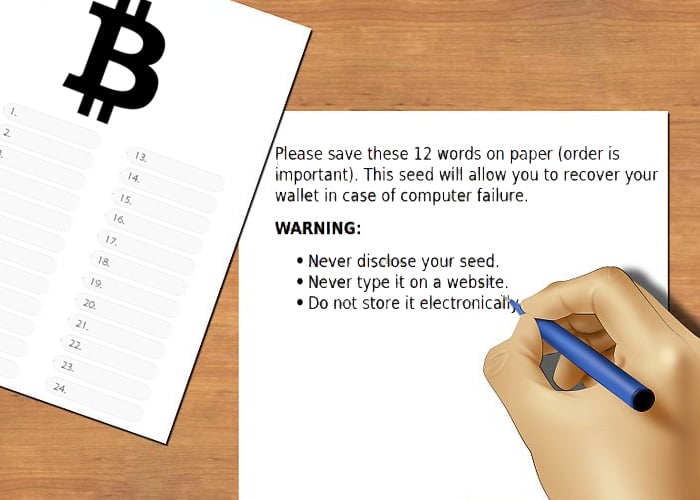
Noncustodial wallet services are platforms that allow users to possess their . The application will either give you a file or have you write down a that can consist of 12-24 random words. A platform that provides users with the ability to store a cryptocurrency’s private keys gives the user 100% control over the funds. If you possess your private keys, you wholly own bitcoin or any of the other 2,000+ cryptocurrencies in existence.
So moving back to the BCH hard fork example, if you held pre-fork bitcoin cash in a noncustodial wallet, this will have allowed you to have complete ownership over your BCH and BSV. Noncustodial wallets include the , BRD, Blockchain, BTC.com, Electron Cash, Copay, Jaxx, Coinomi, Edge, and many more because these platforms give users the ability to store their own private keys.
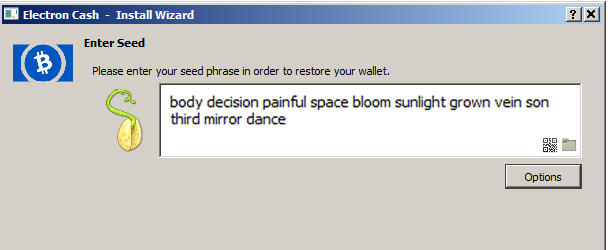 An example of an Electron Cash mnemonic phrase or private key.
Individuals using these types of user-controlled wallets had the ability to split their BCH and BSV right after the split happened. Because individuals store their funds in a wallet they have sovereign control over, they are 100% responsible for the safety and security of the keys. Noncustodial wallet owners also on their own, unless the wallet software offers a native splitting solution within the client. This means that if a user sends some BCH without splitting their BSV first in a noncustodial wallet, they face losing the BSV after sending the transaction. Having full ownership of your cryptocurrency private keys by means of a noncustodial wallet means you are accountable for every action, including splitting coins.
Research and Get to Know the Storage Solution You Choose
There are lots of applications and platforms that offer cryptocurrency storage in wallets, but you need to be careful which one you choose. It is very important to understand the difference between custodial (third-party control) and noncustodial (sovereign control) storage solutions. The difference can be huge when it comes to exchange hacks, blockchain splits, and other unknowns that take place within the cryptocurrency ecosystem. The best thing to do is research the service or application you use to store your cryptocurrency and perform due diligence. Find out whether or not the application you use is a custodial or noncustodial solution and decide for yourself if the service is safe and secure enough to hold your precious digital assets.
Do you understand the difference between custodial and noncustodial cryptocurrency services? Let us know what you think about this subject in the comments section below.
Images via Shutterstock, Electron Cash, Pixabay, Jamie Redman, bitcoin.com.
The post appeared first on .
On Wednesday, November 28, bitcoin price and the overall crypto market bounced back showing the much-needed recovery. Earlier on Sunday, bitcoin below $4000 and further slipped to $3600 levels. At the same time, the overall cryptocurrency market lost over $20 billion in just a few hours. It was all bloodshed in the market as the entire altcoin space faltered along with bitcoin.
bitcoin Recovers on Nasdaq News
For nearly three days bitcoin was trading at $3600-$3700 levels until it hit a 15% recovery on Wednesday. On Wednesday, bitcoin jumped back over $4300 levels majorly recovering its lost ground. The reason behind ‘s recovery was the news of Nasdaq its bitcoin futures contracts by Q1 2019. Citing internal sources, Bloomberg broke this story saying that Nasdaq is currently seeking regulatory approval from CFTC for its futures contracts.
The overall crypto market also recovered adding $20 billion to the market valuation. If you carefully observe the charts for and the on CoinMarketCap, both of them have huge similarity and patterns. It shows that bitcoin is currently holding the pulse of the crypto market. So far, bitcoin and the crypto market seem to be consolidating. The bitcoin price movemnet today remains between $4150-$4350 i.e. $200 or nearly 5% at the current levels. At the press time bitcoin was trading at $4342 with a market cap of just over $75 billion.
Similarly, the overall cryptocurrency market valuation is consolidating around $140 billion.
Gloomy Economic Condition Can Benefit bitcoin
A recent from Forbes highlight why bitcoin can prove to be valauble in this gloomy economic condition.
“bitcoin is a rare, unlevered asset in a levered world. Global debt has reached $250 trillion ($70 trillion higher than in 2008); the U.S. runs a trillion-dollar deficit, pension funds are underfunded amidst retiring populations, and student debt has snowballed to $1.5+ trillion in the U.S. (with 9/10 borrowers struggling to make payments). All of this puts pressure on central banks to print excessively into the foreseeable future, diluting the value of fiat currency. Smart money (and increasingly, just more money), will flock to unlevered assets that have limited supply – gold, bitcoin, or other alternative assets that aren’t part of the mainstream investment world. Traditional assets such as equities, government / corporate bonds and real estate are all highly levered,” report Forbes.
Furthermore, the Forbes report shows the blockchain-powered FinTech will benefit in the long term, due to blockchain’s conceptual premise of social scalability.
Traditional Market Experts Show Confidence in bitcoin
bitcoin is receiving a huge support from traditional market experts as global economic situation seems worrysome. At the same time, financial heavyweights like Nasdaq, ICE and Fidelity are making important announcements. This helps to restore the confidence of the bitcoin investors. In a with Finance Magnates, CEO of decentralized stock exchange DSTOQ, Craig Mc Gregor, said:
“Despite the obvious recent changeability of the market, the underlying value of crypto remains blockchain technology and its capacity to solve real-world problems. This fact is acknowledged in the commitment to bitcoin futures from major traditional players such as Nasdaq, Cboe, and CME.”
Mc. Gregor also said that giant like Nasdaq won’t waste its resources if it was not confident of bitcoin’s come back. However, no one can accurately predict when the market will recover. CEO and Co-Founder of digital asset class portfolio management firm INVAO, Frank Wagner said that the latest Nasdaq report shows traditional financial players showing interest in the asset class.
“Traditional investors, both institutional and retail, want trusted, guided routes into the crypto market and futures provide an approachable introduction, allowing them to bet on future prices without having to actually buy the asset. I foresee sustained interest building in this area in the months ahead,” Wagner said.
We just hope that there is no more price downfall for bitcoin and the crypto market. Hopefully we can bid adieu to 2018 on a good note.