
In today’s edition of The Daily, we feature a story about William Shatner flaunting his vast crypto knowledge, from Tether to Kitties. Additionally covered are a bank which wants to offer a digital deposit box for exchanges and investment funds, a new development in the Charlie Shrem lawsuit and more.
Also Read:
Tether Blows Captain Kirk’s Mind
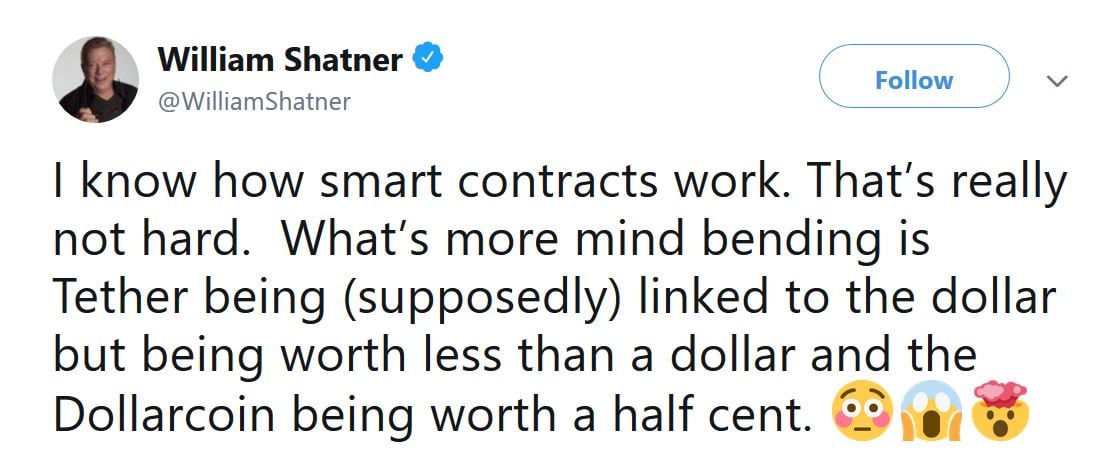
William Shatner, the original Captain Kirk, wants you to know that he knows his crypto. After admitting that he doesn’t fully understand the bitcoin mining business he was getting into, Shatner has now gone on a tweet storm showing just how much he learned.
Besides discussing developments in smart contracts, Shatner also dropped a truth bomb on Tether (USDT). He wrote: “I know how smart contracts work. That’s really not hard. What’s more mind bending is Tether being (supposedly) linked to the dollar but being worth less than a dollar…”
Obviously having a lot of fun with this dive into the world of cryptocurrency, the TV star was also happy to engage with fans about . And after learning that he can breed them, Shatner joked that he is now waiting for the accessories, “the Crypto Kitty Dream House and the Crypto Kitty Corvette.”
Canadian Bank to Launch Deposit Box for Exchanges
 Versa Bank (previously Pacific & Western Bank of Canada) is a Canadian chartered bank publicly traded on the Toronto Stock Exchange. It announced on Thursday it has completed beta testing for its “” and is now starting to offer the new service to cryptocurrency exchanges and crypto-based investment funds. The company states it does not have the ability to ‘drill’ into a client’s deposit box, or to examine its contents.
President and CEO David Taylor stated: “While many are considering ideas and plans for a digital safety deposit box, we have designed and built it, and are now commercializing a first of its kind service that provides our clients with the most sophisticated security and authentication technology available globally, in which our clients enjoy absolute privacy. The Versa Vault will now begin rolling out services to cryptocurrency exchanges and crypto investment funds.”
Court Unfreezes Charlie Shrem’s Accounts
Earlier this month, it was reported that a U.S. federal court has ordered the freezing of Charlie Shrem’s accounts on Coinbase and Xapo. This was done after he was hit by a lawsuit alleging that the early bitcoin pioneer had from the founders of the Gemini exchange. But in what might be an indication of the merits of the allegations, the court has reversed the asset freezing order in a hearing on Thursday. Now Shrem can go back to his luxury shopping spree, and maybe get a third Maserati.
Cryptopay Mail Bomber
 London’s Metropolitan Police has revealed on Friday that a 43-year-old Swedish man was sentenced to six and a half years in jail for mailing a homemade bomb to a “bitcoin company.” The Stockholm District Court found Jermu Michael Salonen guilty of attempted murder for sending a bomb to Cryptopay – a UK based crypto wallet and payment solution.
According to the Met Police, the motive for Salonen’s actions is that he was locked out of his account, unable to access his funds after losing his password. In August 2017 he asked Cryptopay to reset his password and send him a new one but the company refused as this contravened their privacy policy.
Commander Clarke Jarrett, head of the Met Police Counter Terrorism Command, said: “Salonen seemingly made and sent a device that had the capability to seriously harm and even kill over something as inconsequential as a change of password. Fortunately the bomb did not detonate. It was due to sheer luck that the recipient ripped opened the package in the middle rather than using the envelope flap which would have activated the device.”
What do you think about today’s news tidbits? Share your thoughts in the comments section below.
Images courtesy of Shutterstock.
Verify and track bitcoin cash transactions on our , the best of its kind anywhere in the world. Also, keep up with your holdings, BCH and other coins, on our market charts at , another original and free service from bitcoin.com.
The post appeared first on .
Well, in the last few months, there were several stories of an increase in institutional penetration in the crypto market. Last month in early October, a Bloomberg cited Bobby Cho, global head of trading at Cumberland, affirming to this. Cho told Bloomberg that bigger hedge funds are now replacing high-net individuals in the crypto market.
Much recently, Morgan Stanley’s research arm presented a of its observation for growing institutional participation. bitcoin bull Mike Novogratz has several times that there can be a huge inrush of institutional money flowing into the crypto market by mid-2019.
Also, there is a common notion developing that unclear regulations are stopping institutional players from entering the crypto space. While this narrative is gathering heat within a large number of investors, Bloomberg has another story to present.
Regulators Not a Major Hurdle to Institutional Entry
In its latest article, Bloomberg , “The biggest roadblock to Wall Street behemoths rolling out cryptocurrency businesses could come from their own clients, rather than from regulators.” In their latest report, Bloomberg cites the observations made by fintech entrepreneur and Revolut Ltd. founder – Nikolay Storonsky.
Revolut, currently valued at over $1 billion allows retail investors to speculate on cryptocurrencies like bitcoin and Ether. While speaking at the Web Summit 2018 in Lisbon, Storonsky said that Wall Street institutional giants have little interest in cryptocurrencies. This could possibly make things difficult for big financial institutions like ICE and Fidelity who are targetting institutional players by derivative products tied to digital assets.
“Unless these big institutional investors and hedge funds move heavily into the crypto world I just don’t think banks will move because they simply try to make money from their clients,’’ said Storonsky. “There is no interest from big institutional investors so far.’’
If Storonsky’s claims are true, it can crash down huge hopes of thousands of retail investors. After this year’s severe meltdown, the crypto market is now eagerly waiting for institutional entry. However, Storonsky’s views are quite similar to BlackRock CEO Larry Fink. Earlier this year, Fink said that his company’s clients have “zero interest” in cryptocurrencies.
Moreover, just last week in a CNBC interview, Fink that his company won’t launch an ETF product until the market is “legitimate”. However, he noted that BlackRock has not closed the doors to crypto investments and associated products.
Big Institutions Preparing for Next Crypto Run
A number of traditional financial institutions, which were earlier hostile to cryptocurrency, are now warming up to them. Morgan Stanley is reportedly working on swaps for the bitcoin Futures. However, it will start trading them only after having a proven institutional demand. Other banking giants like Citi Group and Goldman Sachs are also working on bitcoin products.
However, Storonsky says that this year has been so far quite bad for the crypto market. Revolut’s bitcoin trading volumes are as low as just 20 percent to what they were during December 2017. For the fortunes of the crypto market to turn over, 2019 will likely have to show some huge improvements. However, he still feels that Wall Steet won’t be the prime beneficiary of it.
“Fintech will be very big in crypto for the foreseeable future,’’ he said. ‘’I just don’t think banks will catch up.’’


