
Last week I read that Fujitsu will establish a Blockchain Innovation Centre in Brussels. This decision surprised me, when I think of innovation, I can’t help but think of Henry Chesbrough and his two books, Open Innovation and Open Business Models. Pondering the key lessons from Chesbrough, I quickly reached the conclusion that Fujitsu should have set-up its Innovation Centre in London, as London has all the ingredients to enable truly disruptive blockchain innovation. Here’s the Blockchain Innovation Cookbook and why London has got the 8 key ingredients to make your Blockchain Innovation Initiative a success.
Full disclosure this article might be a tad bias as I live and work in London
1. Get Plugged Into the Start-up Community
The key concept in Open Innovation is that good ideas don’t just come from inside an organisation but from outside. By having an open business model, organisations can bring together internal and external ideas to create and share value. With this in mind, it’s a really exciting time for larger organisations to be operating in London as there is a vast pool of entrepreneurial ideas, talent, skills and disruptive energy waiting to be harnessed
Just go to meet-up and search Blockchain London and literally every night of the week there are Blockchain meet-ups on every aspect of Blockchain from Smart Contracts to Supply Chain to Insurance. Just last week, we turned up to a Corda meet-up only to notice the Enterprise Ethereum Alliance were having their meet-up in the same building; so, the option of two great meet ups, both offering beer and pizza! It was tough, so we split up and went to both. I went to Corda and it was great seeing the enthusiasm and passion ChainThat has for disrupting the London Insurance Markets. What was really beneficial was seeing the live demo of the early product and listening to the challenges the team had with scaling point-to-point secure systems and how these had been overcome by a platform move. It was also really interesting to see how they are using the attachment functionality to enable smart contract and legal contract alignment
But what’s this got to do with R&D and Open Innovation? Well, it’s about ‘fail fast’ and the fastest way to fail is to learn from someone else’s ‘mistakes’, and what we’ve found at all of these meet-ups is an open willingness share knowledge; failures and successes, to help the overall community learn and grow
 Heads we go Corda, tails Ethereum!2. Disrupt Your Own Business Model
The Business Model Canvas by Alexander Osterwalder looks at the 9 building blocks that every organisations’ business model has. The mapping below shows how Blockchain is already disrupting and radically transforming each of these elements
 9/9 Business Model elements will be disrupted by Blockchain and DLT Technology()
One of the biggest blockers to Innovation and a point that Osterwalder continuously emphasizes is that organisations are so focused on their existing business model and achieving small incremental improvements (optimizing it) that they don’t create the space and environment to think about disrupting it. We all know the story of blockbuster and what happened when it failed to disrupt its existing business model with new technology; Netflix did it for them and the rest is history (see article from Chief Innovator)
So, the most central ingredient to Open Innovation is Business Model Innovation; the ability of an organisation to radically disrupt its own business model before someone else does. Therefore, every Blockchain R&D / Open Innovation capability needs to include a business model innovation space
Customer and Value Proposition — at the heart of every business model is the Customer and the value created for the Customer; everything else supports this simple pairing. Ensure your Blockchain Innovation capability is centred around the needs of the Customer not the uniqueness of the technology
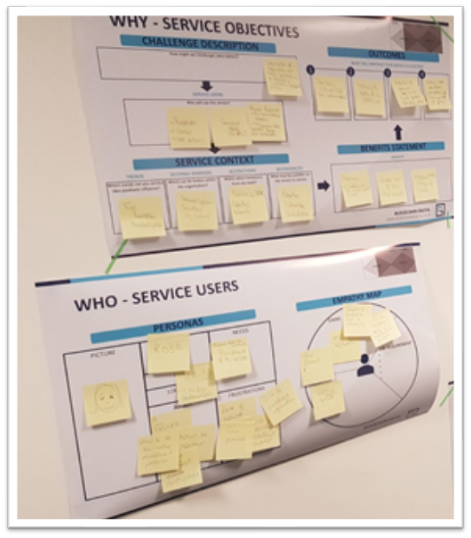 Service Design Toolkit3. Prepare for IT Architecture Integration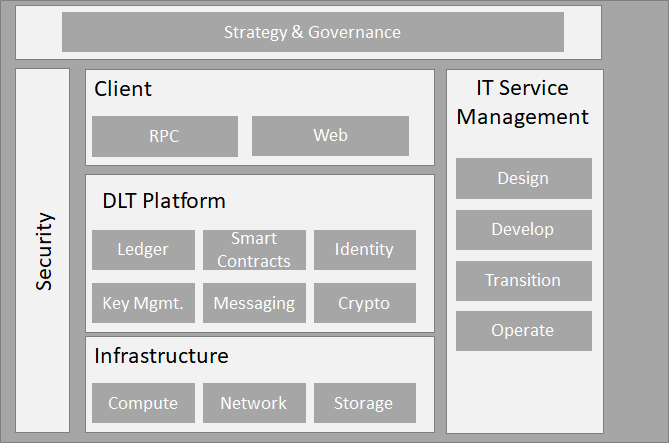
Typically, your Blockchain Innovation capability will sit within the business, but it’s important to build multi-disciplinary Blockchain Innovation capability that includes your IT team and suppliers. Whatever blockchain capability you decide to build, be it your current provider’s preferred technology or one that is a better fit for your use case, it will need to sit alongside and interact with the other components of your IT architecture therefore including your current supplier is key. The good news is that all the big IT providers including IBM, HP, Fujitsu, Microsoft, Amazon etc have entered the blockchain space, and have London-based resource with blockchain skills
4. Seek Inspiration from Academic Leadership
London brings a real powerhouse of academic research into Blockchain and Distributed Ledger Technology. Imperial College London (ICL) is conducting ground-breaking research into blockchain technology and digital assets and the University of Central London (UCL) has opened a Centre for Blockchain Technologies (CBT) to provide a cross-sectoral platform and drive the adoption and integration of DLT blockchain technologies into industry and society
When starting your Blockchain Innovation capability make sure to reach out and build relationships with UCL and Imperial as both teams are really open, approachable and interested in helping organisations succeed. By way of a taster, check out this excellent piece from UCL Smart Contract Templates: Foundations, Design Landscape and Research Directions
5. Don’t Let Policy and Regulation Constrain Innovation – Work With Government.
If Blockchain Innovation is really all about Business Model Innovation, then organisations’ business models are bound by legislation and heavily influenced by policy. The great news for London and UK organisations is that the UK Government is committed to “ensuring that industry and society benefit from the full potential of blockchain and other distributed ledger technologies (DLT) making the UK a leader in Blockchain/DLT innovation and implementation” — APPG Programme
What this means in practice is that the UK Government has formed an All Parliamentary Party Group to create a road-map for Blockchain and DLT. The mission of the group is to ensure that industry and society benefit from the full potential of blockchain and other distributed ledger technologies (DLT) making the UK a leader in Blockchain / DLT’s innovation and implementation
The process is, via a schedule of meetings focus or ‘evidence’ meetings, to bring the technology, use cases and future policy scenarios into open discussion while considering industry and societal implications as well as environmental opportunities
So, whatever the focus of your innovation initiative, be it supply chain optimization; impact of fraud, smart contracts, next generation services, education and research, agriculture, manufacturing, energy, healthcare or national registers, connecting to the UK APPG on Blockchain is an important step
6. De-Risk your Innovation with Standards
Building Innovation capabilities around new technologies like blockchain has inherent risks such as risks associated with early adoption; lack of evidence to quantify business benefits and wider economic impact, lack of clarity on how the technology would be governed, uncertainty around regulation, interoperability challenges and security and encryption of data. Engaging with standards bodies helps to mitigate these risks
Working with standards bodies could play an important role in ensuring you select technologies that will enable future interoperability between your platform and others avoiding you ending up with a fragmented ecosystem
Working with emerging standards supports stronger consensus on consistent terminology and vocabulary; improves understanding of the technology, and helps progress consensus across your sector. Standards also help ensure your innovation initiatives address security, resilience, privacy and data governance considerations
The great news for organisations wanting to build blockchain innovation capabilities in London is that the BSI headquartered in London is making a leading contribution to ISO 307 Blockchain and DLT see “Distributed Ledger Technologies: Challenges, Opportunities and the Prospects for Standards”
7. Make it Legal
A key part of any Blockchain Innovation team is someone who can look at the solution from a legal perspective, including conformance against data legislation and the enforcement of your smart contracts. The saying goes ‘code is law’, but in a business litigation sense it’s not, law is law. So, whilst code can ensure automated transactions, and finality of transactions, it’s important to understand the overarching legislative framework so as to avoid unintended consequences. One area of particular interest is jurisdiction, in a globally distributed ledger system understanding the jurisdiction that applies to the execution of the smart contract is important as this will make a material difference to the states of the smart contract. For example, the State of Tennessee has passed a Bill 1057 to legally recognize the status of smart contracts
For those organisations setting up in London, all the top law firms including Eversheds, Dentons and DLT Piper are building their blockchain offerings
8. Work with Innovation Intermediaries
I started this blog with Henry Chesbrough so I’ll end by quoting a bit from chapter 6 of his book, Open Business Models; ‘This rich environment of abundant and widely distributed knowledge can be daunting for firms. How can you know where to seek out knowledge in this turbulent context? The good news is that others have already began creating businesses and their own open business models, to help you tackle these Open Innovation Challenges’
For organisations setting up R&D / Open Innovation Capabilities in London, there are a wealth of Innovation Intermediaries and Partners with Open Business Models that can help you accelerate your capability build. There are many to mention but for starters, check out Big Innovation and Digital Catapult
So, should Fujitsu have opened their Blockchain Innovation Centre in London? Well I think so, but either way it’s great to see large players starting to realize the truly disruptive potential of blockchain and Distributed Ledger Technology