
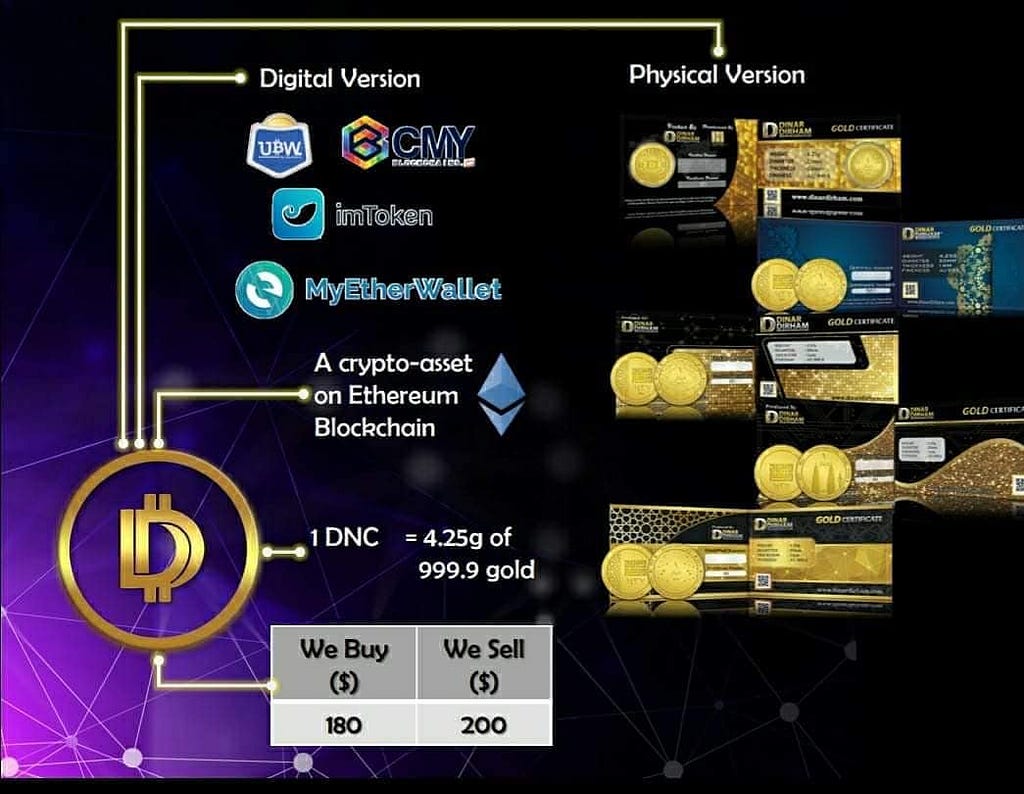
Crypto currency such as bitcoin, Ethereum must be backed up with pure gold. Or can be exchanged for real gold prices
Here I will discuss about 2 things with combined ETPS and Bcmy wallet. Look the picture
What is ETPS


Thanks for watch and reading.
⚘💌https://bit.ly/2Gc9dn0 (ETPS)
⚘💌https://bit.ly/2I6kZvo


I have recently read a great article regarding disruptive innovation by fellow writer George (the article can be found ). Through this article, I was able to better understand the concept of disruptive innovation and think about how this concept is directly applicable to the nature of Blockchain technology – Blockchain, is a disruptive force to all the industries that it can add value.
As defined by Christensen, “disruptive innovation refers to a technological or market advance that fundamentally transforms or creates entirely new markets”. As shown by the definition, a disruptive innovation can either completely alter the economics and the means of exchange of an existing market (for example, Amazon for the Book market), or result in the creation of an entirely new market for products/services (for example, the Internet). Blockchain, has the capability to operate both as a “market distruptor” and a “new market creator”.
As part of this article, I want to focus on Blockchain as a disruptive innovation force in the Financial Services industry – arguably the area where Blockchain will have the biggest impact, it is important for readers to understand how blockchain applications can entirely transform the financial services industry as we know it today. It is highly probable, that Blockchain applications that are/will be created in the near future, will directly compete for market share with central, investment and commercial banks and other financial services institutions.
1. Blockchain in Banking
Why does Blockchain have the capacity to disrupt traditional banking channels and how can it act as a disruptive innovation force? Blockchain technology allows transactions to occur without the need of a third party (i.e. A bank). It allows transparency and anonymity of transactions, since everything is recorded on the Blockchain and cannot be altered. Due to the fact that whatever is recorded in the Blockchain is unalterable, the risk of fraud is greatly reduced.
A number of financial institutions are already experimenting with the creation of Blockchain-based applications, in order to automate and simplify their processeses. As of now, everything is still in an experimental phase, however, commercial development at scale of Blockchain developments is expected to occur around 2020.
2. Banking Services
The three (3) main categories of banks are central banks (often governmental entities, controlling a state’s fiscal and monetary policy), investment banks (offering financing, M&A, trading and asset management services to institutions and high net worth individuals), and commercial banks (high street banks, offering online banking, current account, savings and credit financing services to individuals). What are the main products and services offered by banks & other financial institutions that cam be disrupted through Blockchain-based applications?
Payments services – exchange of valueSavings & deposits – storage of valueLending & Fund-raisingHedging & risk management
Let’s explore each of the above value propositions offered by banking institutions, and how those can be disrupted by the establishement of Blockchain applications.
3. Payments – value exchange
In 2017, a total of $250 trillion in international payments was performed worldwide. Those payments, have generated an excess of $200 billion in revenue for the banks sending/receiving the sums. Furthermore, international money transfers take an average of 3 to 4 business days to be completed succesfully.
The usage of Blockchain networks in order to perform payments, will result in the digitization of any asset/security involved in the transaction. As such, the fees associated with money transfers will be greatly reduced, whereas transfers using Blockchain payment networks (for example, networks such as the Ripple or the Stellar Lumens one) take an average of 2.5 hours to be performed, a significant improvement to the 3–4 day average which is currently the norm for international payments.
4. Savings & Deposits – Storage of Value
Users which want to hold Cryptocurrencies, will have to create a digital wallet. This is a very straightforward process that can be performed online by anyone. By creating a digital wallet, users can both hold and exchange cryptocurrencies with other individuals without the need of creating a bank account.
5. Lending and Fund-raising
In order for banks to lend certain sums of money to an individual or business (for example, personal loans, mortgages, business loans etc.), the bank will have to assess the applicant’s credit worthiness by reviewing his credit history. By saving data and transactions in the Blockchain, the information that is required in order to allow institutions to take credit decisions becomes readily available.
Furthermore, the existence of ICOs has created a new form for companies to raise funding, without needing the traditional fund-raising services that banks offer, such as business loans or investment banking advisory services.
6. Hedging and risk management
Through investment banks that offer trading services, major corporations ise to trade derivatives and other financial instruments in order to manage their risk. The creation of a Blockchain-based infrastructure to trade financial derivatives, reduces transaction and settlement times and largely reduces professional fees (for example, brokers, lawyers etc.)
Through the above points, the readers can see that Blockchain is a force of disruptive innovation for banks and other financial services firms. The banks that manage to adopt the technology and utilise its potential faster than other organizations, are likely to receive a major competitive advantage against their counterparts. For the banks that resist the changes occuring by the prevalence of Blockchain, they are risking the emergence of disruptive applications utilising the Blockchain, which will challenge them and more than likely will result in loss of profits and market share for them.
What are your thoughts on the above article? Please let me know in the comments section if you are interested in a future article for any other industries that are going to be disrupted by Blockchain technology.
Petros Leandros, MSc


