July 23, 2026

Capitalizations Index – B ∞/21M

TechStars-Backed Alkemi Enters DeFi Race With $16 Million Liquidity Pool

Techstars-backed alkemi enters defi race with $16 million liquidity pool

TechStars-Backed Alkemi Enters DeFi Race With $16 Million Liquidity Pool

A new type of decentralized finance (DeFi) app wants to boost crypto-market liquidity by offering you interest on your coins.

Today at the Techstars Blockchain Accelerator demo day, Alkemi CEO Ryan Breen will unveil a crypto liquidity pool deal worth $16 million from industry veterans like Joseph Weinberg, chairman of the data network Shyft, and Alex Friedberg of BXB Capital. Alkemi is looking to create a liquidity system for exchanges by making an accessible honeypot that service providers can dip into when demand increases faster than supply.

“It’s solving inter-settlement lag,” Weinberg told CoinDesk, comparing Alkemi’s model to bitcoin-oriented solutions like Liquid. “You have a reduction in fee rate across the space over time because you have general liquidity across the space. You have a faster rate of execution.”

The Alkemi protocol will let users connect their personal wallets to a smart contract via a mobile app that, like a savings account at a bank, allows exchanges to use those funds for settlements while users determine their own lockup timeframes. This isn’t a loan, however, it’s a type of virtual deposit where the user retains custody of the private keys.

“We’re starting with ethereum because that’s where the lion’s share of a lot of the token issuance has been,” Breen said.

While the app, scheduled for launch by 2020 after the protocol undergoes security audits, will eventually support bitcoin, fiat-backed stablecoins, XRP and a variety of other assets, it fits squarely into what Breen called the DeFi movement, which includes the use of smart contracts to experiment with utility and efficiency for self-custodied assets.
Techstars-backed alkemi enters defi race with $16 million liquidity pool

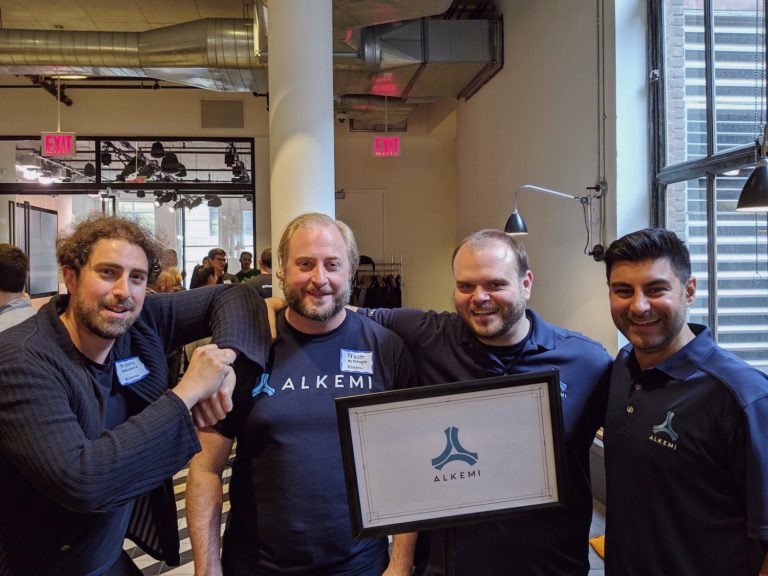
The Alkemi team, left to right: CIO Aristotle Adrulakis, Fraser McNaught, CEO Ryan Breen and Alim Khamisa.

Stepping back, the most prominent DeFi projects so far include the loans startup Dharma, the token exchange platform UniSwap and MakerDAO, which is often associated with the ethereum-backed DAI stablecoin. Although DAI has failed to maintain its dollar-peg over the past few months and loan fees continue to rise, DeFipulse.com shows more than $332 million worth of cryptocurrency is currently locked in Maker and Dharma loans alone.

Breen said liquidity across the space remains a hurdle.

“Decentralization by design is dividing and separating the concentrations of wealth. But then you have liquidity [issues] where it actually requires concentrated access to wealth,” Breen said. “We believe that solving the liquidity paradox in the space will involve projects working together, as opposed to one, winner-take-all scenario.”

Communal Access

In order for this to impact the DeFi ecosystem, exchanges and other distribution platforms will need to get on board.

Alkemi is betting that providing liquidity pools will save exchanges and institutional funds money. Those savings are then divided into three parts: app users gain a third of the crypto saved (like interest on a savings account), Alkemi gets a third and the institutional partner keeps the remaining loot.

“The biggest problems arise with surging demand where liquidity dries up,” Frank Schuil, CEO of the Swedish exchange Safello said in reference to the broader market. “Established players have little problems tapping into these [liquidity pools]. More difficult is to get good terms from these parties and agree on settlement arrangements.”

While Safello isn’t a member of the Alkemi consortium, Weinberg said this is precisely the type of friction he hopes the new DeFi startup can address.

Speaking to how integrating with exchanges could reduce price inefficiencies while increasing access among less well-established players like the DeFi protocol Uniswap, Weinberg told CoinDesk:

“A lot of the times you have exchanges that have to re-balance their own books, and not just exchanges, all kids of liquidity pools. … The question is can you have smart contracts controlled by participants that make the flow of capital more efficient?”

Pool image via Shutterstock

Published at Wed, 01 May 2019 15:45:55 +0000

Previous Article

Astronomical May Promotion at mBitcasino!

Next Article

Australia: Cryptocurrency trading to be scrutinized by island nation’s Taxation Authority

You might be interested in …

These 27 Companies Support Bitcoin Unlimited, 44 Oppose

While bitcoin Unlimited is gaining traction among miners, only a handful of bitcoin companies are in favor of its bigger block and Emergent Consensus proposal.


Breakdown by Company

The scaling debate in which two predominant bitcoin improvement proposals, SegWit and bitcoin Unlimited, are competing for miners’ support is becoming more and more intense.

As the debate escalates, supporters from both sides are now threatening to push for user activated forks (both soft and hard). While bitcoin Unlimited is considered the most popular proposal in terms of hashing power, a look at the companies that support it or SegWit reveals the exact opposite.

As of this writing, out of the companies listed in Coin Dance, 66 support SegWit and 58 are ready for it. Only 8 companies oppose SegWit.

On the BU side, there are 27 in favor, with 9 companies ready for it. This means that 70% of companies actively support SegWit, compared to 20% for BU. The other 10% are undecided or “unknown”. The companies that support BU include:

  • AntPool
  • Atlanta bitcoin
  • BitAddress.org
  • bitcoin.com (Saint Bitts LLC)
  • BitcoinPlug
  • Bitmain
  • BTCPOP
  • Canoe
  • Coinucopia
  • GoUrl.io
  • bitcoin WordPress/PHP Gateway
  • Keys4Coins
  • MrCoin
  • Slon BTM
  • Bitfire.io
  • Bittoku GK
  • btc.top
  • GBMiners
  • Keyois
  • Prohashing
  • Satoricoin
  • ViaBTC
  • Bitzillions
  • Magnr
  • Bitaps.com
  • CTY bitcoin Vietnam TNHH
  • OKCoin
  • Trezor (Ready)
  • Electrum (Ready)
  • bitcoin Wallet for Android (Ready)
  • Bifinex (Ready)
  • Breadwallet (Ready)
  • Gemini (Ready)
  • Lamassu (Ready)
  • Rocketr (Ready)

It should be noted that even among the 9 companies that are ready for BU, two also support SegWit (Electrum and Trezor) and 5 are ready for SegWit (including Bitfinex and Gemini). 

It’s also worth noting that some of the companies that are against bitcoin Unlimited are not even supporting SegWit. They are simply opposed to BU’s Emergent Consensus.

Meanwhile, 4 of the 8 companies that oppose SegWit and are all signaling for BU are mining pools.

Who Supports What?

We can see that some predominant exchanges like Poloniex, LocalBitcoins, CoinCheck and others are ready for SegWit, while other names like BTCC, Xapo and Bitso support it.

On the BU side, in addition to bitcoin.com, Magnr, BitAddress.org, and several BTM providers, the biggest names by far are mining pools such as Bitmain’s Antpool, ViaBTC and GBMiners. However, the independence of these mining pools has recently come under question by the community.

//platform.twitter.com/widgets.js

At the same time, the only major exchanges that support BU also support SegWit, including OKCoin, Bitfinex (ready) and Gemini (ready).

The companies that actively oppose SegWit include 4 mining pools and 4 other small companies that don’t have much bearing in the bitcoin ecosystem. Conversely, among the companies that oppose BU actively, we find names like BitGo, Vaultoro, Bitsquare, and GreenAddress.

Among the undecided, we still have names like Bitstamp, Bittrex, Bitmex, Kraken, and others.

bitcoin Businesses Generally Against BU, Hard Fork

The general animosity towards bitcoin Unlimited can also be observed in the industry letters that have been signed so far. For example, a list of nearly 20 exchanges has signed a hard fork contingency plan in which the BU token would be listed as BTU or XBU.

Canada’s bitcoin ecosystem has also produced an industry letter in which a large number of economic nodes operators signaled their rejection for BU and proposed industry guidelines for hard forks.

Moreover, the data is also reflected (despite varying data depending on the course) by the share of bitcoin Core (84-91%) nodes among total network nodes compared to bitcoin Unlimited’s (2-9%).

The conclusion that can be draw from this data is that despite the growing popularity of bitcoin Unlimited among mining pools, bitcoin companies as well as user nodes are largely opposed to the bitcoin Unlimited proposal.

Would you boycott a company based on their support or lackthereof? Let us know in the comment below!


 Images courtesy of Coin.dance, Shutterstock, nodecounter.com

The post These 27 Companies Support Bitcoin Unlimited, 44 Oppose appeared first on Bitcoinist.com.