TD Ameritrade Put An Actual Ad on the Bitcoin Blockchain
TD Ameritrade planted an ASCII flag – that is to say, imprinted an advertisement – on bitcoin’s blockchain earlier this month.
The online broker announced that it sent 68 bitcoin transactions to create a digital flag with its logo on the bitcoin blockchain, in a post published .
The company used the feature in bitcoin’s protocol to insert the characters, creating 68 invalid transactions as a result. Due to the nature of the blockchain, this flag is now forever preserved on the cryptocurrency’s ledger.
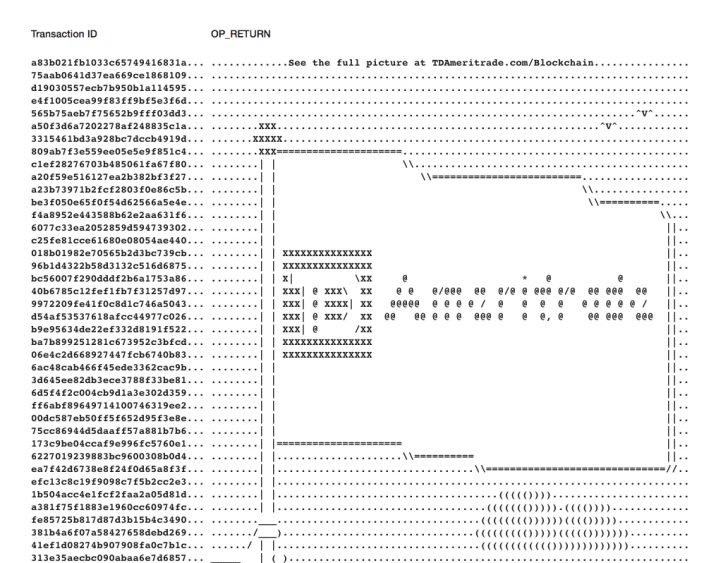
“We love finding new ways to use emerging technology. So we decided to have a little fun and plant our flag. Okay – technically, we embedded it,” the broker said, adding:
“With a part of the blockchain called OP_Return, which functions like the memo space on a check, simple messages and characters can be placed within transactions on the blockchain. By linking 68 individual transactions, with 80 characters per transaction, we were able to create the larger image.”
No bitcoins were actually transferred through these transactions, according to data from Blockchain.info.
OP_Return was first introduced in 2013 as a way for users to include some messages in the blockchain. However, the release notably stated that developers were not endorsing data storage in the blockchain, saying that “storing arbitrary data in the blockchain is still a bad idea; it is less costly and far more efficient to store non-currency data elsewhere.”
The official bitcoin wiki page notes that OP_Return can be used to convey information.
“We’re proud to be part of it. Forever,” the broker wrote.
image via Jonathan Weiss / Shutterstock
The leader in blockchain news, CoinDesk is a media outlet that strives for the highest journalistic standards and abides by a . CoinDesk is an independent operating subsidiary of Digital Currency Group, which invests in cryptocurrencies and blockchain startups.
bitcoin News Brasil Pré-venda da plataforma de jogos de blockchain TriForce Tokens atinge meta de capitalização mínima e arrecada mais de US$ 750 mil Comunicado de imprensa bitcoin: A plataforma descentralizada de jogos TriForce Tokens garantiu […]
After an unidentified actor “accidentally” triggered a series of bugs that destroyed approximately $150 million worth of digital currency, the world waits for a substantive answer — is this vulnerability an anomaly? An “I told you so”? Or a humbling opportunity to secure the Ethereum network?
What Happened?
On November 6, “Devops199,” an alleged amateur programmer, set off a chain of bugs on Parity, a popular digital wallet for Ethereum. These bugs affected multisignature, or “multisig,” accounts — “wallets” that require multiple users to sign off with their keys before funds can be transferred.. The place these wallets connect to is known as a “library” contract.
According to Parity, an attempt to fix a vulnerability that allowed hackers to steal $32 million from multisignature wallets in July of 2017 inadvertently created a second vulnerability in the library contract. This allowed Devops199 gain sole ownership of the library that every multisignature wallet used for their code.
After Devops199 realized what had happened, he “killed” (deleted) the code. Unfortunately, this locked all funds into multisignature wallets permanently, with no way to access them.
Because of the functionality of the current blockchain, $150 million worth of ether (ETH), the tradable currency that fuels the Ethereum platform, is now effectively destroyed and inaccessible to anyone.
Among the victims of this bug are several recently successful ICOs that chose to store their funds in a Parity wallet because of its multisig option and compatibility with various hardware wallets.
Parity’s Response (So Far)
On November 7, tweets on Parity’s official Twitter account acknowledged the vulnerability and confirmed that the funds affected are frozen and can’t be moved anywhere.
A day later, on November 8, Parity de-briefed the bug, explaining that it was indeed possible to turn the Parity Wallet Library contract into a regular multisig wallet and become the owner of it, which is exactly what Devops199 did. Parity now has a to check if a user/wallet has been affected by the vulnerability.
Parity’s History of Hacks
This isn’t the first time Parity has fallen victim to a security exploit. Parity’s multisignature contracts were previously the target of three thefts totalling 150,000 ether in July of 2017 (the second-largest hack after the DAO fiasco). And losses could have been exponentially higher. However, the “White Hat Group,” a collection of hackers and activists, was able to intervene and drain the majority of other wallets before they could be compromised as well.
Future multi-sig wallets created in all versions of Parity Wallet have no known exploits. – Official Parity website post following the July 19 hack
Jeff Coleman, an expert in blockchain technologies and currently a researcher and advisor with , described Parity’s response to the July 19, 2017, attack as having been “worrying, to say the least.”
Coleman told bitcoin Magazine that his primary concerns centered around Parity’s inadequate response and its tendency to downplay the significance of the compromise, choosing instead to blame a large number of external causes:
They blamed observers for not finding the bug before it was exploited; they blamed lack of incentivization for observers; and they blamed the Solidity language for not blocking access by default to the functions the [Parity team] failed to protect.
He further noted that Parity seemed to be blaming the complexity of the well-audited wallet (which they still believed to be secure) from which they had originally modified their code. And also that Parity didn’t take responsibility for their own inadequate quality control and audit procedures.
S.O.S.?
Developers in the community are desperately trying to find a fix to the Parity predicament. Coleman believes that “from a technological perspective, there is nothing short of a hard fork [a non-backward-compatible change to the Ethereum protocol] to restore the destroyed funds.”
After the DAO hack in 2016, the Ethereum Foundation had already accepted a hard fork to restore lost funds, with the common understanding that this was a sort of “mulligan” — a one-time fix for a young, developing blockchain. This scenario, nevertheless, divided the Ethereum blockchain into two parts and created Ethereum Classic, the original Ethereum blockchain, backed by a community that vehemently opposes editing transaction history to restore lost funds.
Using hard forks as interventions to “correct” worst-case scenarios like this is highly controversial, especially since blockchains are meant to be immutable. So, it’s difficult to convince the Ethereum community to use a hard fork to rescue one team from a mistake. While many acknowledge sympathy for smaller accounts storing personal ETH, sentiment is not as sympathetic for the 300,000 ETH that belonged to the Polkadot Project, project associated with the Parity team.
Arseny Reutov, an application security researcher for blockchain security firm , affirmed this community sentiment, while acknowledging that hard forks can be solutions. However, he agrees that Ethereum cannot simply hard fork any time there is a problem on the network. He believes blockchains should expect “more and more high profile thefts and incidents,” and that the problem lies in the infant Ethereum platform itself — specifically, in the native Solidity programming language.
If a Hard Fork Isn’t the Answer, Then What Is?
Both Coleman and Reutov believe that the key to gaining the community support necessary to restore funds is to combine the Parity situation with similar situations in which funds have been lost due to various kinds of mistakes. As an example, Coleman referenced those detailed in : “Reclaiming of ether in common classes of stuck accounts.”
Coleman also pointed out that in any of these instances, it must be “completely unambiguous who the original owners of the assets were.” The necessary changes could then be made and packaged together in an “already planned hard fork, such as the upcoming Constantinople fork.”
Even so, restoring funds is problematic. Ethereum core developers must discern which mistake-affected funds will be returned to users. Will all funds be returned or only a select few — or will this be a ~500,000 ETH learning experience?
EthTrader: The Ether news, tokens, memes, staking, economics, trading, and investing hub. Daily General Discussion – November 2, 2018 Welcome to the Daily General Discussion thread of /r/EthTrader. Thread guidelines: Please refrain from discussing non-Ethereum […]