
February 25, 2026

Capitalizations Index – B ∞/21M

Switzerland Merchants Charged 8% by PayPal Showing Merits of Crypto

Switzerland merchants charged 8% by paypal showing merits of crypto

Switzerland Merchants Charged 8% by PayPal Showing Merits of Crypto


Switzerland merchants charged 8% by paypal showing merits of crypto

PayPal, a leading payments processor valued at over $97 billion, charges merchants high percentage-based fees on top of a flat based fee of 2.9 percent. The high transaction fee of PayPal has led merchants to explore alternatives like crypto to minimize expenses.

For most normal users on PayPal, a transaction from one user to another in the same country is charged a base fee of 2.9 percent. But, if the transaction is sent to a user in a different country, conversion rates apply, often taking the fee from 2.9 percent to over 5 percent.

For merchants, the fee can exceed the range of 8 to 10 percent depending on the country a merchant or a user is based in.

8% Fee, Locking Funds For 3 Months

On a cryptocurrency-related subreddit (/r/cryptocurrency), one Switzerland-based merchant shared a screenshot of a transaction covering a payment received from a buyer with seller protection.
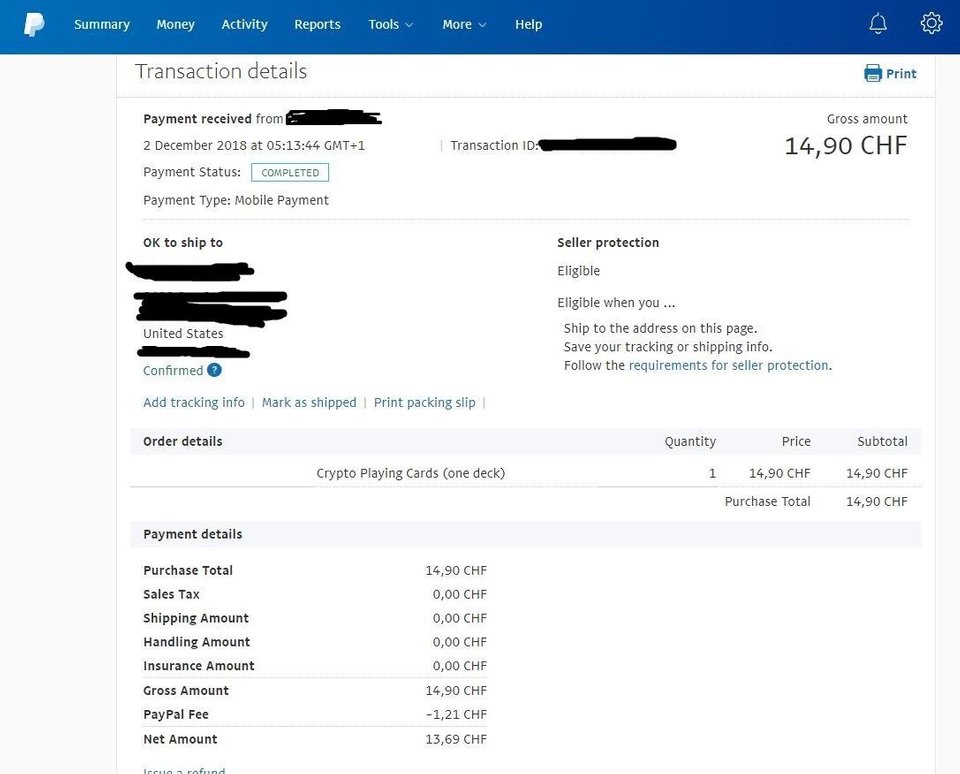
Switzerland merchants charged 8% by paypal showing merits of crypto
Transaction screenshot shared by a merchant based in switzerland with an online alias u/julices_grant

For a purchase of one deck of crypto playing cards worth 14.9 francs (CHF) which is equivalent to $15, PayPal charged a transaction fee of 1.21 franc, an 8.12 percent fee.

The payment seems small due to the low price of the product, but if the merchant sells 1,000 of the crypto playing cards and generates $15,000, an 8.12 percent fee on the revenue is $1,218.

Merchants often have to deal with a wide range of costs and for those dealing with physical products, merchants have to cover manufacturing costs and taxes among other expenses. An 8.12 percent fee before any other expense is deducted from the revenue places a significant burden on a merchant.

On most payments platforms, a system called seller protection also locks certain payments received by merchants from time to time for three months, disallowing merchants from withdrawing the money sent by buyers for a set period of time in case the buyer wants a refund.

Such a policy causes a major problem for merchants, especially for small businesses which are scaling, that need to address urgent payments and cover expenses with the revenue generated through e-commerce platforms and facilitated by PayPal.

The Swiss merchant said that six payments are currently stuck for another three months without a specific reason provided by PayPal.

The merchant wrote:

But now I wished I never used PayPal, got a lot of money stuck for another 3 months (6 total) and they give me no reason at all. After being a customer of theirs for 6 years one day they decided nope were gonna hold your money, ban you from our service.

Can Crypto Service as an Alternative?

Despite the increase in the value of Bitcoin and major crypto assets over the past nine years, the cryptocurrency sector has not seen an improvement in merchant adoption at the same rate as other areas of the space.

Prior to the bull run of cryptocurrencies in late 2017, it was difficult for cryptocurrency companies to convince merchants to adopt digital assets due to the lack of mainstream awareness of the asset class.

As the infrastructure around digital assets strengthens and companies like ICE and Bakkt continue to build services around it, more merchants could begin to integrate cryptocurrencies as an alternative to payment processors.

Already, the Switzerland-based merchant has integrated a cryptocurrency payments processor into an e-commerce website to experiment with digital assets.

Featured image from Shutterstock.

Get Exclusive Crypto Analysis by Professional Traders and Investors on Hacked.com. Sign up now and get the first month for free. Click here.

Advertisement

Published at Sat, 22 Dec 2018 07:30:37 +0000

Previous Article

Facebook’s New Crypto Will Be Used On WhatsApp

Next Article

Facebook speculated to create native cryptocurrency transferable through WhatsApp, India to be testing ground

You might be interested in …

Cyber-Security Hero Who Stopped WannaCry Attack Arrested in Las Vegas

Marcus Hutchins, the British security researcher who aided ailing Wannacry malware victims, including the UK’s National Health Service, arrested by the FBI in Las Vegas.


The security researcher who stopped the Wannacry malware attack by registering an internet domain that the malware communicated with has reportedly been arrested at an airport. According to emerging reports, Hutchins was arrested in Las Vegas as he was leaving the country after attending the Blackhat and Def Con conventions which are held annually for security researchers.

Friends of Hutchins who were with him at the conventions say they do not know his whereabouts and have not heard from him for 18 hours. The US Department of Justice, however, released the following statement:

Marcus Hutchins… a citizen and resident of the United Kingdom, was arrested in the United States on 2 August 2017, in Las Vegas, Nevada, after a grand jury in the Eastern District of Wisconsin returned a six-count indictment against Hutchins for his role in creating and distributing the Kronos banking Trojan.

Confusion and Coincidence Amid Arrest Details

Members of both cryptocurrency and cyber security communities have taken to Twitter to express their disbelief and confusion:

//platform.twitter.com/widgets.js

Others were quick to rush to the 23-year-old security researcher’s defense:

//platform.twitter.com/widgets.js

//platform.twitter.com/widgets.js

Motherboard was the first to break the story, where there still seemed to be confusion about quite what had happened. In an e-mail to the publication, a U.S. Marshals spokesperson stated:

My colleague in Las Vegas says this was an FBI arrest. Mr. Hutchins is not in U.S. Marshals custody.

Ironically, hours after Hutchins was arrested, more than $130,000 worth of the bitcoin ransom taken by the creators of WannaCry appear to have been tumbled through a mixer for withdrawal. This marks the first movement of the coins on the bitcoin network since the attack.

It is important to note that there is absolutely nothing to suggest that the withdrawal is in any way connected to Hutchins’ arrest.


The Kronos Malware

Bitcoin Wallet Malware

The Kronos malware was spread through emails with malicious attachments, hijacking credentials such as internet banking passwords and other such sensitive information. Malware such as Kronos and Wannacry are increasingly getting media attention and look set to be at record numbers in 2017 if statistics released by antivirus companies are to be believed.

What are your thoughts on this? Is Marcus Hutchins’ arrest possibly only a case of guilt by association? Let us know in the comments below.


Images courtesy of Shutterstock

The post Cyber-Security Hero Who Stopped WannaCry Attack Arrested in Las Vegas appeared first on Bitcoinist.com.

Crypto market wrap: matic moons on binance endorsement

Crypto Market Wrap: MATIC Moons On Binance Endorsement

Crypto Market Wrap: MATIC Moons On Binance Endorsement Crypto markets still consolidating; ETH looking promising, XLM and XRP slide, NEO gains and MATIC moons.  Market Wrap The consolidation has continued on crypto markets for another […]