July 12, 2026

Capitalizations Index – B ∞/21M

Swiss Stock Exchange Operator is Launching a Crypto Assets Exchange

Swiss stock exchange operator is launching a crypto assets exchange

Swiss Stock Exchange Operator is Launching a Crypto Assets Exchange


Swiss stock exchange operator is launching a crypto assets exchange
Advertisement

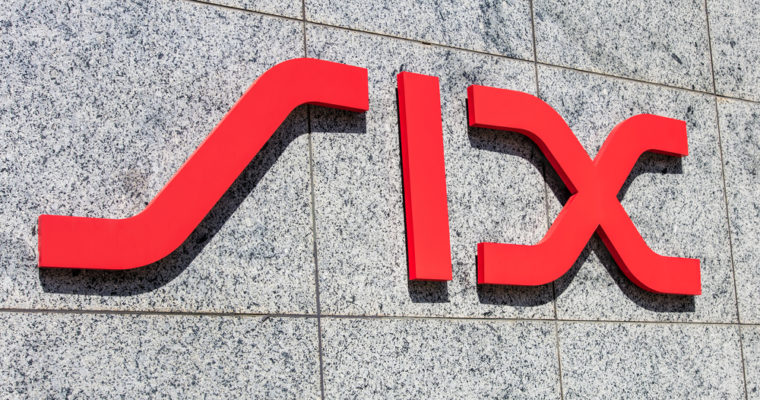
SIX, the owner and operator of Switzerland’s principal stock exchange has announced plans to launch the SIX Digital Exchange – a crypto assets exchange fully regulated by the country’s financial regulator and central bank.

In an announcement on Friday, Swiss Exchange operator SIX revealed its new crypto-initiative which it claims ‘will be the first market infrastructure in the world to offer a fully integrated end to end trading, settlement and custody service for digital assets.’

Dubbed the SIX Digital Exchange (SDX), the blockchain-powered platform will facilitate the tokenization of clients’ existing securities as well as enable the issuance and trading of digital assets.

“The digital exchange will allow clients of SIX to trade, settle and custodize digital assets in the same way they currently do in the traditional world,” explained SIX head of securities and exchange Thomas Zeeb, describing SDX as an all-in-one platform.

SIX further stressed that the platform will see ‘the same standard of oversight and regulation’ from FINMA, Switzerland’s financial regulator and the Swiss National Bank, the country’s central bank.

“This is the beginning of a new era for capital markets infrastructures,” said SIX chief executive Jos Disjsselhof, heralding the launch of the upcoming exchange which will launch services in mid-2019.

He added:

For us, it is abundantly clear that much of what is going on in the digital space is here to stay and will define the future of our industry. The financial industry now needs to bridge the gap between traditional financial services and digital communities.

To this end, SIX will also facilitate its clients offer their own tokens through initial coin offerings (ICOs) to raise funds. “We’re putting together a team of developers and advisors that will help clients create ICOs and new products around that,” Zeeb added, underlining SDX as “an ecosystem”.

Pointedly, the exchange operator noted that SDX will not be used to enable the direct trading of cryptocurrencies like bitcoin and Ethereum and will instead help introduce traditional financial market participants to tokenize their bankable and non-bankable assets into digital assets.

Featured image from Shutterstock.

Follow us on Telegram or subscribe to our newsletter here.
Join CCN’s crypto community for $9.99 per month, click here.
Want exclusive analysis and crypto insights from Hacked.com? Click here.
Open Positions at CCN: Full Time and Part Time Journalists Wanted.

Advertisement


Published at Fri, 06 Jul 2018 11:27:36 +0000

Altcoin News

Previous Article

Swiss Stock Exchange Operator is Launching a Crypto Assets Exchange

Next Article

Quazar Coin $QCN Climbed 100% During the Last 24 Hours

You might be interested in …

How Bulletproofs Could Make Bitcoin Privacy Less Costly

bulletproofs

Bulletproofs, presented in a paper titled “Bulletproofs: Short Proofs for Confidential Transactions and More,” describe a new zero-knowledge proof system. The proposal uses on-chain scaling for privacy and suggests a new, faster and more compact way to verify privacy-enhancing Confidential Transactions (CTs). Specifically, Bulletproofs can decrease the size of these verifications for these types of transactions drastically. Furthermore, the authors of the paper — Stanford University’s Applied Cryptography Group, overseen by professor Dan Boneh — have already managed to create a practical implementation for Bulletproofs.

This is how it works.

Currently, all transaction information — such as wallet addresses and especially the sent amount of bitcoins — are visible on the bitcoin blockchain. This affects the privacy of all users. If we wish to pay wages via the bitcoin network, for example, this means that every salary will be visible on the blockchain network. This, in turn, could mean that someone (like your landlord) could look up how much money you’re making to try and increase your rent accordingly.

Confidential Transactions are much needed to bring any type of blockchain to a higher level of privacy. Confidential Transactions combine and utilize several cryptographic tricks so that only the sender and the receiver of a transaction are aware of the amount transacted. These cryptographic tricks let users obfuscate the amounts they are transacting while still allowing onlookers to perform math on the obfuscated amounts. Basically, anyone can still check that the sum of sent bitcoins is greater than the sum of received bitcoins.

Confidential Transactions are realized with “zero-knowledge proofs.” These proofs are best described as a method for proving to another party that a Confidential Transaction is valid without conveying any information about the Confidential Transaction itself.

However, as stated in the Bulletproofs paper: “Current proposals for CT zero-knowledge proofs have either been prohibitively large or required a trusted setup. Neither is desirable.”

First of all, if we have to prove multiple range proofs, which is the case for multisignature transactions, the complexity and size will scale in a linear fashion. For example, if the size of a single proof is 2 kB, two proofs are 4 kB, three proofs are 6 kB and so on.

Additionally, zero-knowledge proofs typically require a trusted setup: they must be initialized by some trusted authority. However, the security properties of the bitcoin system don’t apply to that authority because in practice it means that the authority could produce fake “proofs.” These fake proofs could lead to uncontrolled and undetectable inflation.

Bulletproofs could solve these problems.

According to the paper, “In any distributed system where proofs are transmitted over a network or stored for a long time, short proofs reduce overall cost.”

Bulletproofs are claimed to be able to reduce the cryptographic proof significantly: from 8 kB to 734 bytes, though this depends on what the transaction looks like. Moreover, when dealing with multiple proofs, the size increases with just a few percent instead of this linear scaling. And in addition, Bulletproofs do not require a trusted setup.

Andrew Poelstra, contributor to the research paper and mathematician at Blockstream, believes that Bulletproofs are very practical: “We have already implemented a first version in the bitcoin crypto library libsec256k1, which can verify proofs three and a half times faster than the verifier for the classic rangeproofs. It is a drop-in replacement for classic rangeproofs that does not affect other aspects of the system and is therefore very easy to integrate.”

Until now, Confidential Transactions were just a theoretical concept because they were so heavy to implement. With Bulletproofs, the implementation of Confidential Transactions on bitcoin suddenly becomes more likely.

The post How Bulletproofs Could Make Bitcoin Privacy Less Costly appeared first on Bitcoin Magazine.