promised decentralized value transfer: be your own bank.
Yet more than a decade later, the vast majority of volume still transpires on centralized exchanges that have full control over your crypto.
, billions in lost funds, and shady banking partnerships have prompted a wave of new, “decentralized” exchanges.
But despite the promise of these DEXs, most are limited to only a single family of assets (e.g. only ETH and ERC-20 , or only , LTC and the like), necessitate undesirable trust assumptions, or are constrained by a slow, loathsome user experience.
Introducing Switch 💸
Today, we’re launching Switch, a new for non-custodial crypto .
Switch sidesteps the problems of traditional DEXs by employing a novel solution: streaming micropayments, which work by moving little bits of value piece-by-piece until an entire payment or trade is complete.
Streaming micropayments enable lightning-fast swaps, interoperability across blockchains, and complete self-custody of assets.
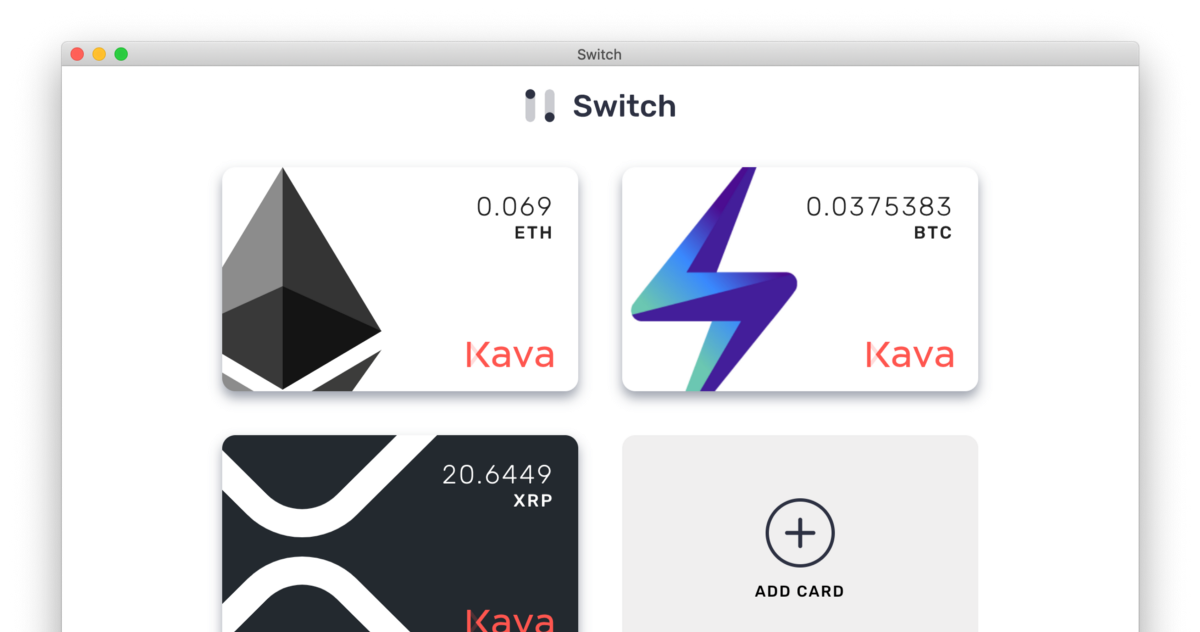
Load funds onto “cards,” swap between them, and withdraw at your leisure. Only you have access to these funds, even while !
bitcoin? Ethereum? You got it! 🌈
Today, Switch supports the three top crypto assets: , using LND and the Lightning Network; Ether, using Machinomy payment channels; and XRP, using its native payment channels.
Crucially, nearly any or layer 2 network that transfers value fast and cheaply can support non-custodial in Switch. No specialized required!
We’ve been building the foundation to support ERC-20 such as Dai, and hope to roll out support in the coming weeks. On top of that, many more asset integrations are in the pipeline.
Wait, it’s that fast? 🏎
Switch swaps are fast, and complete in seconds for small value transfers.
Since streaming micropayments leverage payment channels and layer 2 networks such as Lightning, each “packet” of value settles on the order of milliseconds.
No slow on-chain transactions, or outrageously long escrows. It’s just: Settled. Boom. Done.
Networked liquidity 🕸
Switch is underpinned by the to send packets over a decentralized network of “connectors,” or money routers, which provide liquidity.
Inspired by the internet, Interledger is an for interoperability across all payment networks.
Each card in Switch is linked to a connector, and provides an “uplink” to the Interledger network to perform swaps and send peer-to-peer payments.
For this beta release, Switch uses a connector operated by Kava. But coming soon, we’ll roll out support for user-defined connectors, and all the tools, infrastructure, and docs necessary to operate one yourself.
Safe and secure 🔐
Even if you use the Kava connector, don’t trust us!
When between , Switch will prefund a very small amount of the source asset — the equivalent of $0.10, by default — to the connector. Then, the connector sends back a small amount of the destination asset. If the exchange rate is reasonable, we repeat the process. And again. And again; many times per second.
If at any point the connector stops sending or sends us too little of the destination asset, we halt the exchange. This enables non-custodial , since the counterparty risk is merely a few cents, and comparable to that of atomic swaps.
But by contrast to atomic swaps, streaming micropayments also mitigate and — which is a win-win!
Try it today 🚀
Switch is available in beta for , and supports both testnet and mainnet, with trades up to $20.
Follow our to get up to speed and configure Switch on testnet in minutes.
While we hope it’s all smooth streaming, as this is beta-quality software, issues may arise. We’re rapidly iterating to make Switch more reliable, feature-complete, and secure. If you encounter any bugs or unexpected behavior, we’d encourage you to !
And for the latest updates from Kava, ~ we’d love to hear about your experience with Switch!
Published at Wed, 22 May 2019 20:59:48 +0000
![Bitcoin [btc] and other cryptocurrencies push cryptocurrency trading volumes to a record high](https://ohiobitcoin.com/wp-content/uploads/2019/02/crypto-trading-volume-oct-17-present.png "Bitcoin [btc] and other cryptocurrencies push cryptocurrency trading volumes to a record high")