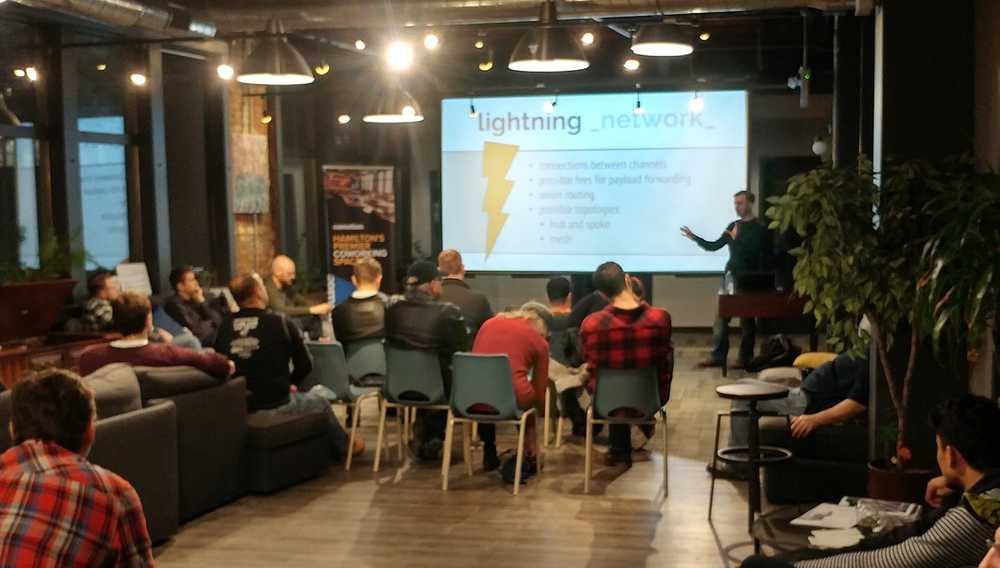
 Alex, talking up a storm.
We had the amazing opportunity to speak at the last month regarding the Lightning Network. We were able to have an insightful discussion with all of the members, and our eyes were opened up to some perspectives we hadn’t even considered yet. Below, we’ll quickly outline our talk and summarize some of the most important talking points. Make sure to to follow along!
What is the Lightning Network?
The Lightning Network is a second layer solution that runs on top of the bitcoin blockchain. This expansion protocol allows for greater scalability and new functionality, while improving system wide privacy.
How Does it Work?
By taking transactions off the main chain and consolidating them at a later time, the network can stay open and clog free. Users of the Lightning Network open a payment channel with another party, and from there can use a funded system to transact limitlessly without incurring regular bitcoin network fees. This isn’t to say that fees do not exist, there is one to open, fund, or close a channel, but the transactions that occur within that payment channel are subject to significantly lower fees than those occurring on the bitcoin network.
This may help: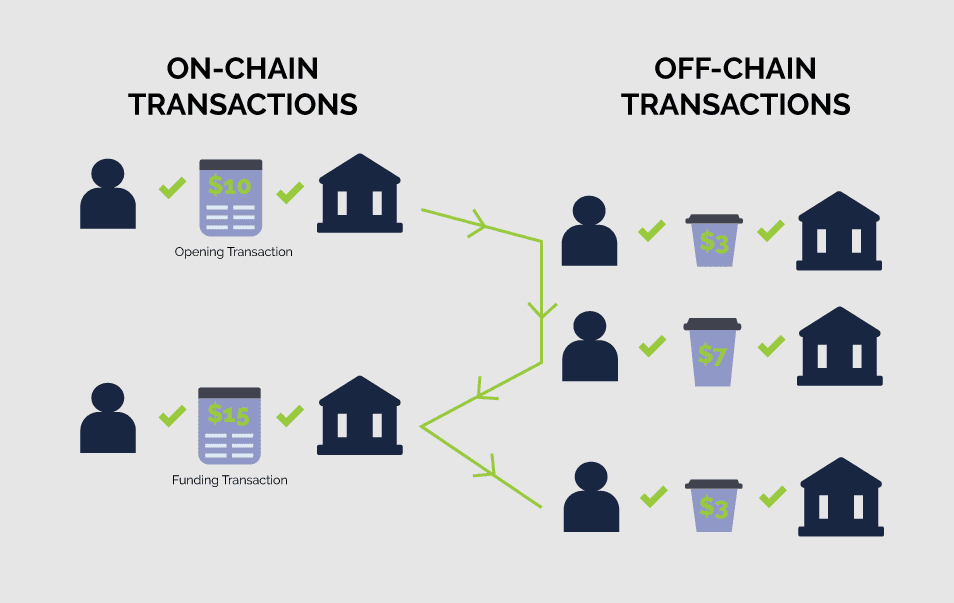 On-chain vs off-chain transactions in the Lightning Network.
A consumer has a favourite coffee shop that they frequent. They would like to open a payment channel with said coffee shop and so they send an opening transaction request and fund the channel with $10. This transaction is verified through proof of work and added to the bitcoin blockchain. The consumer is then free to spend the funds they placed in the channel at the cafe, each purchase is verified through signatures from both the consumer and the business. After spending the total amount of funds in the channel, the consumer wishes to add another $15 to the channel. This is approved by both parties, verified through consensus, and written to the bitcoin blockchain. The consumer now has another $15 to spend, off chain, at the cafe. The consumer can fund their channel again, or either party may choose to send a closing transaction which will once again be verified and consolidated onto the bitcoin blockchain.
This protocol allows for quicker transactions through the use of hot wallets. These internet connected wallets allow for instant signature and verification of transactions, meaning consensus is only needed to verify the opening, closing, or any additional funding of the channel that will be reported on the bitcoin blockchain. Are bitcoin transactions actually becoming faster? No, it’s important to note that this does not actually increase the amount of transactions the blockchain main net can handle, but it does help to remove smaller transactions that could hold up the system.
Payment Channels.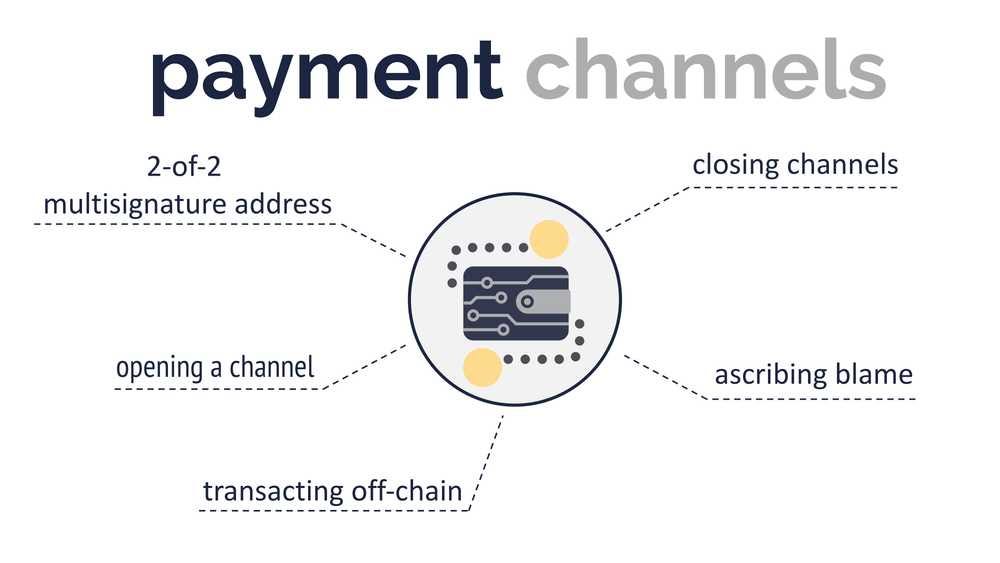 Our little slide about Payment Channels on the Lightning Network.
Let’s break down this slide:
Starting with the 2-of-2 Multisignature Address, as addressed above, this means that both parties are using their private key to sign off on every transaction that occurs in a payment channel.A channel is opened when both parties create the 2-of-2 multisignature address by placing funds into a payment channel through a transaction.Transactions inside the payment channel occur off chain in order to remove strain on the network.To deter bad actors, there is the notion of ascribing blame. Let’s go back to our coffee shop example. Say the channel is funded by $50 supplied by the consumer. After the consumer has spent $48 dollars, they decide they want to close the payment channel, however, they decide to initiate a closing transaction that says they have only spent $25 of the $50. In this case, the coffee shop will not sign off on the transaction and will ascribe blame by proving that the counter party has broadcast an old transaction. The coffee shop is then rewarded the entirety of the channel, that being the original $50.Channels are closed when both parties sign off on a closing transaction. Regardless of how many transactions occurred in the channel, the only ones to go onto the bitcoin public ledger will be the opening, funding, and closing transactions.The Network.
Channels are the connections between two nodes on the network. What will happen in the Lightning Network is that one transaction could potentially travel though several channels before arriving at its final destination. In order to do this, the nodes that are operating those channels may charge you to use them, however, these fees would be very minimal.
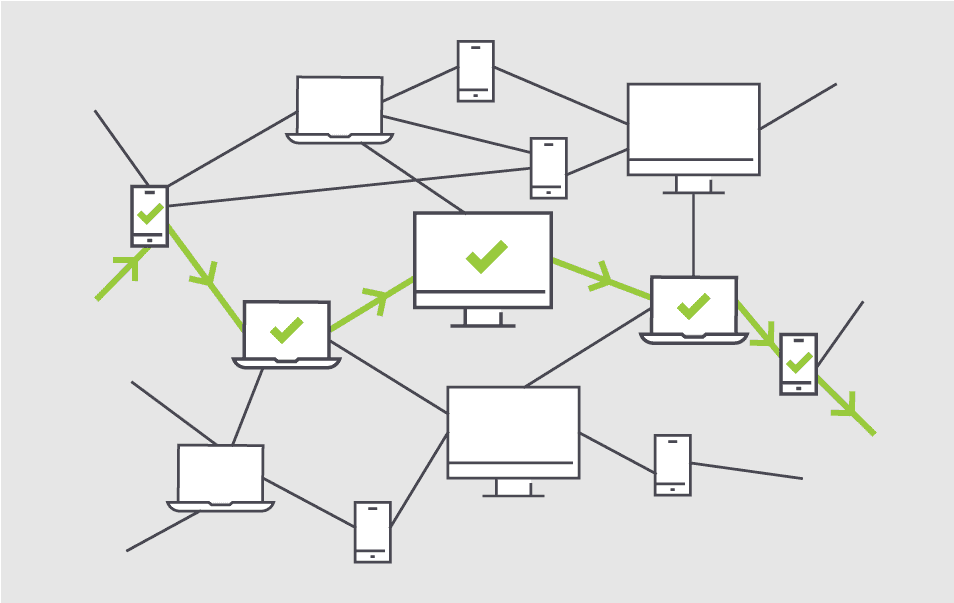 A topography based off diagrams from
If transactions are going to go from channel to channel, onion routing will help to keep the pseudo anonymous structure of bitcoin. In simplest terms, a node forwarding a transaction would only be able to see the party that sent them the funds, and the party they must deliver the funds to, any parties before or after that point are unknown to the intermediary.
The Good Parts.1. No Custodial Risk.
No one is holding onto your information, meaning there is no central point of failure in the network.
2. Requirement for Hot Wallets Discourages Centralization.
Ultimately, cryptocurrency is working to remove the centralization that exists in traditional models. As we mentioned above, everyone is required to use a hot wallet in the lightning network. This could lead to a mesh topography that creates many smaller hubs and decreases the loses that would occur if a larger, central hub was hacked.
3. Fast and Massively Scalable.
Taking countless transactions off chain will help to reduce potential backlogs in the bitcoin network, while providing a way to grow the functionality and usability of system.
The Bad Parts.1. Hub Operator’s AML Requirements.
For hubs to forward crypto and take part in these transactions, is it necessary for them to follow regulations around money transfers? If they don’t know where the money is going to or coming from, can they really be held accountable? At this point, we don’t know. So far, there has not been any clarity provided on this matter through government regulation.
2. Possible Centralization Towards Hub and Spoke.
No one knows for sure how the topography of the Lightning Network will take shape, there is the possibility it could discourage centralization, but there is just as much of a chance of encouraging it. Hubs could become central intermediaries that hold a large amount of funds and become targets for hackers.
3. Requirement for Hot Wallets.
Hot wallets are great for transacting instantaneously, but their connection to the internet makes them inherently more vulnerable than a cold wallet. One must realize that as is the case with the wallet in your pocket, it isn’t a great idea to keep a lot of money stored there. A hot wallet is better suited for micropayments or smaller, less important transactions.
That was a very quick overview of our presentation, and realistically, there was only so much we could dive into in an hour. Overall, we think this innovation is extremely important for bitcoin, blockchain, and cryptocurrency as a whole. However, it is currently an unknown as to whether or not this technology will solve the scaling problem, and there are other programs with the same focus that should not be ignored. In order to match, and eventually surpass, the usability and speed of existing payment processors, bitcoin has to continue to evolve.
At this point, we feel that the Lightning Network is still an experimental protocol that is not quite ready for market, but we can’t wait to see what the future brings! In fact, we are working together with to set up lighting nodes and contribute to the ecosystem. As self proclaimed compliance and AML ninjas, Outlier is hoping to provide examples of how lightning channels work to the government for clarity regarding regulations. Keep up with our project by following our and .
Further Reading
“The bitcoin Lightning Network”: Paper:
Basis of Lightning Technology (BOLT) — Lightning Network Specs:
Lightning Network Daemon (LND):
Additional Resources:
is a Canadian Blockchain Venture Studio that strives to create entirely new and decentralized models on a global scale. As a company run by humans, we want to know if we’ve made a mistake. Do we need to make a correction or do you have a different point of view on the topic? Let us know in the comments below.
Originally published at .


