April 21, 2026

Capitalizations Index – B ∞/21M

Sudden Bitcoin Price Breakout Sets New Bull Target at Over $5K

Sudden bitcoin price breakout sets new bull target at over $5k

Sudden Bitcoin Price Breakout Sets New Bull Target at Over $5K

Sudden bitcoin price breakout sets new bull target at over $5k

View

  • With bitcoin’s move today to 4.5-month highs near $5,080, the transition from bear to bull market appears done and dusted.
  • The trend change would gain credence, though, if and when BTC finds acceptance above the former support-turned-resistance of the 21-month exponential moving average (EMA), currently at $5,200.
  • The cryptocurrency is looking overbought as per the 14-day relative strength index, so prices may have a tough time breaking above $5,200 in the near-term.
  • bitcoin could see a pullback to $4,400 if signs of bullish exhaustion increase in the next few days.

After today’s breakout, bitcoin (BTC) now needs to move above crucial resistance near $5,200 to solidify the case for a longer-term bull market.

The world’s largest cryptocurrency by market capitalization crossed the last bearish lower high of $4,236 (Dec. 24 high) at 04:30 UTC Tuesday and jumped to $5,080 – the highest level since Nov. 19 – confirming a transition from a bear to a bull market.

The rally to a 4.5-month high was accompanied by a surge in 24-hour trading volumes to above $15 billion – the highest since mid-January 2018, according to CoinMarketCap. The bullish reversal, therefore, looks sustainable.

Further, the spike witnessed today has reinforced the positive trend change signaled by both the weekly moving average convergence divergence (MACD) and the money flow index a few weeks ago.

While the path of least resistance is now to the higher side, the bulls now face taking out the former support-turned-resistance of the 21-month exponential moving average (EMA), currently lined up at $5,200.

The persistent defense of that average support in the five months to October 2018 had triggered hopes of a strong bullish move. More importantly, a convincing break below that technical line on Nov. 14 invited strong selling pressure.

So the bulls need to force a convincing break above the 21-month EMA before claiming a complete victory over the bears.

As of writing, bitcoin is changing hands at $4,800 on Bitstamp, representing a 15 percent gain on a 24-hour basis.

Other major cryptocurrencies like ethereum’s ETH token, XRP and EOS are up at least 5 percent each. Meanwhile, names like litecoin, cardano and monero are flashing double-digit gains.

Weekly chart

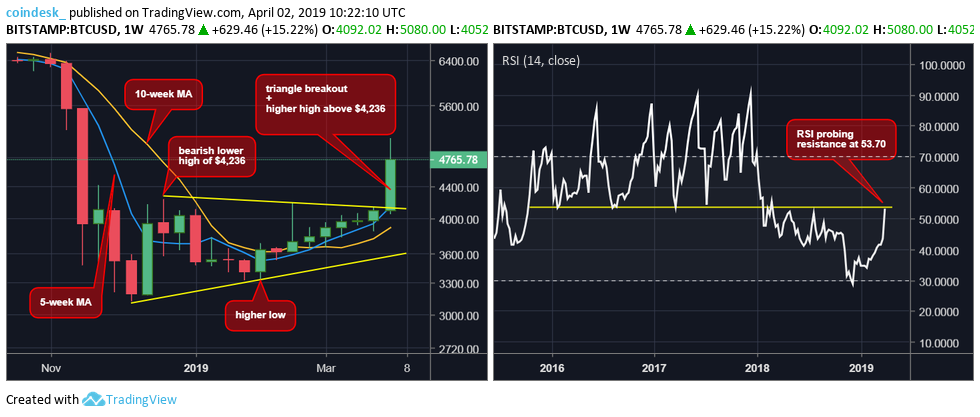
As seen above, BTC’s move above $4,236 has activated twin bullish cues: A bullish higher high and a triangle breakout, both confirming a bearish-to-bullish trend change.

The 5- and 10-week moving averages (MAs) are also trending north, indicating a bullish setup, while the relative strength index (RSI) is probing the former support-turned-resistance of 53.70. A break higher would further strengthen the bullish case.

Monthly chart

BTC came close to testing the 21-month MA, currently at $5,200, earlier today. A monthly close above that average would solidify the bullish reversal and encourage further buying, possibly leading to a move above $6,000.

A break above the 21-month EMA, however, may remain elusive for a few weeks, as the cryptocurrency is looking overbought on shorter duration charts.

Daily chart

On the daily chart, the 14-day RSI is at 86.00 – the highest level since December 2017.

The overbought reading would gain credence if the cryptocurrency creates bullish exhaustion patterns (e.g. doji, bearish engulfing, or inverted bearish hammer candles) in the next few days.

In that case, prices could fall back to $4,400 (Nov. 29 high) and consolidate for a period.

Disclosure: The author holds no cryptocurrency assets at the time of writing.

Bitcoin image via Shutterstock; charts by Trading View

Published at Tue, 02 Apr 2019 11:14:55 +0000

Previous Article

‘Doesn’t Seem Like Too Many People are Selling’ – Says Bitcoin Market Analyst

Next Article

$20,000 Bitcoin Short Trader Gives Buy Signal as Bitcoin Price Hits $5,000

You might be interested in …

Alpacoin $apc soars 41% in the last 24 hours

AlpaCoin $APC Soars 41% In the Last 24 Hours

AlpaCoin $APC Soars 41% In the Last 24 Hours AlpaCoin rose 41% within the past day. AlpaCoin is trading at 5.1E-07 BTC or about 51 PND. AlpaCoin is crytpocurrency, that allows instant payments to anyone […]

How the Blockchain Could Become an Image Dataset Repository for AR/VR

How the Blockchain Could Become an Image Repository for AR/VR

Lampix, an augmented reality (AR) startup, is building the world’s first blockchain-based “image mining” network. The company has embarked on the ambitious mission of developing one of the largest image databases.

The database, which will be available for all to use, intends to be the backbone of AR and machine-learning training. It seeks to suppress startups and developers’ dependency on proprietary image datasets owned by tech giants.

“Existing databases are controlled by the company who built them: Google, for example, has made such a database. However, there are two problems with this approach: Google controls this database and can, at any moment, forbid their competitors from using it, remove access to it, etc. Second, this database includes only the data Google thinks is needed,” George Popescu, CEO and co-founder of Lampix, told bitcoin Magazine.

Instead, Lampix is electing to offer a database where “no single company, and not Lampix neither, will control who has access to the data, and what data should go in the database.”

“No centralized control. This is why we are working on the blockchain,” he said.

Leveraging blockchain technology, Lampix is building a network that rewards users with Lampix tokens, called PIX, to take pictures, describe them and assemble open-source, curated image datasets. Miners can use any device that has a camera with the sufficient resolution, including the company’s Lampix device, to submit datasets.

Datasets submitted will consist of an image and description. To make sure the image and description match, voters will either upvote or downvote a dataset and will be compensated with PIX tokens if their vote aligns with the consensus.

Third-party developers will be able to access these datasets to train their own computer vision applications by paying a small fee using PIX.

Lampix is planning to include a hash of each picture on the blockchain once it is approved and added to the database. This will increase security and address two main concerns: ensuring that a picture hasn’t been tampered with and ensuring that a user is using a full dataset, meaning that no picture has been removed or added.

“Developers will be able to tap into this database for their own product, such as Google Glass, Holo Lens or our Lampix product and create applications,” he said. “This is exciting, as for any application, a lot of data is necessary to make it accurate and work properly.”

Lampix plans to create a total of 1.1 billion PIX tokens. It will sell 50 percent of its tokens in a crowd sale over a period of three days. At launch, one PIX will cost $0.12. The company aims to raise roughly $50 million.

Popescu said the team is currently working with exchanges to list the PIX tokens in as many platforms as possible. “We expect it will be listed on Gatecoin, Bittrex, Kraken, Yunbi and a few more quickly,” he said.

New York-based Lampix builds and sells hardware devices and software that bring augmented reality to any flat surface, turning these surfaces into interactive displays. Using machine learning and computer vision, Lampix recognizes objects and projects context-relevant buttons and menus for different actions.

The company serves the likes of Bloomberg and PwC, as well as large retail chains. It claims it has a pipeline of about 200 famous companies inquiring about its Lampix device.

The database will allow Lampix to improve its technology and make it more accurate as computer vision and machine learning need a lot of images for training and testing.

“Our plan is simple: to map the world inside. Not the room, but actual objects on desks, tables, the surfaces themselves. Or even objects on the floor, on the kitchen counter, on your bathroom counter,” he said. “Google Maps changed the world, but they only have access outside. Imagine what will happen if we map the interior world.”

Much of the business world’s interest in blockchain has been centered on financial and banking services. Yet, possible applications of the technology go well beyond financial services.

“There is a lot of opportunity with user content which is not being explored very much. Many people focus on blockchain in finance,” Popescu said. “However, I think that sourcing user content, and using the technology to manage license and access, is a huge opportunity. AR/VR is just a small piece of this.”

The post How the Blockchain Could Become an Image Dataset Repository for AR/VR appeared first on Bitcoin Magazine.