CNBC Transcript: Prospective Fed Nominee Stephen Moore on ‘s “Squawk Box” Today
WHEN: Today, Tuesday, April 30, 2019
WHERE: CNBC’s “”
The following is the unofficial transcript of a CNBC interview with Stephen Moore on CNBC’s “Squawk Box” (M-F 6AM – 9AM) today, Tuesday, April 30th. The following is a link to video of the interview on CNBC.com:

Watch CNBC’s Full Interview With Prospective Fed Nominee Stephen Moore
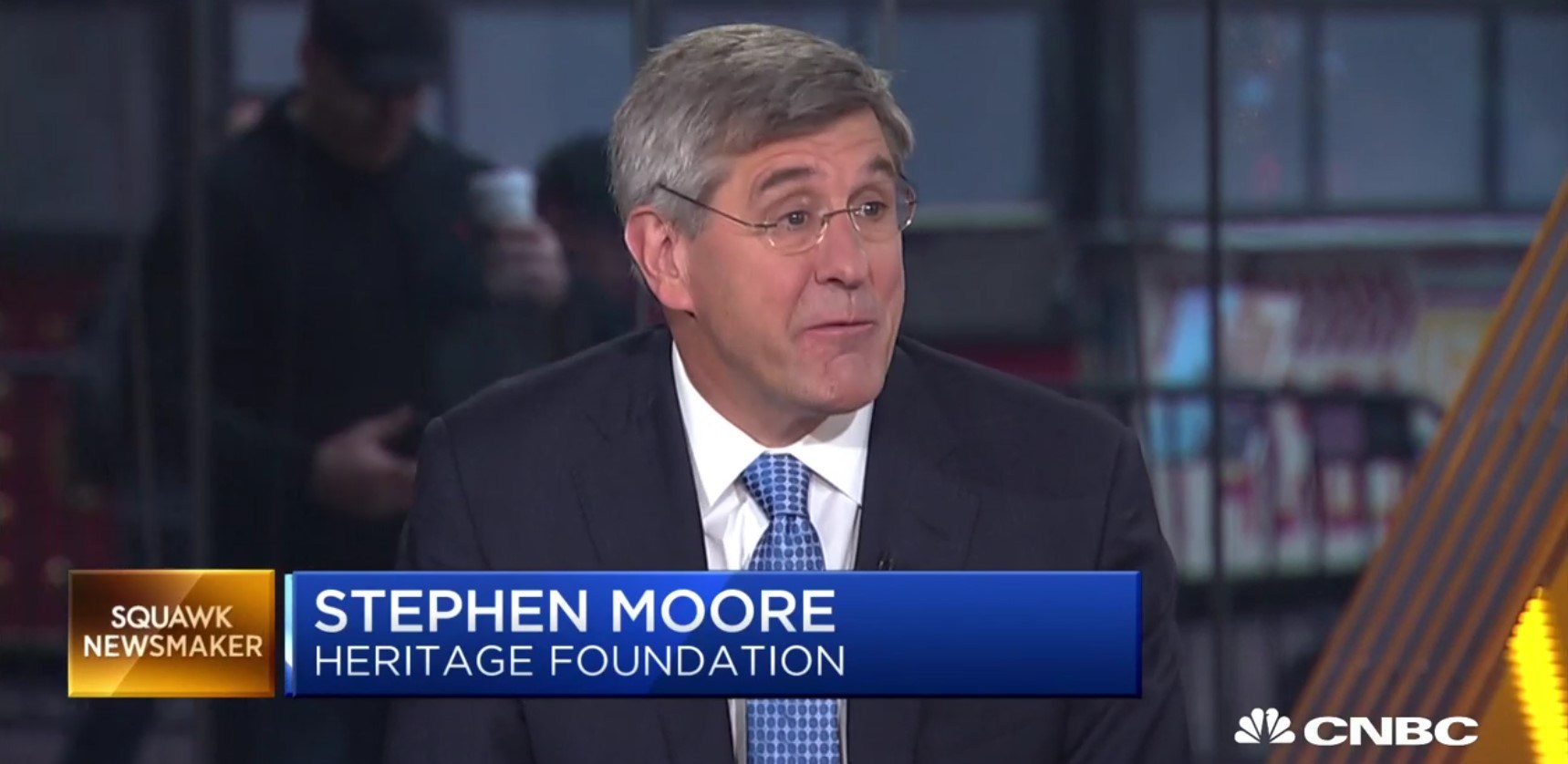
JOE KERNEN: The Fed kicking off a two-day meeting. Not much is expected on the rate front, which our next guest agrees is the right move. Here to talk about the future of and much more, Heritage Foundation’s Steve Moore. President Trump is considering him for a Fed board position and you’ve been on the show over the years, many, many times —
STEPHEN MOORE: Thank you for having me back.
JOE KERNEN: And it’s great to have you today on the set. I don’t — did you ever think that a Fed board position was in your future, Stephen?
STEPHEN MOORE: No, I never really did.
JOE KERNEN: Never did.
STEPHEN MOORE: I mean, it was the honor of my life when the President called me about a month ago and asked me to do this. And I half kiddingly said, you know, ‘Mr. President, you’re throwing me into the frying pan.’ I had no idea that it was going to be like this.
JOE KERNEN: What did—
STEPHEN MOORE: And by the way, let me just —
JOE KERNEN: Yeah, good ahead—
STEPHEN MOORE: I talked to a reporter the other day who has covered the Fed for 30 years. He said he’s never seen anything like this before. I mean, it’s not like I’m going to be . And so, it’s been kind of a lightning rod. But I’ll say this, Joe — you know, I was reflecting on this last night in talking to one of your producers — if there’s anything positive coming out of this, all of a sudden everybody’s paying attention to the Fed and what its role is and what people think about the role of money. And I think that’s a positive thing, if anything good has come out of this–
JOE KERNEN: And I hear exactly what you’re saying, but approach it this way —
STEPHEN MOORE: Yeah.
JOE KERNEN: I’m not sure whether the President looked into all of your writings at Heritage —
STEPHEN MOORE: I’m sure he hasn’t.
JOE KERNEN: — about your view on monetary policy. So, I’m thinking that he saw you basically say, agree with him about the Fed should not have been raising rates, and I think you called it economic malpractice, that rate hike in December — I think he saw that, and most of the decision he’s making is based on you sort of being a political ally in terms of what you’re going to do on the Fed. And I think that might — I don’t know — I mean, I know a lot more about — maybe – about your thinking. And I think, I’m not saying you wouldn’t be a good Fed board member at all, but I’m not sure made that decision based on a deep knowledge of what your feelings are about monetary policy.
STEPHEN MOORE: Actually, I’ll disagree with that. I mean, I’ve known the President for now for four years. And Larry Kudlow and I started working — I think it was almost exactly four years ago.
JOE KERNEN: Larry could have been have been telling him that, so—
STEPHEN MOORE: Well, my point is that I was working side by side with Larry Kudlow and Art Laffer and Donald Trump to put this economic agenda together. I mean, look, if you want the biggest selling point for me is I helped put the economic agenda together. We’ve got the best economy in 20 years, the best job market in 50 years. I mean, that’s a pretty good qualification. All of these people, by the way, who are attacking me, people on “The Washington Post” editorial board, “The New York Times” editorial board, Paul Krugman? I mean, can you think, Joe, of three entities that have been more wrong on the over the last three or four years than “The New York Times” editorial board?
JOE KERNEN: No, I can’t.
STEPHEN MOORE: These are the people, literally who said if Donald Trump is elected President, he’s going to cause the second great depression. Now we have the best economy in 20 years, and these are the people who are attacking me. So, my only point is Trump has known me for a long time. This wasn’t — Trump was trying to think, what could I do to help serve his economic agenda, and I think that’s why he tapped me –
JOE KERNEN: Not necessarily what the Fed’s mandate is. The Fed’s mandate is price stability and full employment. It’s not necessarily, as we know from past arguments Presidents have had with the Fed — it’s not about the President’s economic initiatives to spur growth and get him re-elected. That’s not why the Fed exists.
STEPHEN MOORE: No, but look, I think the reason the economics team over there picked me, because it wasn’t just Donald Trump a lot of people had some input into this. It was because we believe – I mean, this is the core belief of sort of supply side economics —
BECKY QUICK: Right.
JOE KERNEN: Right.
STEPHEN MOORE: — that you can grow this economy at 4% without inflation, with full employment, and incidentally, I mean, the news that we saw on Friday is further vindication that Trump’s agenda is working. We have 3.2% growth and there is no inflation out there.
ANDREW ROSS SORKIN: Stephen, let me ask you, though, about that. Because there’s two— I think there’s two significant economic questions that relate to this.
STEPHEN MOORE: Yes.
ANDREW ROSS SORKIN: And we can criticize different newspapers for predicting one thing or the other, but then at the same time, then we have to look at the predictions that you’ve made over time.
STEPHEN MOORE: Right, sure.
ANDREW ROSS SORKIN: You know, after the financial crisis in 2010, you were calling for hyperinflation. You thought that things were going to get —
STEPHEN MOORE: Yeah.
ANDREW ROSS SORKIN: And that clearly never happened. More recently, you’ve been talking about the idea that we are living in some kind of deflationary time, which I also don’t think is necessarily accurate.
STEPHEN MOORE: Right.
ANDREW ROSS SORKIN: So, how do you square those issues?
STEPHEN MOORE: So, good question. First of all, let’s go back to the great . Go back and read my book. Read the first two chapters of the book that Laffer and I wrote in 2008, that came out in the summer of 2008, called “The End of Prosperity,” where we called — we basically said, ‘This is the end of prosperity. We’re going to see a period now of, you know, severe economic contraction.’ And we were exactly right. I mean, I feel like if you look at economists, who had that period right? I did. I was the one who said the economics $800 billion stimulus plan would not work. I was the one who said Obamacare– all of these regulations were going to create a very, very poor recovery, and by the way –
ANDREW ROSS SORKIN: You would have wanted more expansionary plan, in fact, I think if we go back in time.
STEPHEN MOORE: I was wrong — and I’ve said this from day one — I was wrong about what happened in terms of prices in 2009 and ’10, ’11, but what I wasn’t wrong on was that all of the, quote, fiscal stimulus, has almost zero impact on growth. And my point was — and this is an important point in terms of understanding monetary policy, because this is a teachable moment for people — you can’t make up for bad tax policy, bad regulation policy, you know, bad health care policy, by printing money. And that was kind of the view of the Fed, and it doesn’t work. And that period proves it. Now, in terms of the last few months, again, has there been any economist who’s been more right about the last four months than me? I was the one — you’re right, Joe — I basically did say—
JOE KERNEN: Right.
STEPHEN MOORE: — this was an act of economic malpractice. And guess what, it was an act of economic malpractice when the fed raised rates in December, it was indefensible, the stock market crashed in anticipation and when that happened and by the way, when the Fed put its tail between its legs – I mean, let’s be very clear about the chronology here. It was really starting that day that the stock market and the economy boomed and we’ve not got –
ANDREW ROSS SORKIN: But how –
STEPHEN MOORE: So, thank goodness the Fed listened to me.
ANDREW ROSS SORKIN: But how can you say we’re in a deflationary period? I mean—
STEPHEN MOORE: Because look at what happened to commodity prices over that period. Commodity prices from September through December they fell by like 12%, 13%. When you’ve got–
ANDREW ROSS SORKIN: But just to be specific then, when – your call for deflation was strictly about commodity prices?
STEPHEN MOORE: Yes. Every element: soybeans, wheat, cotton, copper, oil, natural gas, all of them were falling in price. Now, tell me how that’s not a deflation when you have every — my point about commodities — because again, this is a teachable moment for people understanding how prices work. The best forward-looking indicator we have on where prices are going is to look at commodity prices, because those — you have it right on your computer screen what’s happening with — in real time. We don’t know what’s happening with the Consumer Price Index. We don’t know what is. We don’t know, what the producer price is for three or four months afterwards. So, I like to look at commodities. I’m not going to only look at commodity prices, but I do think they’re a good lead — they’re the canary in the coal mine about where prices are headed.
MAGGIE WILDEROTTER: So, Stephen, when you think about the future, all right? Let’s say you get into the Fed.
STEPHEN MOORE: Yes.
MAGGIE WILDEROTTER: What do you see in terms of the value added that you can deliver collectively?
STEPHEN MOORE: That’s a great question. And I really liked the piece that Jeremy Siegel wrote about me yesterday in “The Wall Street Journal,” where he basically said, ‘Look, I don’t even agree’– he said, ‘I don’t agree with Stephen Moore on a lot of things’ – and he says he agrees with some of the things — but he said, ‘It would be healthy to have divergent views on the Fed,’ and I happen to agree with that. And the question i would ask my critics is why are they so afraid of me? And why are they so afraid that someone with my views will get on the Fed? And I think it’s partly because they think I’ll be an effective communicator and maybe change — I’d like to — I said this a couple months ago on your show — I mean, a couple weeks ago on your show. I’ll say it again. I want to make Chairman Powell the most successful Fed Chairman in history, where we do get 4% growth with zero inflation. I really think we can get there.
JOE KERNEN: Do you think it’s ridiculous for people to worry about the comments in the past about women? That might be what they’re fearing.
STEPHEN MOORE: I mean, look, if this comes down to, when we have that vote, and you know, in the senate, because I have to get 50 senators — if it comes down to things I wrote 18 years ago that were in politic that I’ve apologized for that were, you know, insulting, then I’m in trouble. If it comes down to my economic ideas, I think we’ll be–
BECKY QUICK: Steve, this is not just stuff written 18, 20 years ago. I’ve known you for a long time, too, and I was a little surprised by some of the stuff that I read that was more recent. 2014, column for “The National Review”: What are the implications of a society where women earn more than men? We don’t really know, but it could be disruptive to family stability. If men aren’t the bread-winners, will women regard them as economically expendable? We saw what happened to family structure and low-income and black households when the welfare check took the place of a father’s paycheck. Divorce rates go up when men lose their jobs.
STEPHEN MOORE: So, I’m glad you brought that up, because let me clarify what I was trying to say, because maybe I wasn’t being specific about this. The biggest problem I see in the economy over the last 25 years is what has happened to male earnings, for black males and white males as well. They’ve been declining, and that is, I think, a big problem. Look, I want everybody’s wages to rise, of course. But talking about women’s , they have risen. The problem has actually been the steady decline in male earnings, and I think we should pay attention to that, because I think that has very negative consequences for the economy and for society.
MAGGIE WILDEROTTER: Yeah, but I also think, as a bread-winner in my family, I think that women should be paid fairly for what they do.
STEPHEN MOORE: I agree. No disagreement on that.
MAGGIE WILDEROTTER: You just need to have a semicolon and make sure you’re always saying that as well.
STEPHEN MOORE: Amen. Well put. And that was the point I was — if you read the whole article. See, this is the problem. People take one — one or two sentences out of a piece. It was all about what’s happening with white middle-class and black middle-class earnings, and they’ve been falling for males, whereas women’s earnings have been — and I want gender equity in terms of pay and things like that, but I want to make sure everyone’s wages are rising. By the way, our record on wages has been fantastic. I mean, we’ve seen really big gains –
JOE KERNEN: So you’re in the middle of process, Steve. Do you end up on the Fed or not? What do you think? 50/50, 80/20, 10/90? What do you think?
STEPHEN MOORE: I think I’m going to be on the Fed. By the way, the President and the White House economics team’s totally behind me on this. I mean, I’ve actually been —
MAGGIE WILDEROTTER: Which has been apparent, too. came out again yesterday –
STEPHEN MOORE: They — in fact, one time a couple weeks ago –
JOE KERNEN: You’ll still come on if you become a big-shot?
STEPHEN MOORE: — ‘You’re not stepping down, get back in the race!’
JOE KERNEN: You’re still going to be on the show if you’re a big-shot?
STEPHEN MOORE: I’m not going to remember the little people like you.
JOE KERNEN: I know. That’s what I’m worried about.
STEPHEN MOORE: I’m teasing.
JOE KERNEN: Thank you, Steve. Thanks for coming on. Maggie —
MAGGIE WILDEROTTER: Good luck.
JOE KERNEN: — thank you for spending two hours with us.
MAGGIE WILDEROTTER: It’s been great. I enjoy you guys. You’re terrific.
The post appeared first on .
Related
Published at Wed, 01 May 2019 09:42:19 +0000