
Stellar Lumens and Kin Foundation have developed a very talked-about partnership in the crypto-sphere and accordingly as asked by many, both of them came together for a night-talk on a Subreddit platform to answer various questions from the viewers. The AMA session was run by Tomer – Stellar Engineer, Boris – Stellar Partnerships and Gadi – Kin Technical Dev Leader.
The ask/me/anything session started with Kin’s technical Dev leader talking about all the results and tests that were run by Kin on Stellar’s network, which details will be published on a post by Ory. When it comes to the lightning network, Gadi added that as it is still not completed, nothing can be added on the matter.
When asked about Stellar’s future partnerships that might benefit the Kin product like the IBM, Stripe, Keybase, etc; Gadi says, identity is a real challenge, however, it’s still early to understand the actual needs and requirements for digital service. Regarding other technological cooperation’s, they don’t have any planned yet.
Gadi explained how Kin and Stellar will take care of the funding in the initial phase as they would like to learn from the real-world use cases. The KRE reward is designed to allow digital services to maintain themselves including any infrastructure costs that would incur.
The issue here is born in the case of creating a large account with the target to maliciously spam the process of account creation. The solution is found in the first phase, users that are approaching and registering will be set under-radar and accordingly, accounts that are on status – spam identified – will not be funded.
There is still much to be cleared out of the blurred image when it comes to what tokens will Kin use. Many question if Kin will have its own token or use the Stellar Lumens to get things going. Currently, there is another token called ‘KIN’ in the Stellar network.
“We are happy to have KIN use Stellar as it will be one of the first mainstream companies to use cryptocurrency in production. The fact that Kin is using Stellar to power their ecosystem of digital services will be a positive sign to other large companies considering launching their own token-based economies.”
Stellar was shown to have 95% of all lumens in the top 100 wallets and the Stellar Development Foundation’s mandate is to distribute 95% of lumens over time through various programs. ‘It’s not supposed to happen overnight’, they say.
On the discussion post, the hosts added that the beauty of Stellar lies in its simplicity:
“Other chains can try to be all things to all people, but we stay focused on what we do well – facilitating fast, cheap and scalable payments. Importantly, we’ve been doing this in production for several years now, whereas many of the up and coming chains, at least at this point, are still just words on a page.”
The post appeared first on .

Our Story
We have been asked many times recently to “tell our story”. Why blockchain with ecommerce? What brought us to where we are today? How did we form our team?
It all started in 2010 when a mutual friend introduced me to Robert Palmer as a kindred entrepreneurial spirit. We decided to fill a void within the e-commerce space. There was a large need to provide financing for product purchases to the unbankable and credit challenged demographic in the US. So, off we went to develop our e-commerce platform. Through this journey we experienced many pitfalls that exist in e-commerce today. Several platforms, integrations, and many miles of custom code later (thanks Byron Levels), we still faced many of the same challenges.
We realized that we were constantly trying to develop a platform that would protect us from data breaches, prevent fraud, manage our supply chain, create a positive customer experience, all while trying to reduce transaction costs. It seemed as though all we were doing was development projects. There were no off-the-shelf solutions to the problems we were faced with. Every third-party integration required custom coding, which took time. We were always at the mercy of third party providers. And the fees! Our accounts payable was taking a beating with third-party providers. We were spending ridiculous amounts in processing fees. We had to process credit applications, process credit card transactions, process front-end and back-end fraud prevention measures, process supply chain tracking, and so on. The third-party providers were making money hand-over-fist while the e-commerce company was struggling to compete in the marketplace operating on razor thin margins.
Eventually, we wrestled it under control. As our operation leveled out we began to prepare for our e-commerce marathon. We started patting ourselves and our awesome team on the back. We had managed to develop out an amazing ecommerce platform. Our marketing was spot on. Our customer service was amazing. Our fulfillment was humming right along. We had managed to build a $40m company from scratch. We had found all of the ingredients to scale this company to $400m. Then the hammer came down.
In March of 2015 we started to experience some very disappointing trends in our customer receivables. Our first-payment default rate jumped up. It jumped way too high. Something was not right at all. Then I got a message from our customer service manager. Customer service took a call from a lady that stated she never placed an order with our company and that she was receiving collection calls. Then another customer called stating the same. And another call, and another… Before we could start analyzing the data, we had an all out firestorm on our hands. Our phone system couldn’t keep up. Our email and online chat was through the roof. Our credit servicing company was freaking out. It was crazy and not in a good way.
On that day in late March we had discovered that our company was victim to a massive consumer fraud attack. The past 40 days or so of sales were littered with stolen identities. We thought we had proper fraud protection in place, but the fraudsters proved to be one-step ahead of the fraud prevention community. What were we to do? We had hundreds of thousands of dollars in pending orders. We had no idea who was real or a fraud. We had to do something fast!
The story I tell you above was real. The events that took place soon after the attack affected me very personally. I took great offense to the fraud. I felt like I had been robbed at gunpoint and beaten to within an inch of my life. It affected my health, my family, my business partner, his family, my management team, every employee, our third-party providers, our marketing partners. This affected us ALL. The next few weeks and months were a nightmare for us all. Morale was in the ditch. The energy of our company was sucked completely away by the massive theft. I then began my search for a real answer to the fraud. By this point in my career I had gained enough tech knowledge to know that there was an answer somewhere. Having actually bought some bitcoin in 2012, I understood the lack of use-case for crypto. I had read about blockchain technology and possessed enough understanding of smart contracts, but I still hadn’t put two and two together. Late 2016, I had the light-bulb moment. It occurred to me that the solution to our all of our challenges could be found in blockchain. Blockchain, crypto and smart contracts will bring trust to ecommerce. TRUST!
Our Team
Robert and I work well together in business. We compliment each other in business in many ways. The business relationship we have doesn’t come around very often. His strengths in business fill my weaknesses and vise-versa. (His being an attorney also helps.) My entrepreneurial aggressiveness is tamed by his skepticism.
Brandon was the best man in my wedding. We grew up together, went to high school together, both joined the military at the same time and have kept in close contact throughout the years. There is a level of trust that we have that you don’t see often enough in relationships. Besides being well educated and knowledgeable on many subjects, Brandon also has a very organized mind and even-keel temperament.
Byron and I have been through fire together. We have accomplished the impossible on timelines, and we successfully fought a massive fraud attack head-on. For six years Byron has taken my thoughts and ideas and coded them into existence. It seems like there is nothing too small or too big for his imagination. Byron’s laid-back personality, along with his experience as a network guy makes him the ultimate technology advisor.
The way I like to put it, Gary thinks with his whole brain. He has the gift of creative thinking and logical reasoning. He also has a lot of experience in the area of securities law. To put it simply, I wish a lot more lawyers were like Gary. He knows the law, he’s an experienced litigator, but he doesn’t feel the need to constantly remind you and everyone else in the room. And he’s a good neighbor. He makes his talent available to the community where I live by working as a municipal judge.
Patrick is a fellow LSU football fan, GEAUX TIGERS. Having been educated in my home state of Louisiana, we have a commonality more than skin deep. His experience in finance is world class. He has managed large funds and investor assets. He has managed and sold many old-school offerings to market. A few years ago, when crypto showed up in his news feed, he discovered he had a taste for it. Since then, he’s been active in the financial side of blockchain and crypto.
Chris and I have worked on many outsourcing projects together. We have spent many hours communicating with our teams while they sit on the other side of the globe. Chris’ enthusiasm brings energy to any office. I know my people are in good hands when Chris is directing them.
Raphael is a relative new find. He quickly impressed us. His creative skills and eagerness to get the job done add a welcome talent to this team.
Denis, Robert, and I have worked together on many projects. Denis has the uncanny ability to affirm an idea or shoot it down while making you feel great about it. He was intrigued by crypto and blockchain from early on. Now, the newbies call Denis one of the old guys. In addition to a ton of hands on experience, he brings an impressive crypto network to our project.
Written by: David de Pingre, Founder & CEO

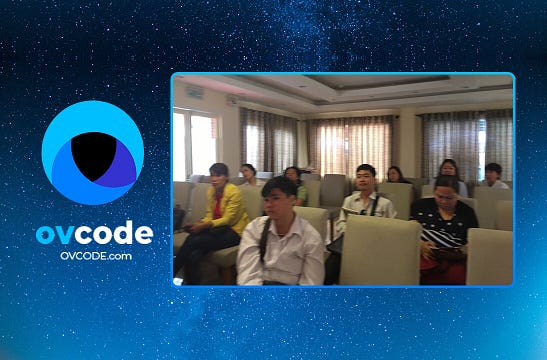
Promoting the usefulness of OVCode in everyday life, a technology seminar was conducted on March 17, 2018 in Ho Chi Minh, Vietnam.
일상 생활에서 OVCode의 유용성을 증진하기 위해 2018 년 3 월 17 일 베트남 호치민에서 기술 세미나가 개최되었습니다.
Tăng cường tính hữu dụng của OVCode trong cuộc sống hàng ngày, một cuộc hội thảo công nghệ đã được tiến hành vào ngày 17 tháng 3 năm 2018 tại Hồ Chí Minh, Việt Nam.
During the seminar, OVCode CEO Bobby Suson, shares the features of OVCode’s blockchain technology to potential partners and supporters in Vietnam.
세미나 기간 동안 OVCode의 CEO 인 Bobby Suson은 OVCode의 블록 체인 기술의 기능을 베트남의 잠재적 인 파트너 및 지지자들과 공유합니다.
Trong buổi hội thảo, Giám đốc điều hành OVCode Bobby Suson, chia sẻ các tính năng của công nghệ blockchain của OVCode cho các đối tác tiềm năng và những người ủng hộ tại Việt Nam.

The blockchain is usually associated with cryptocurrencies, but the technology behind it can be used for much more than registering cryptocoin transactions. The blockchain could provide a lot of improvements in real life. These are, for example, five practical applications of the technology.
Electric cars and smart charging
More and more electric cars are appearing on the road and there are plans to ban all cars with a combustion engine by 2030. That does ensure that suddenly a lot of energy is needed and if coal-fired plants are used for this, it might be better to simply keep cars on the road.
It is of course the intention that renewable energy is used and the blockchain can help by matching the demand and supply of sustainable energy.
The Dutch energy supplier Vandebron is actively working on this. The blockchain and smart algorithms are used to ensure that there is no shortage of sustainable energy during peak times and that energy from coal-fired power stations is not being used.
Efficient Logistics sector
The blockchain can also do a lot of good in the logistics sector. According to Michael Vogel, CEO of Netcoins, the biggest limitation of every logistics system is that it involves people. He believes that in all processes involving people, there is the possibility of manifesting errors and delays.
By means of the blockchain many processes could be executed automatically with the help of smart contracts. Because many intermediaries can be eliminated, processes can also run more efficiently, which also saves money.
Due to the transparency of the blockchain, it is no longer possible to cheat with the accounting. Safety is also being lifted to a higher level, as many systems in the sector are connected to the Internet and the technology uses advanced encryption.
 Data securely in the cloud
Google is one of the big companies, which is also busy with the blockchain. The company would use the technology to better secure personal data of customers.
The company also intends to make the Google blockchain as a white label product available to other companies, which can also provide extra security when dealing with transactions. In addition, it is possible to use the technology to keep your data safe and hackproof in the cloud. Although Google has not indicated that it plans to do this, it is likely that it goes that way.
 Automatic contracts
The blockchain could mean a lot for every sector where contracts play an important role, such as insurance companies, financial institutions, brokers and law firms. Everything could be a lot more efficient through smart contracts. Smart contracts are just like normal contracts, but you can add conditions and actions that are automatically executed without an intermediary. This, of course, also saves money.
 Blockchain in health care
Even in healthcare, technology can do a lot of good. example, is a start-up that works together with the Centre for Disease Control to put data on the outbreak of diseases and epidemics on the blockchain. According to the startup, this could increase the effectiveness of responding to outbreaks and treating the affected patients. the blockchain to track the progress of patients after they leave the hospital. They are also working on a project, where the blockchain serves as a decentralized database for patient data.
