
Stablecoin Wars: Poloniex Eliminates USDC Trading Fees in Bid to Boost Volume
Advertisement
In case you missed it, Poloniex, one of the major altcoin exchanges, . Previously, Circle was focused primarily on the major coins versus fiat pairings, but since its acquisition of Poloniex it has had the opportunity to dive into more tokens, and in September it launched its own stablecoin to compete with tether (USDT) and the Gemini Dollar (GUSD), which was launched around the same time. The purpose of “” is to help traders denominate their cryptos without creating a crypto-to-fiat event as well as to have coins that are pegged with some degree of certainty to the US dollar.
USD Coin has already been listed for use at Coinbase, one of the largest bitcoin exchanges in the world (owing to the fact that Coinbase is also a of the token’s development consortium), and of course, they immediately put it to work on their new property, Poloniex. Now people wanting to get hold of and trade USD Coin on Poloniex have more incentive to do so, as Circle has decided to stimulate usage by eliminating trading fees for the coin on the Poloniex platform, at least through the end of November.
As CCN reported, Poloniex users are already trading for USD Coin. Somewhat ironically, they are also offering to exchange USDC against USDT.
For the present, this means that Poloniex users have two stablecoin options. It is unclear whether Poloniex will list USDT indefinitely, but it has been on the exchange almost since its inception as Poloniex transformed from a major altcoin exchange to a major everything exchange.
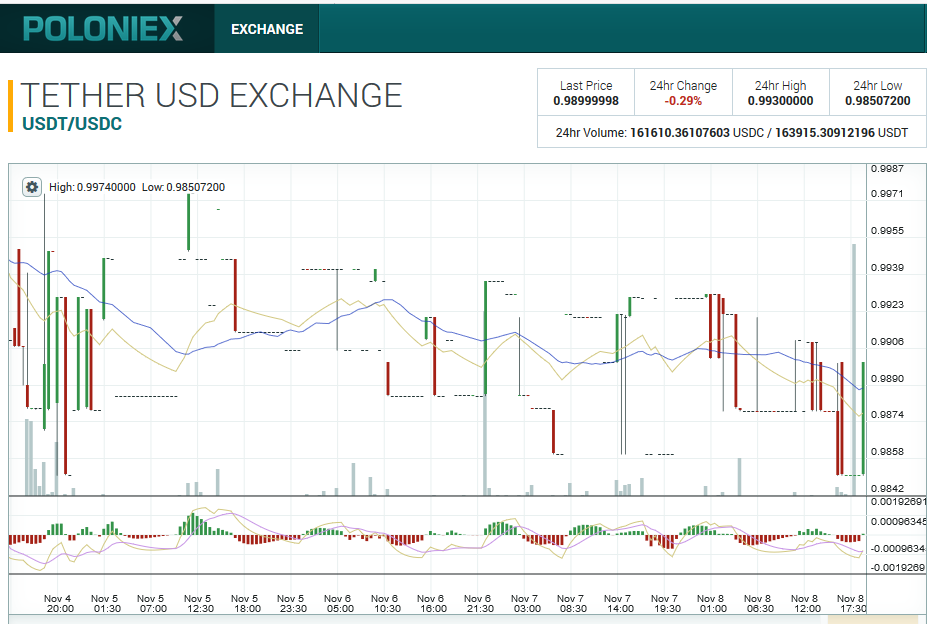
At the time of writing, a minor arbitrage opportunity existed between USDC, wherein one could purchase a USDC for $1.00 and buy around $1.01 worth of USDT. Tether is supposed to be exchangeable directly for $1.00 via Bitfinex, so the divergent trading, done in mass quantities, is an opportunity for savvy traders with deep pockets to profit.
According to Circle, over $130 million in USDC are now in circulation, and this number should expand as usage of the token increases. Trading volume, though, has yet to match its market cap, as daily turnover is just $3.4 million.
the FIAT to BTC order that started it, and how it propagated. Here are the main takeaways from our analysis and some screenshots of our solution. All the analytics shown are provided in real-time to […]
Ralli Bitcoinil. Sellist hinnatõusu ei ole kuude jooksul toimunud Bitcoini hind on kasvanud üle 20 protsendi. teisipäeval, 2. aprillil, lisades $ 5000 — taset, mida ei ole näha alates 2018. aasta novembrist. BTC määr langes kiiresti alla […]
Speaking on November 25 at , Ethereum inventor and co-founder Vitalik Buterin his vision for Ethereum 2.0. He described major changes in Ethereum’s architecture that are likely to be implemented over the next few years to improve Ethereum in terms of privacy, safety (consensus safety and smart contract safety) and, of course, scalability, which was the main focus of Buterin’s talk.
Buterin doesn’t seem worried about competitors. “The Ethereum killer is Ethereum, the Ethereum of China is Ethereum, the Ethereum of Taiwan is Ethereum… 2.0,” he said.
The fact that Ethereum is booming seems to confirm Buterin’s optimism. ETH’s price has been relentlessly climbing, recently reaching almost $500, and Ethereum is handling than all other major blockchains combined.
Decentralization, scalability and security are among the important properties that blockchain systems should have, but there are conflicts. Off-chain solutions are useful, but limited. According to Buterin, it’s very easy to have two of these properties but very hard to have all three. However, Ethereum’s ambitious goal should be that of achieving all three at the same time. “We want to scale to thousands of transactions per second, on chain, without any supernodes,” reads one of Buterin’s slides.
Sharding
— dividing a blockchain network into several smaller component networks (called shards) capable of processing transactions in parallel — is considered to be a promising way to achieve high throughputs comparable to the thousands of transactions per second of traditional payment networks such as Visa and MasterCard.
“You can think of [sharding] as, in a fairly simple version, creating a blockchain where you have, let’s say, a hundred different universes, and each of these universes is a different account space,” said Buterin. “So you can have an account in some universe or you can have a contract in some universe and you can send a transaction in some universe, and if you send a transaction in some universe it only affects stuff in some universe.
“But these kind of 100 universes are not just separate blockchains; they are systems that are also interconnected with each other,” continued Buterin. “Particularly, they share consensus. So in order to break even one of them, you have to break the whole thing.”
Buterin went on to describe relatively easy and more sophisticated ways to implement sharding in the Ethereum blockchain, outlining a sharding roadmap that foresees, at least initially, the creation of new “universes” that don’t impact the main chain while permitting iterative experimentation, such as introducing higher levels of scalability, starting with “quadratic scalability as nodes validate certain shards and act as light clients for other shards.”
Privacy
Buterin noted that zero-knowledge proof (zk-Snarks) privacy technology equivalent to has been implemented in , offering application developers new ways to implement tighter privacy. These new privacy tools will permit showing transactions to specific parties while hiding them from public view. Buterin went as far as saying that the privacy problem is now three quarters of the way to being solved.
Proof of Work vs. Proof of Stake
A major upgrade to Ethereum will be the introduction of (PoS) in which, according to Buterin, might be ready by next summer. With the first release of Casper, Ethereum will transition from pure Proof of Work (PoW) to hybrid PoW/PoS. “In this scheme, all of the proof-of-work mechanics will continue to exist, but additional proof-of-stake mechanics will be added,” .
The main reason why PoS is seen as a necessary development is, of course, the need to reduce the energy requirements of PoW blockchains like the current versions of Ethereum and bitcoin. claims that bitcoin mining consumes as much power in a year as 159 countries, which is clearly far too much, and Buterin admitted that today’s Ethereum isn’t any better than bitcoin in that respect.
Smart Contract Security
Smart contracts implemented with Turing-complete programming languages are arguably the main innovation introduced by Ethereum. While smart contracts are finding countless applications and moving lots of money, the security and safety of Ethereum smart contracts have been questioned. Buterin confirmed that Ethereum will eventually introduce formal verification for smart contracts and that a new Python-like smart-contract programming language — dubbed “” — is being implemented to enable the development of safer Ethereum applications.
While Buterin hasn’t said anything that he has not said in previous talks and papers, his BeyondBlock talk served as a useful confirmation and summary of the ambitious Ethereum development roadmap.
Besides Buterin’s talk, all the talks given at BeyondBlock Taipei 2017 are included in the full video recordings of and .