March 11, 2026

Capitalizations Index – B ∞/21M

Sparkswap, World’s First Lightning Atomic Swap Exchange, Now in Beta

Sparkswap, world’s first lightning atomic swap exchange, now in beta

Sparkswap, World’s First Lightning Atomic Swap Exchange, Now in Beta

bitcoin’s first decentralized exchange to make use of the Lightning Network’s Atomic Swaps is now in beta.

Sparkswap, an exchange with backing from Pantera Capital (which announced its ambitious mission to become the most decentralized ₿itcoin exchange on the market in August 2018), has now opened its beta to users. Leveraging the Lightning Network, the exchange is non-custodial and trading is decentralized. Users will be able to execute buy and sell orders between each other directly and, thanks to atomic swapping, they’ll also be able to trade coins across blockchains.

“At no point can either Sparkswap or your counterparty deprive you of your assets — the trades either complete or they do not,” Sparkswap Founder Trey Griffith told bitcoin Magazine. “We are also a venue for trading, not an over-the-counter service like ShapeShift, so users are trading with each other.”

For this mainnet launch, Sparkswap will only feature a ₿itcoin and litecoin trading pair, but it could feasibly support other atomic swap-friendly cryptocurrencies like decred, vertcoin or komodo. Griffith added that the exchange also has “plans to accommodate many other cryptocurrencies, including beyond ₿itcoin Script-based projects.” The technology, Griffith said, can accommodate other payment channel networks that aren’t necessarily compatible with the Lightning Network, so long as certain criteria are met.
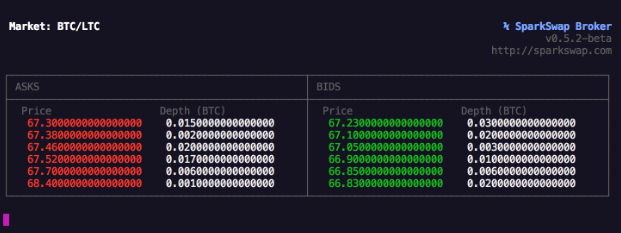
Sparkswap orderbook

To access the exchange, users need to download Sparkswap Broker, the exchange’s open-source software. This kit includes everything needed to bootstrap both a ₿itcoin and Litecoin full node, as well as ₿itcoin and Litecoin Lightning nodes for running payment channels. If you’re already running full nodes, then you’re free to use these, though Griffith said that, for now, the exchange’s inaugural users cannot leverage their own Lightning nodes or custodial Lightning services.

When we asked if the exchange will evolve to support other Lightning Network technology like Submarine Swaps in the future, Griffith said that the semi-on-chain nature of this technical trick doesn’t fit Sparkswap’s use case.

“Our focus is on making cryptocurrency trading fast enough for professional users without sacrificing ₿itcoin support and self-custody,” Griffith said. “Submarine Swaps by their nature are on-chain for half of the transaction, so while they provide an important service for the network (as evidenced by Lightning Loop), they don’t fit the needs of the product that we’re building [or] our users.”

Debuting at the outset of 2018, the Lightning Network continues to enjoy increasing developer activity and impressive growth. With technical solutions, wallets and services proliferating, as well as community initiatives like the Lightning Torch, Griffith believes that optimism has supplanted the doubt that used to surround the Lightning Network in the infancy of its construction. For him, Sparkswap harnesses both this positive outlook and the payment network’s great promise, and there’s not a better time to be working toward the future of ₿itcoin.

“I’ve been building on Lightning since late 2017 when it was still ‘never going to ship,’ so from my perspective these projects and efforts have been under the surface for a long time, but are now finally breaking through,” Griffith said. “Lightning is certainly not a finished product, but it has a ton of interesting applications, including near-instant cross-chain swaps like Sparkswap, that I’m excited to see get built out and gain usage. Collectively, we’re building the infrastructure that is going to power a ₿itcoin-based financial system, and that makes this a very exciting time to be in this industry.”

Published at Mon, 08 Apr 2019 20:28:06 +0000

Previous Article

Breez launches public beta of Lightning Network enabled bitcoin wallet

Next Article

The Week To Be In Crypto [04/08/2019] – Jonathan Tompkins – Medium

You might be interested in …

Russian National Arrested in Greece with Ties to Money Laundering, BTC-e, Mt. Gox Theft

Alexander Vinnik, 38, has been arrested in Greece on a U.S. warrant. While he is suspected of running one of the largest online money laundering operations, additional reports are emerging naming him as the mastermind behind the Mt. Gox heist that sent bitcoin spiraling out of control in 2013.


The Man Behind the BTC-e Exchange

For almost seven years, BTC-e has operated as one of the oldest digital currency exchanges in the world. During that entire time, the people behind the company have been completely anonymous.

Until today.

The alleged mastermind behind a multi-billion dollar money laundering scheme and, according to sources close to the exchange, a key person behind BTC-e has been unmasked as Alexander Vinnik, a Russian national who was arrested today in Greece. Vinnik is wanted in the United States on suspicion of money laundering at least $4 billion USD through bitcoin transactions.

Vinnik is currently being held in custody by Greek authorities pending a U.S. extradition request.

Greek police have stated:

An internationally sought ‘mastermind’ of a crime organization has been arrested. Since 2011 the 38-year-old has been running a criminal organization which administers one of the most important websites of electronic crime in the world.

With Vinnik’s extradition, the U.S. investigation will go into full swing. This is the latest in a series of U.S. efforts to curb cybercrime worldwide. Last week, a multi-national coordinated raid involving the U.S. and several other countries resulted in the takedown of the Darknet site known as Alphabay.

BTC-e have long been known for their lax regulations user identity verification and their uncooperative nature when it comes to anti-money laundering organizations. Perhaps coincidentally, the exchange has conspicuously been offline since last Thursday, with the website currently citing “unscheduled maintenance” as the cause of the interruption of service.

//platform.twitter.com/widgets.js

A feed of tweets from the BTC-e is on the site as well to keep users informed.

Ties to the Mt. Gox bitcoin Hack

Vinnik was also found to be in control of a sizable number of Bitcoins that could possibly be traced back to the hack of the Mt. Gox exchange back in 2013. A group of security experts known as WizSec published a blog post earlier today detailing how the hack took place. The group maintains that Vinnik has been their prime suspect in their years-long investigation into the bitcoin theft and that the same conclusions about his involvement were made independently by other teams working to uncover what really happened.

WizSec explains:

In September 2011, the MtGox hot wallet private keys were stolen, in a case of a simple copied wallet.dat file. This gave the hacker access to a sizable number of bitcoins immediately, but also were able to spend the incoming trickle of bitcoins deposited to any of the addresses contained. […] By mid-2013 when the funds spendable from the compromised keys had slowed to a near halt, the thief had taken out about 630,000 BTC from MtGox.

Mt. Gox Where is Our Money

Not only can the Mt. Gox coins be traced to Vinnik, but other less known heists can be traced to him as well.

According to WizSec:

Coins stolen from Bitcoinica, Bitfloor and several other thefts from back in 2011 and 2012 were all laundered through the same wallets.

Vinnik has denied all accusations against him in a Greek court of law. More information on this story will surely be released in the coming days, so make sure to stay tuned.

Do you think that Vinnik will be extradited to the States? Or will other countries try and lay their claim to prosecute? Let us know in the comments below, and make sure to check back at Bitcoinist.com for more information on this story as it unfolds.


Images courtesy of Japan Times, Reuters/Alexandros Avramidis, Shutterstock

The post Russian National Arrested in Greece with Ties to Money Laundering, BTC-e, Mt. Gox Theft appeared first on Bitcoinist.com.

Salon to mine monero with ad-blocking readers’ computers

Salon to Mine Monero with Ad-Blocking Readers’ Computers

Salon to Mine Monero with Ad-Blocking Readers’ Computers Adam James · February 14, 2018 · 7:30 am If you’re prone to running ad-blocking software, don’t be surprised to hear your computer’s fans start kicking it […]