subtitle: view & pure
Solidity has a concept called function modifier.
It creates additional features on function or apply some restriction on function. (decorates a function!)
The way to make a modifier is similar to the way to make a function.
modifier onlyOwner () {
require(msg.sender == owner);
_;
}
Instead of a keyword ‘function’, you could replace it to ‘modifier’ and insert underscore _ into modifier definition. As stated earlier, a modifier decorates the function. It could decorate(execute) first before original function, or after original function, or else.
Where to put underscore _ decides where to execute original function.(because of this feature, underscore is called to ‘placeholder’.)
Look at the modifier defined above,
Throughrequire(msg.sender == owner);
checks whether the address(msg.sender) is same with owner address defined on contract.
2. Through
_;
This is where the original function executed. (placeholder for where to execute original function.)
modifier can also be created directly by the developer, however there is built-in modifier on Solidity already.
The most commonly used function modifiers are view and pure.
view simply means “this function is read-only.” The function with ‘view’ modifier only executes without any data being written or overwritten.
function getKittyName() view {
return addressToKitty[msg.sender];
}
(The above function just returns addressToKittye[msg.sender] without any data being written. It merely reads the value.)
pure means a pure function, which is a function to return a value using only the parameter of the function without any side effects(bring outer variable and changes it).
function doCrazyMath(int num1, int num2, int num3) pure {
return (num1 + num2 * num3 % num1) * (num2 * num3) + num3;
}
(The above function returns a very odd math, but after all, it just returns the value using only the function’s parameter num1, num2, num3.)
Functional modifiers are very useful in defining a function briefly.
It will be much easier to understand if you look at cryptokitty’s contractor code.
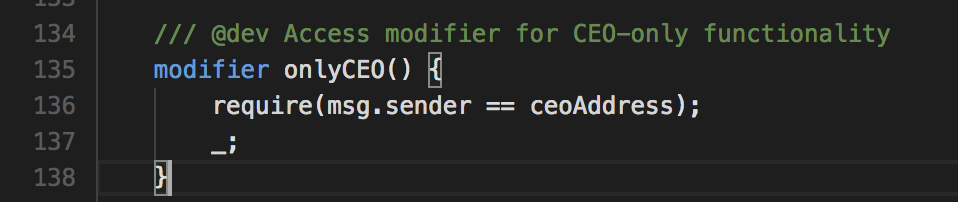 modifier onlyCEO
CryptoKitty has a modifier named onlyCEO, as the name suggests, “Only the CEO of CryptoKitty can execute this function.” (make a restriction on function)
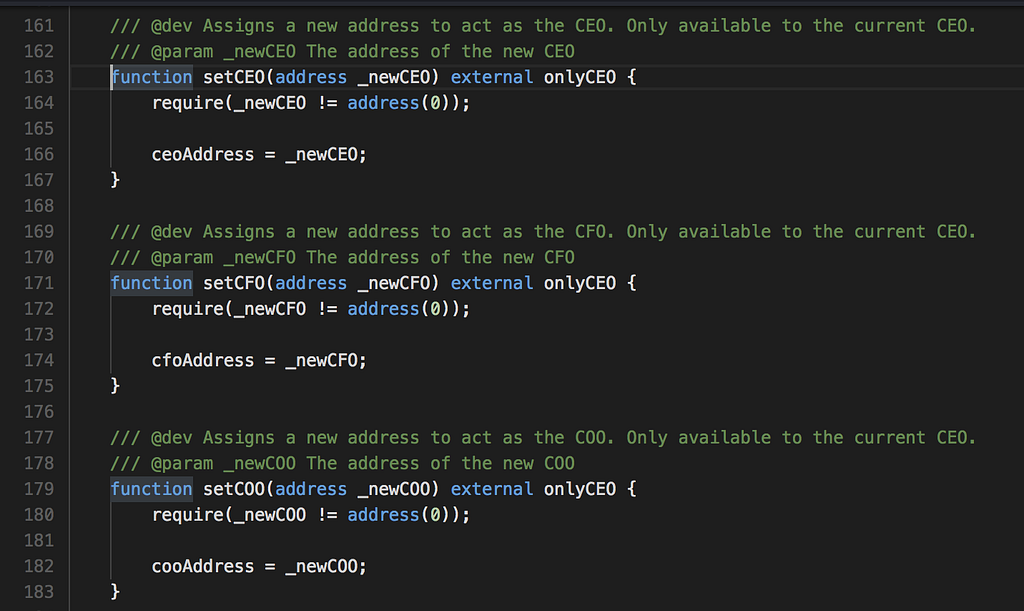 onlyCEO modifier usage
onlyCEO modifier is attached to setCEO, setCFO, setCOO functions. It means that only the CEO can appoints the CEO, CFO, COO.
Without these modifiers, all of the above functions would have
require(msg.sender == ceoAddress);
You should put it in all of those functions.
With function modifier in Solidity, you can make code both readable and concise. 🙂

 BitPay Merchants are now allowed to Accept bitcoin Cash PaymentsBitPay has integrated bitcoin Cash Payments for Merchants
Digital currency payment processor is now allowing it’s merchants to accept Payments. Previously, Bitpay has been supporting payments in (BTC). The Atlanta-based organization declared on Wednesday in its .
Merchants whoever decides to let the customers pay in either or through BitPay can receive their funds via direct bank deposits within next business day. The service would charge only one percent transaction fee, which will be charged by both networks.
BitPay announced:“bitcoin Cash will give BitPay merchants another option for receiving blockchain payments from users worldwide, without the risk of credit card fraud or chargebacks. And since bitcoin Cash costs only pennies (or less) for consumers to send, it’s great for BitPay merchants who want to accept blockchain micro-transactions for things like video games, food delivery, or app downloads.”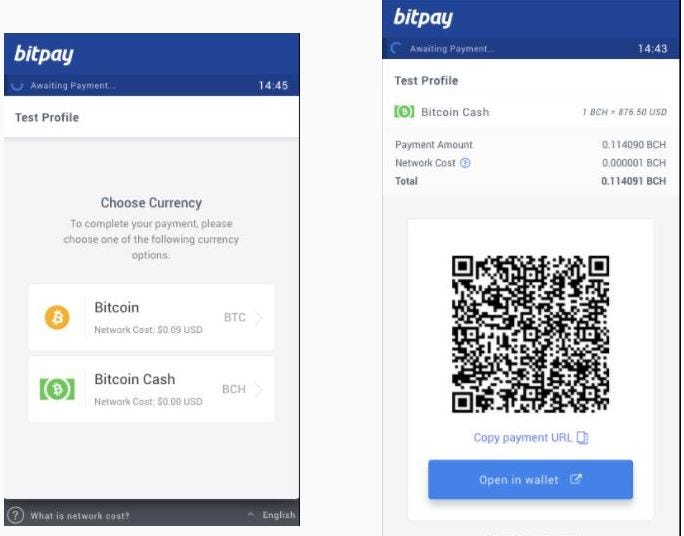
Adding bitcoin Cash support is a small part of a massive effort. To start supporting payment processing on multiple chains which would be determined on numerous chains those would be chosen on the network hashing power, security, usefulness for payments, adoption, and market value as key as the key factors depending on the blockchain payments that BitPay supports.
BitPay’s addition of bitcoin Cash on its platform also intends that BCH will be allowed to access the same tools and integrations that users already have. It also involves the capacity of using BCH tokens for purchasing gift cards in-app from and Brazilian e-commerce marketplace .
The initiative taken by BitPay seems to be an advantage for bitcoin Cash, which exchanges itself as a payment-friendly blockchain. As of now, bitcoin Cash is trading at $710, according to Coindelite .
To read latest news visit
 Power and Prosperity
New ICO Paradigm?
China Next-Generation Digital Economy
The largest Initial Coin Offering, ICO for short, will probably be the one Beijing Government is to launch in the coming months, according to local official newspapers, nevertheless it will not be the only one Blockchain-based project that is not based on crowdfunding, a very popular means by which funds are raised for a new cryptocurrency venture.
As a matter of fact crypto startups are releasing their own cryptocurrency during ICOs with a purpose of funding their projects built on the Blockchain. Ironically the Chinese Government is not willing to secure funding for its cryptocurrency project indeed, neither build an anonymous payment system, rather looking for a contemporary and secure way to control transactions on the largest market on earth, reflecting cunningly to the insatiable hunger of millions of Chinese netizens for digital tokens. The big takeaway here is China’s a rising, affluent economy. We’re seeing a complete rise of the consumer based on e-commerce.
But when momentum is high there is usually much more than meets the eye. A new project, first of its kind in China, called – as you very well guessed the “Eighth Continent” is the equivalent of China – is also launching its own ICO, and challenging the classic scheme of crowdfunding. Since the platform behind it, the Social Marketplace is ready to be rolled out once ICO closes, the purpose of this particular initial token sale is to organise a “Distributive Crowdsale” as the owners call the merits of their action instead of a classic crowdfunding.
What is a Distributive Crowdsale and in what is it different from a crowdfunding rally? If basic crowdfunding ICOs as a general rule are simply a win-win situation for investors and entrepreneurs, providing large returns in short time period on the one hand, and offering on the other easy access to liquidity and a much larger pool of investors, the Crowdsale seems to put the stakes higher. It is all about strategy and perks. If crowdfunding people get their share from the ICO to fund alleged development of their solution, based on the cutting edge technology of blockchains’ open ledger, claiming to build something they might not build after the ICO, the Distributive Crowdsale founders don’t get a penny from the ICO, token sold are distributed respectively to the buyers on 8th Continent platform directly. Then what is in it for the entrepreneurs? The Distributive Crowdsale is no mere charity: participants are asked to be active and trade digital products and assets on the 8th Continent Social Marketplace for a period of 88 days before they can get to their funds, or if they are busy they can buy the units of an equity investment trust involved in holding securities of the best performing companies on the marketplace with a core investment cycle of one year. Both ways investors’ funds converted to digital currency are transformed into working capital.
While the 0.8% transaction fee charged by the operator probably suffice to finance the platform and its related services, and maybe is a profitable venture for some, the trading business on the digital marketplace seems to be also lucrative for the investors for many reasons. The increase in value of the tokens purchased after the ICO driven by the buy ins of constantly growing trader community, and the profit users generate while trading, are probably the major ones. But there is another one more subtle: a substantially new business strategy shall prevent losses to all of those who chose to take part in it. The holy grail 8th Continent holds under his large sleeves is called ad fee sharing, or “overcoming the zero-sum game paradigm”. Instead of running a game where any quantifiable gains by one party are equal to the losses of another party, why not branding the digital products and services subject to be traded by the users, and let the advertisers pay a small amount which will be divided equally between the users and the operator? The idea seems pretty clever, even if not new, yet no stock exchanges or commodities markets implemented it though before .
We’d like to see what comes next; the ICO on April 18th for sure, to be launched on also available on ICO Bazaar or on Token Market, which will probably be an interesting investment for those who believe in the working product, and expect a substantial profit due to value increase of 8th Continent’s token, the ECB (8th Continent Bit) secured namely by the potential masses joining the platform in China the year to come.