SEC Suspends Trading in Securities of Crypto Exchange Bitcoin Generation
The Securities and Exchange Commission () has temporarily suspended in the securities of Generation, the government agency on April 29.
In a statement, the said the suspension will be effective from 9:30pm EDT on April 29 until 11:59pm EDT on May 10.
The said it had taken the decision “due to concerns about the accuracy and adequacy of information in the marketplace” surrounding its outstanding common stock, promotional activities and the impact they had on the market, as well as the company’s current financial condition. It added:
“The commission cautions broker-dealers, shareholders, and prospective purchasers that they should carefully consider the foregoing information along with all other currently available information and any information subsequently issued by the company.”
Brokers and dealers are being urged not to enter quotations relating to Generation’s securities unless they strictly comply with the commission’s rules.
The company is based in Oklahoma, and the has also said it has concerns “regarding the viability and valuation of a bond that Generation purportedly acquired from an entity based in the United Kingdom.”
This statement appears to relate to the of a €20 million bond in March 2018, which was worth about $24.4 million at the time and sourced from the London Stock Exchange. When the bond was announced, the CEO of Generation, Deniz Hadjiev, described it as a “small step in improving the financial situation of the company as we continue to build our operations.”
Last fall, the had the in securities of a Nevada-based firm that had falsely claimed that its crypto- activities were approved by the .
Bravado / Zcoin Interview – $XZC: A leading anon ‘privacy’ coin @BitcoinBirch (Twitter) interviews the COO of Zcoin, Reuben Yap. Zcoin is a leading privacy coin and Reuben shares with us some of his plans […]
A report by Cambridge University’s CCAF reveals that the number of people using cryptocurrency today has seen significant growth and rivals the population of small countries.
Global Cryptocurrency Benchmarking Study
The has recently published a research paper called , which examines several sectors of the global cryptocurrency industry, including exchanges, wallets, payment providers, mining and more.
The study was led by Dr.Garrick Hileman, senior research associate at the CCAF and a researcher at the Centre for Macroeconomics. According to the CCAF, it’s the first global research of its kind to systematically investigate all key cryptocurrency industry sectors based on non-public “off-chain” data.
The paper makes several key findings that challenge some of the erroneous concepts that many have regarding the cryptocurrency space and shows that digital currencies are becoming an increasingly important part of our society. Dr.Garrick Hileman wrote:
“The growing usage and range of capabilities we document in this study indicate that cryptocurrencies are taking on an ever more important role in the lives of a growing number of people (and machines” around the world. As we show in this study, the number of people using cryptocurrency today has seen significant growth and rivals the population of small countries.”
According to Dr. Hileman, a second paper by the CCAF focusing will also be launched in the following weeks. The paper is centered around the use of blockchain technology by more established industry players as well as at public sector institutions such as .
What’s in it
The study collected data from nearly 150 cryptocurrency companies and individuals, covering 38 countries from five world regions, including names like from Blockchain.info, from bitcoin.com and companies like , , , Unocoin, and others.
The CCAF carried out four online surveys from September 2016 to January 2017 and communicated with the companies and individuals involved in order to collect this data. For companies that did not contribute to the study, the dataset was supplemented with additional research and web scraping using commonly applied methods.
The counts with four sections, each covering one of the aforementioned industry sectors: exchanges, wallets, payments and mining. There are also three appendixes; the first one is an introduction to cryptocurrencies, the second offers a more detailed intro to the cryptocurrency industry and the third covers the geographical dispersion of cryptocurrency users.
Key Findings
The CCAF highlights the following findings as the key points of the paper:
The current number of unique active users of cryptocurrency wallets is estimated to be between 2.9 million and 5.8 million. (The majority of which are located in North America and Europe)
The lines between the different cryptocurrency industry sectors are increasingly blurred: 31 percent of cryptocurrency companies surveyed are operating across two cryptocurrency industry sectors or more, giving rise to an increasing number of universal cryptocurrency companies.
At least 1,876 people are working full- time in the cryptocurrency industry and the actual total figure is likely well above two thousand when large mining organizations and other organizations that did not provide headcount figures are added.
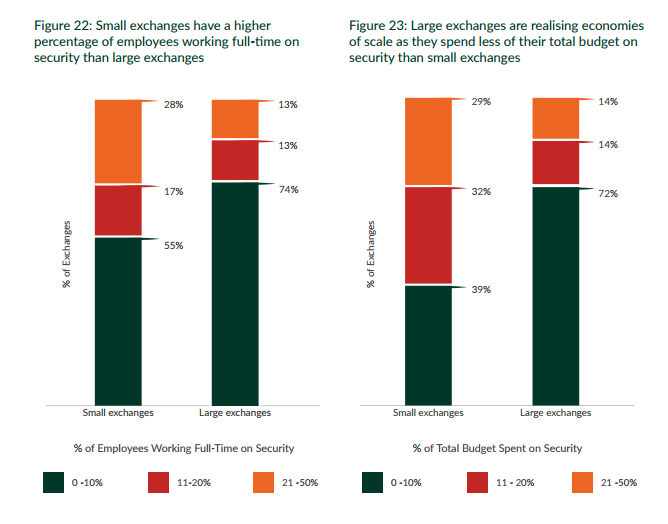
Average security headcount and costs for payment companies and exchanges as a percentage of total headcount/operating expenses are similar but significantly higher for wallets.
Exchanges
The exchanges sector has the highest number of operating entities and employs more people than any other industry sector covered in the study; a significant geographical dispersion of exchanges is observed.
52% of the small exchanges hold a formal government license compared to only 35% of large exchanges.
On average, security headcount corresponds to 13% of total employees and 17% of the budget is spend on security.
Wallets
The lines between wallets and exchanges are increasingly blurred; 52% of wallets surveyed provide an integrated currency exchange features, of which 80% offer a national-to-cryptocurrency exchange service. In contrast with exchanges, the majority of wallets do not control access to user keys.
Payments
While 79% of payment companies have existing relationships with banking institutions and payment networks, the difficulty of obtaining and maintaining these relationships is cited as this sector’s biggest challenges.
On average, national-to-cryptocurrency payments constitute two-thirds of total payment company transaction volume, whereas national-to-national currency transfers and cryptocurrency-to-cryptocurrency payments account for 27% and 6% respectively.
Mining
70% of large miners rate their influence on protocol development as high or very high, compared to 51% of small miners.
The cryptocurrency mining map shows that publicly known mining facilities are dispersed, but a significant concentration can be observed in certain Chinese provinces.
Do you think cryptocurrency use is growing? Have you seen indicators of increased mainstream adoption? Let us know in the comments below!
bitcoin Price Set for Major Bullish Breakout: Traders Advertisement According to sources who are analysing the current situation regarding the bitcoin price consistently, it appears that the cryptocurrency may be in line for a major […]