The Securities and Exchange Commission filed additional fraud charges against a third co-founder of Central Tech’s $32 million initial coin offering, which had been endorsed by boxing champion Floyd Mayweather and music producer DJ Khaled.
Raymond Trapani was charged with fraud in an amended complaint filed by the SEC on April 20. Centra’s two other co-founders, Sohrab Sharma and Robert Farkas, had previously been charged for their roles in allegedly promoting a , as BTCManager has reported.
Disgraced Trio Faces Possible Jail Time
In a separate action, the (through the U.S. Attorney’s Office in New York) filed criminal charges against Trapani, which means all three are now possibly on the hook for both civil and criminal wrongdoing.
In civil actions, the penalties are usually fines and bans on future securities trading, but criminal wrongdoing can result in jail time.
“The Centra co-founders went to great lengths to create the false impression that they had developed a viable, cutting-edge technology,” Robert A. Cohen, chief of the SEC Enforcement Division’s cyber unit, . “Investors should exercise caution about investments in digital assets, especially when they are marketed with claims that seem too good to be true.”

Centra Tech co-founders Sam Sharma, Raymond Trapani and Robert Farkas. (Photos: Twitter, LinkedIn)
In the SEC’s amended complaint, the agency accused Trapani of working with Sharma and Farkas to bilk investors through bogus marketing claims using fake executive biographies and lying about nonexistent relationships with major credit card companies.
SEC: Texts Show Intent To Defraud
The Securities and Exchange Commission said text messages exchanged among the defendants spotlighted their cavalier intent to defraud investors.
After receiving a cease-and-desist letter from a major bank that Centra falsely claimed it had a business relationship with, Sharma gleefully texted to Farkas and Trapani: “We gotta get that s*** removed everywhere and blame freelancers lol.”
In another text, Trapani asked Sharma to “cook me up” a false document touting fake credentials in order to get Centra’s bogus CTR Tokens listed on a cryptocurrency exchange.
While Floyd Mayweather and DJ Khaled were not charged, former SEC lawyers warned that celebrities who endorse sham ICOs could be , as BTCManager has reported.
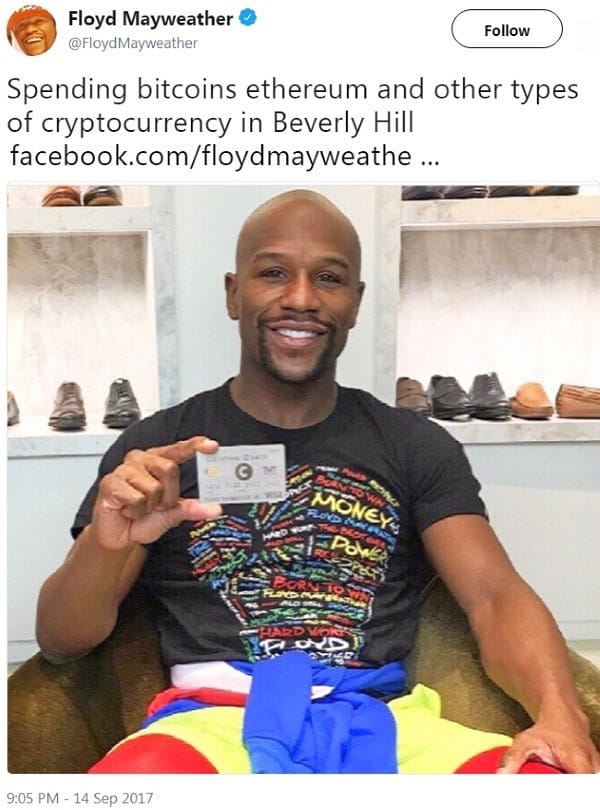
Boxer Floyd Mayweather hyped the Centra Tech ICO on social media. (Twitter)
Regulators around the world are cracking down on cryptocurrency fraud and have launched investigations into the decentralized, largely unregulated industry.
As BTCManager has reported, New York Attorney General Eric Schneiderman including Coinbase, Binance, Bitfinex, and Gemini, asking them to provide detailed information on their operations, internal controls, and safeguards to protect customer assets.
Kraken Refuses To Cooperate
While CEO Tyler Winklevoss issued a statement saying his platform will comply, CEO Jesse Powell defied the Attorney General’s request, saying Kraken will not complete the questionnaire. Powell called the inquiry “insulting” and abusive.
“The placative kowtowing toward this kind of abuse sends the message that it’s ok,” Powell tweeted. “It’s not ok. It’s insulting.”
Powell also sarcastically mocked the NYAG for being clueless about how business works.
“The AG’s tone-deaf response shows just how bad the disconnect really is,” Powell wrote. “Not only are they apparently experts in what legitimate businesses desire, they are also experts in what’s important to consumers.”
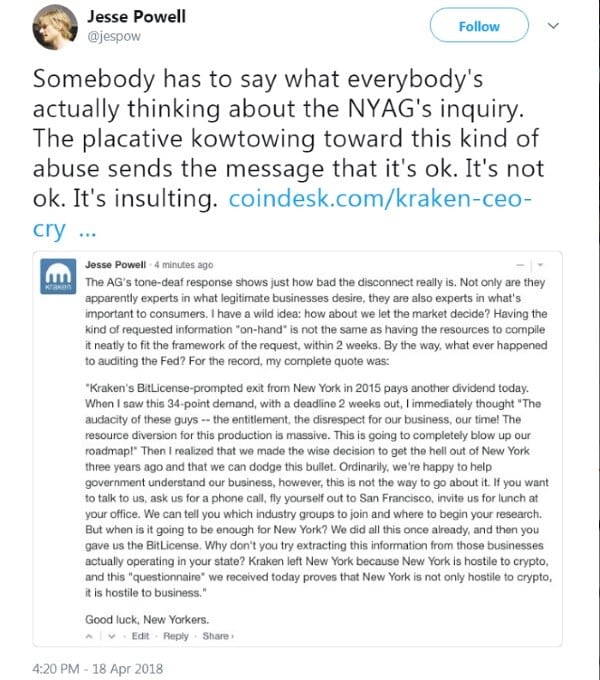
Amy Spitalnick, a rep for the NY Attorney General, issued a statement suggesting Kraken is acting like it has something to hide.
“Legitimate entities generally like to demonstrate to their investors that their money will be protected,” Spitalnick said. “This is very basic information that any credible platform should have on hand and be willing to share with their investors.”
The completed questionnaires are due by May 1. It will be interesting to see what kinds of responses the NYAG gets back, and which cryptocurrency exchanges refused to comply.
The post appeared first on .
With the rise of the digital age and the internet, it became seemingly more difficult for copyright holders to protect their work from unsolicited copying. Before digital books, CDs and torrents, there were mostly good old-fashioned paper books, vinyl records, and videotapes. The latter proved to be the most effective way of creating unlicensed copies. However, there was no efficient way to prevent people from putting a book in a Xerox machine or making a mixtape.
However, while the digital age seemed to make things worse for copyright holders, it gave them a weapon against pirates; DRM (digital rights management). While the internet proved to be highly efficient regarding spreading the content without any consent from its owners, encoding and crumbling data on CDs and files as well as putting digital watermarks on one’s work became a common practice as early as the nineties.
Restricting the Content
DRMs, however, were not as efficient as the copyright holders expected. They made things harder for pirates who now had to become hackers, but it sure didn’t stop them from making illegal copies. No measures, such as license code or protection against copying, seemed to work, they barely slowed the pirates down one bit.
Instead, DRMs made things worse for regular users who were not hackers in any shape or form. One of the most frequently cited concerns regarding DRM is that it prevents a user who paid for a licensed version of software of music to make a backup of what he or she already owns. When it comes to digital, things may become forever inaccessible to a user who had paid for them if a service is discontinued for whatever reason.
There are movements against DRM around the world, and some services such as Google Music provide their content DRM-free. Still, that is not the case for video games or films. For nearly three decades not much has changed, however, the rise of blockchain may change this for good.
Freeing the Content
The very essence of piracy doesn’t necessarily consist in the stubborn unwillingness to pay for content. Most pirate parties of the world have never spoken against remuneration for those who create it; instead, they insist that people have a right to access information or content without restrictions.
The restrictions in question are about the availability and accessibility of content. According to reports, over 60 percent of users who illegally download content online do it not for the sake of defying copyright holders. On the contrary, they claim that they would have paid for the content in question, but it was impossible. For instance, streaming services like Amazon Prime or Netflix impose heavy location-based restrictions on content items; in case of Netflix, the selection of available items varies with a country, while Amazon Prime offers only a handful of its own shows outside of the U.S. marking the rest of the world as unavailable. Though technically it’s not the same, conceptually such restrictions are quite like DRM; they restrict users, limit their choices, and effectively make them fully dependent on corporate decisions they have to way to influence.
The basic idea behind DRM is to protect the content from unwanted copying. However, the blockchain with its transparency and decentralization could change the way things are; it could involve users in the copyright instead of protecting it from them. A restrictive policy could give way to a policy of cooperation and trust.
Instead of licensing content for certain locations, blockchain tech could make any content globally available provided it is paid for. Its infrastructure fully allows for direct payments from users to copyright holders. Additionally, it could make all content cheaper to access by removing intermediaries.
Future of Content Consumption
However, the challenge is that blockchain as a technology is still quite young and untested. Nobody, not even the experts, are yet fully aware of what it’s capable of. Viable solutions are yet to be offered to a mass market.
The tide is changing, though. There are more and more projects and companies that embrace blockchain technology wishing to harness it for the sake of revolutionizing the entertainment industry.
DECENT, for instance, doesn’t limit itself to any particular sort of content and offers an uncensored environment for sharing videos, music, texts, and pictures. It employs blockchain tech to fully guarantee that no third party can control the distribution of content giving the reins in the hands of content creators. This solution, however, can be interesting mostly for bloggers.
, a project headed by established film producers, sales agents, and software developers, aims to roll out a browser plug-in that recognizes content streamed online and enable users to pay directly to the copyright holders anonymously. Once the content is bought, it becomes permanently available to the user. This solution effectively solves the problem of availability of any content without bringing the solution to the brink of legality.
View.ly is another project created by renowned entrepreneurs. They are making a social media-like platform for user-created video content in some ways similar to YouTube where all interactions between viewers and creators are ‘blockchainized.’ View.ly offers a pay-per-view system where authors can reward their loyal fans by granting them access to some premium content.
While this new industry can hardly be called mature, the trendiness of blockchain and the ever-growing request to make content consumption easier and more accessible are likely to change the way things are done in the copyright world. It’s not a matter of a few years, of course, but the next decade is likely to bring about very dramatic novelties in how all sorts of content are distributed and consumed. And, it seems, blockchain is about to play first fiddle there.
BTCManager does not endorse any content or product on this page. While we aim at providing you all important information that we could obtain, readers should do their own research before taking any actions related to the company and carry full responsibility for their decisions, nor this article can be considered as investment advice.
The post appeared first on .