
1 bitcoin = $4,175
Market Cap = $73 billion
bitcoin’s Daily Transfer Volume Close to Overtaking MasterCard’s
bitcoin moved $8 billion in the past 24 hours while MasterCard averages $11 billion a day.
In their recent quarterly report, MasterCard said they processed $4.4 trillion in the year to date, while bitcoin would be at about $3 trillion on a yearly basis if we extrapolate from the daily $8 billion – a level that is fairly common for BTC.
Ethereum comes a very distant second among cryptos, transferring “just” $600 million in the past 24 hours, bringing it to a yearly total of circa quarter of a trillion.
We can’t see Ripple’s data as they’re not really a public blockchain – or a blockchain at all – but all cryptos in combination probably transfer about as much value as MasterCard despite having a far lower capacity in transactions per second.

Visa handles far more at about $30 billion a day or $11 trillion a year according to their self-disclosed stats. That’s with a capacity of 65,000 transactions a second.
bitcoin can handle only about 7 tx/s on chain, or about 0.01% of Visa’s. Yet bitcoin transfers about 25% of Visa’s amount of value processing.
While credit cards handle small transactions, the media value of a bitcoin transfer is about $400, with the average being circa $27,000.
–
Fiat Backlash
One of the Eurozone’s Top Central Bankers Calls bitcoin “The Evil Spawn of the Financial Crisis” –
Banco de Mexico, attacking bitcoin on many fronts. As of last month, you must have a bank account to buy bitcoin. Using cash will be considered money laundering. –
———————————————–
Anti-bitcoin ideologues are getting increasingly violent.
Why can’t they peacefully advocate for their worldview like we do?
–
MINING
Hash Rate Declines Dramatically
In recent days, the price of bitcoin has been falling abruptly, to a level where a lot of the mining hardware that was produced and put online in 2018 is no longer profitable to operate.
The bitcoin hashrate has nearly halved over this period (from a high point of 62 million TH/s to a low of 34 million TH/s a couple of days ago), meaning that almost half of the total mining hardware that was operating in October has been brought offline.
–
CRYPTO ASSETS

Market Cap = $135 billion
Monero

At LA Cybersecurity Summit today, the FBI guy on the panel repeatedly mentioned that they can easily trace bitcoin, but Monero is not traceable and a huge problem for them.
It was in reference to cryptolocker style attacks — he said they usually take payment in bitcoin (which they can trace), but convert it to Monero at which point the trail ends because they cannot trace it. This was FBI Special Agent Justin Vallese.
–
Crackdown on Exchanges
Binance
Binance recently announced our partnership with Refinitiv, a KYC services provider. This partnership was formed more than a month after Binance partnered with Chainalysis for cryptocurrency compliance and investigation services. –
Bitmex
Bitmex been liquidating non compaliant countries’s account holders. –
Hodl Hodl
“We officially started both by ip and by preventing offers for the US locations from being created.”
——————————————-
“Decentralized” Exchanges
IDEX
First DEX implements KYC… “In addition to IP blocking, IDEX will be implementing KYC/AML policies in order to comply with sanctions and money laundering laws”. –
Radar Relay (0x Relayer)
Radar Relay bows to regulatory pressure from FinCen and implements KYC/AML checks required for Money Services Business. –
Shapeshift is dead: will require KYC/AML compliance from all users by the end of the year.
Next up: “DEXs” succumb as well. I bet at least one of IDEX, EtherDelta, Bancor, 0x add KYC restrictions by EoY 2019.
–
COMPANIES / PROJECTS / PRODUCTS
Microsoft Now the Biggest Company in the World
Since Satya Nadella became CEO, Microsoft has almost tripled its market cap to $850B+, and on Friday it replaced Apple as the world’s most valuable company. –
Sci-Hub
just keeps growing. It’s Napster for science: any paper instantly for free. –
Sci-Hub can instantly provide access to more than two-thirds of all scholarly articles
For some major publishers, such as Elsevier, more than 97% of their catalog of journal articles is being stored on Sci-Hub’s servers—meaning they can be accessed there for free.
Sci-Hub was able to fulfill requests 99% of the time—that suggests the 31% of articles that aren’t covered by Sci-Hub are things that people really aren’t requesting.
–
———————————-
Each legal challenge resulted in a spike in Google searches [for the site], which suggests the challenges are basically generating free advertising for Sci-Hub. I think the suits are not going to stop Sci-Hub.
This is the beginning of the end for subscription scholarly publishing. I think it is at this point inevitable that the subscription model is going to fail and more open models will be necessitated.
–
———————————-
Sci Hub has probably put us years ahead with our tech and that will yield compound returns in perpetuity.
I imagine that eventually a paper that cannot be accessed by all will be considered pseudoscience. No wonder that the most rigorous science (physics) goes straight to .
–
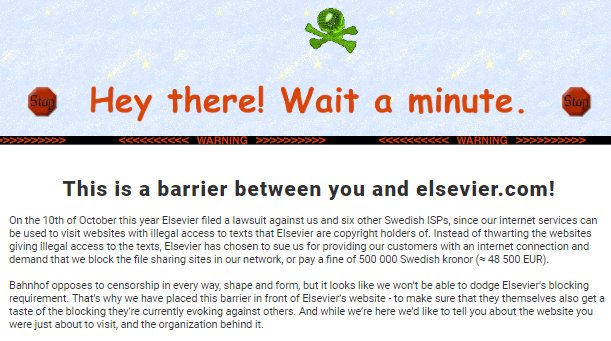
Publisher compels Swedish ISP to block Sci-Hub.
Swedish ISP responds by also blocking publisher’s website.
–
SpaceX This Year
We launched Falcon Heavy.
We launched version five of Falcon 9.
We were able to re-fly a rocket three times, which is great.
Next year, the exciting things are we’re gonna be launching astronauts for the first time to the space station. It’ll be the first time a vehicle from the United States launches astronauts into orbit since the Space Shuttle.
–
THE ASCENT OF MAN
Mars Landing
The InSight lander will study the interior of Mars and listen for Masquakes. –

NASA pulled off its eighth landing of a spacecraft on the surface of the Red Planet as the world watched on Monday.
The first few things the InSight lander did after its hot and harrowing six-minute descent through the Martian atmosphere included snapping a , then and beginning to unfurl its solar arrays.
“With the arrays providing the energy, we are well on our way to thoroughly investigate what’s inside of Mars for the very first time,” Tom Hoffman, InSight’s project manager at NASA’s Jet Propulsion Laboratory, said.

InSight Mars lander acquired this image using its robotic arm-mounted, Instrument Deployment Camera (IDC).
Elizabeth Barrett, who heads InSight’s instrument operations, told reporters that the process of setting the instruments on the ground alone will take two to three months, followed by another month or two to drill and begin getting science data back.
“Landing was thrilling, but I’m looking forward to the drilling ,” InSight principal investigator Bruce Banerdt said in a statement.
The probes and “mole” will dig as deep as 16 feet into the planet to measure internal temperature and to study Mars’ guts. –
Hyper Augmented Reality Informed by the Physical World on an Ongoing Basis.
People will be increasingly living in VR.
VR, telepresence, universal constructors…
Living in VR doesn’t mean retreat from the physical world [They could always in VR within the VR.] Even today, most astronomers are not physically located at their telescopes.
–
5G Holographic Call

Anne O’Leary, CEO of Vodafone Ireland, high-fiving Max Gasparroni, who was in Germany, using fully standardised 5G technology while on the first Irish international holographic call. –
Volumetric Displays: 3D Moving Images That Appear to Float in Thin Air
Alex Hein: 3D holograms aren’t happening till the 2030s
We’re REAL close though

Follow me on Twitter
bitcoin: 1FEZ3uksw8cjuwmLxaPtDePAr27S4q49CW
