March 16, 2026

Capitalizations Index – B ∞/21M

Samsung ASIC Chips – Positive News for Miners

Samsung asic chips - positive news for miners

Samsung ASIC Chips – Positive News for Miners

Samsung asic chips - positive news for miners

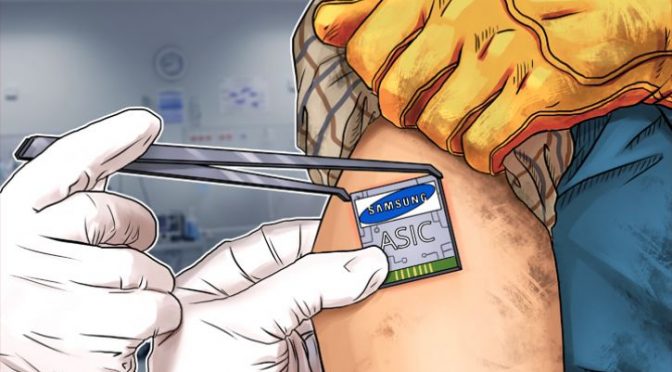
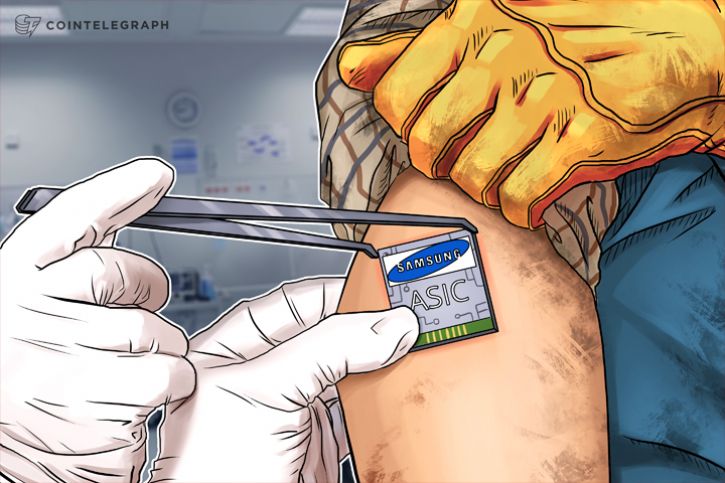
Technology giants Samsung are said to be entering the cryptocurrency world in a move that has positive ramifications for miners at large.

As reported earlier this week in Korean news outlet The Bell, the South Korean conglomerate will produce Application-Specific Integrated Circuits (ASIC) processing chips in its own foundry in a deal with Taiwanese manufacturer TSMC. Ironically, TSMC provides the ASIC chips used in Bitmain’s Antminers, but it’s new partnership with Samsung could well provide the first real competitor to Bitmain’s chip manufacturing ventures.

Bitmain’s stranglehold

Chinese mining giant Bitmain has long had a monopoly on the mining community. Having developed ASIC chips, Bitmain quickly turned the bitcoin mining game on its head.

ASIC miners, which are highly efficient at solving the SHA256 algorithm used to confirm transactions on the bitcoin blockchain, outperform traditional GPUs – which muscled hobby miners and their existing graphics cards out of the market.

With its own mining farms powered by its in-house, signature ASIC Antminers, Bitmain has become somewhat of a black sheep in the mining community due to its 29% global hashing power dominance through its Antpool and BTC.com mining pools.

The big dogs enter mining

Samsung’s foray into the cryptocurrency mining space has a number of ramifications for the mining community. It signals the arrival of a mainstream, global electronics conglomerate to the cryptocurrency space. Samsung has established itself as one of the top global producers of high quality electronics, and its looking likely that its ASIC chips will be highly efficient and powerful.

A number of mainstream tech firms may consider following suit – given the massive demand for ASIC mining units worldwide. One only needs to look at the demand for Bitmain’s flagship S9 Antminers. Recent batches launched on its website have sold out within minutes – highlighting the voracious appetite for quality ASIC miners.

A household name like Samsung further legitimises cryptocurrency mining as a viable business venture.  While it will almost certainly be a revenue booster for Samsung, the company shied away from making any financial predictions on its new venture. The true tester will be the mining community’s feedback once the new chips are launched.

Reports suggest that mass production of the chips began in January 2018, while Samsung are said to developing GPU mining chips which will be focused on altcoin mining algorithms. This could be a boon for Ethereum miners in particular, however further announcements will be needed to provide clarity there.

Samsung are said to be producing chips for the Chinese market first and foremost so it’s not clear when the rest of the world will have access to Samsung-powered ASIC miners.

Published at Wed, 31 Jan 2018 18:30:54 +0000

bitcoin

Previous Article

NordFX’s 1:1000 Leverage Offering Is a Revolution in the World of Cryptocurrency Trading

Next Article

Bitcoin Transaction Fees Are Pretty Low Right Now: Here's Why

You might be interested in …

Software Engineer, Frontend – Marketing

Software Engineer, Frontend – Marketing Kraken is one of the largest and most successful bitcoin exchanges in the world and we’re growing faster than ever…. krakenRemote From Kraken 6 days ago

BIP 91 Has Activated. Here’s What That Means (and What It Does Not)

BIP91.jpg

It looks as if bitcoin is getting Segregated Witness.

Bitcoin Improvement Proposal 91 (BIP 91) just locked in. Up to 90 percent of all hash power signaled support for this soft fork, which implies miners intend, in turn, to trigger Segregated Witness (SegWit) activation. By extension, this should make BIP 148 obsolete and August 1 a non-event.

But SegWit is not certain. In fact, on a technical level, SegWit is not any closer to activation at all.

BIP 91

Segregated Witness, defined by BIP 141, locks in if at least 95 percent of miners (by hash power) signal support for the upgrade within a two-week difficulty period. To do so, miners need to embed a piece of data called “bit 1” in the blocks they mine.

Importantly, this is technically the only way for SegWit to activate right now. And this threshold has not yet been met.

But there are alternative strategies to try and reach this threshold “indirectly” — like BIP 91.

BIP 91 is a bitcoin Improvement Proposal proposed by Bitmain Warranty engineer James Hilliard. It is compatible with the New York Agreement and backed by a number of bitcoin companies and mining pools. It is also compatible with BIP 148, another strategy to meet the BIP 141 threshold indirectly.

Miners have been signaling support for BIP 91 over the past couple of days through another piece of data, “bit 4.” Once 269 blocks within a 336-block window include bit 4, this BIP 91 soft fork gets locked in. This threshold was just met.

This means that after another 336 blocks, a little over two days from now, all BIP 91–compatible nodes will reject any block that doesn’t include bit 1.

As long as a majority of hash power enforces BIP 91, this majority should eventually control the longest valid chain according to all bitcoin nodes. And as this chain consists of bit 1 SegWit-signaling blocks only, it would in turn activate SegWit on all SegWit-ready nodes.

In that case, BIP 141 should lock in by mid-August, and SegWit should be live on the bitcoin network after a two-week “grace period” by the end of that month.

If all goes well …

What Could Go Wrong?

Although well over 80 percent of hash power has signaled bit 4 for BIP 91 activation, this doesn’t actually guarantee anything. Most importantly, it doesn’t in itself mean that these miners will signal bit 1 for SegWit.

Indeed, so far, most miners don’t. Currently, the proportion of miners signaling bit 1 is still far lower than BIP 91 activation would suggest. It is even lower than 50 percent.

Moreover, BIP 91 is probably being enforced by hardly any economically relevant nodes; that is, nodes operated by users that accept bitcoins as payment. Almost no bitcoin users on the network recognize BIP 91 or its bit 4 signaling at all, and will therefore continue to accept blocks with or without bit 1.

BIP 91 is, instead, enforced by hash power alone. This in turn means that a majority of miners (by hash power) could back out of BIP 91 with little more than reputational damage. They could continue to mine blocks that do not signal bit 1, even after BIP 91 activates in a few days. As long as these miners are in a majority, they will still control the longest valid chain: valid according to most miners, and valid to most users.

Furthermore, any minority of miners and the few nodes that do enforce the BIP 91 soft fork would then be forked off the bitcoin network. In a few days from now, these miners would mine (on top of) blocks that almost only they themselves would consider valid, while most of the rest of the entire bitcoin network would completely ignore them. These miners would be wasting their own resources.

With this week’s bit 4 signaling, a majority of miners have effectively made a statement that they intend to start to activate the SegWit soft fork within a couple of days. But for now, that’s really all it is: a very public, blockchain-based statement of intent.

Actual SegWit activation should start next week, if miners stick to their stated intent.

The post BIP 91 Has Activated. Here’s What That Means (and What It Does Not) appeared first on Bitcoin Magazine.