June 2, 2026

Capitalizations Index – B ∞/21M

Ripple’s XRP Market Cap May Be 47% Lower Than Advertised

Ripple’s xrp market cap may be 47% lower than advertised

Ripple’s XRP Market Cap May Be 47% Lower Than Advertised

Ripple’s xrp market cap may be 47% lower than advertised

Ripple, the company behind XRP, may be overstating the digital token’s real market cap by as much as 47 percent, according to cryptocurrency data company Messari. 


A Hole in the Plot

According to a new Messari report, the total circulating supply of XRP 00 is 21.8 billion. This differs significantly from data provided to third-party crypto data services such as CoinMarketCap, where the displayed circulating supply is around 41 billion XRP at the time of writing this.

The same is true for the cryptocurrency’s total market capitalization. The report suggests that the real market value of XRP is $6.9 billion against the widely reported $13 billion, based on the current USD-XRP exchange rate.

The report outlines that Ripple hasn’t shared any methodology or reference exchange data it uses in order to calculate the trading volume of XRP.

Additionally, more than 99% of the trading volume is apparently coming from overseas exchanges, where many of them have been suspected of wash trading.

Ripple’s xrp market cap may be 47% lower than advertised

Where Does the Difference Come From?

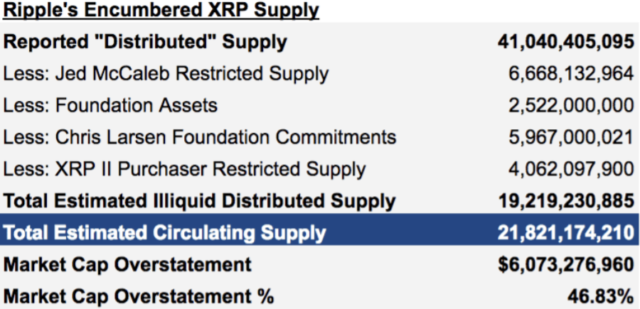
The reports states that 19.2 of the 41.0 billion XRP currently quoted as ‘in circulation’ may either be illiquid or subjected to ‘”significant selling restrictions.”
Ripple’s xrp market cap may be 47% lower than advertised

These include 6.7 billion XRP locked up on selling restrictions on co-founder Jed McCaleb.

An additional 5.9 billion XRP has been publicly committed but not donated to RippleWorks by the co-founder Chris Larsen.

The report also estimates 2.5 billion XRP held under selling restrictions on the wallet addresses of RippleWorks.

Lastly, the 4.1 billion XRP, which are sold through the company’s money services business called XRP II since 2016, could also be subject to re-selling restrictions.

What is more, the report also says that these estimates may be “conservative.”

Persistent Sell-Side Pressure

The “illiquid” XRP, as quoted by Messari, combined with the 59 billion XRP that’s held on Ripple’s own balance sheets, could create ‘persistent sell-side pressure’ on the market, according to the researchers, depending on the structure of the above selling restrictions.

Additionally, Messari is not the first to draw attention to Ripple’s valuation. Earlier this month, Bitcoinist reported that hedge fund chairman, Bill Miller, expressed concerns over Ripple, calling its XRP token “way overdone.” He explained:

The XRP thing doesn’t have to be used on the Ripple network; you can use other things… If you look on Coinmarketcap.com it says there are 38 billion of them but there’s actually around 100 billion because the company has retained 61 billion on their own balance sheet.

In the meantime, talking to CNBC’s Arjun Kharpal at the World Economic Forum in Davos, Ripple’s CEO, Brad Garlinghouse, argued that XRP is more scalable and faster than Crypto [BTC]. Nevertheless, he admitted to still owning bitcoin [BTC] as it’s likely not going to zero.

The reason? He thinks it may become a store of value.

What do you think of Ripple’s potentially inflated market cap and circulating supply? Let us know in the comments below!


Images courtesy of Messari, Shutterstock

The post Ripple’s XRP Market Cap May Be 47% Lower Than Advertised appeared first on Bitcoinist.com.

source: https://bitcoinist.com/ripple-xrp-market-cap-lower/

Published at Fri, 25 Jan 2019 14:00:08 +0000

Previous Article

Long Term Investing Is Your True Advantage

Next Article

Ripple CEO Adamant That Bitcoin [BTC] BTC (BTC) Won’t Collapse To $0

You might be interested in …

Le NASDAQ prêt à ouvrir un exchange de cryptoactifs

JournalduCoin.com Le NASDAQ prêt à ouvrir un exchange de cryptoactifs Le Nasdaq, deuxième plus grand marché d’action des États Unis, capitalisé à plus de 9 milliards de dollars, s’intéresse de près aux cryptomonnaies. Suite à […]

Social Messaging App Kik Will Bring Crypto Tokens to Teen Market

Social Messaging App Kik Will Bring Crypto Tokens to Teen Market

Chat platform Kik has revealed that it is launching its Kin token that will deliver the basis for a decentralized ecosystem of digital services.

Ontario-based chat platform Kik, which has over 300 million active users registered worldwide, including around 40 percent of American teens, has announced today that it is launching its Kin token, a digital currency that will provide a foundation for a decentralized ecosystem of digital services.

Today’s technology has meant that it is impossible not to stay connected with friends and family worldwide with many using messaging apps to do so.

So much so, that by 2019 more than one-quarter of the world’s 7.5 billion population will be using messaging apps, according to data from eMarketer.

Aside from being a cheaper alternative to SMS and MMS, messaging apps are big business that offer a slew of functions: group chats, gaming, GIFs, videos, stickers, emojis, photos and in-built web pages. Not only that, but a majority of messaging apps users are young, which is an extremely important demographic for messaging apps.

Kik believes that through its token it can bring together the areas of communications, information and commerce in a new way that will fuel how today’s generation and future ones will connect. Founded in 2009, Kik was the first chat app that went viral in 2010 from zero to one million users in 15 days. Since then the company has continued to meet the innovation space by becoming the first chat app to become a platform in 2011 before establishing itself as the first app within the Western world to add bots in 2014. Now, Kik is the first chat app to add its own digital currency.

Speaking to bitcoin Magazine, Ted Livingston, Kik’s CEO said that the main motivation for launching their Kin token, which comes from the word “kinship,” came down to two main insights: digital services, which are becoming more important to our daily lives, and the fact that these services are being owned and controlled by fewer and fewer companies. This, in turn, is bringing about less innovation and choice. According to Livingston, this centralization is the result of both economics and competition.

“From an economic side, it’s very hard for independent developers, including companies as big as Kik, to monetize,” he said. “There are a few companies that have huge scale that use that scale to monetize their advertising.”

Livingston adds that, when these bigger companies monetize their advertising, they then give everything else away for free. This means that for independent digital services who don’t bring in enough money through advertising, they live in a world where these giants have set the expectations where everything should be free.

“As a result, it’s very hard for all these digital services to monetize,” Livingston adds. “Those that do, these giants then turn to a copy-and-crush strategy where they take all the ideas from the players, copy it and use their much larger resources to crush the other competitors who do make it.”

As a result, Livingston states that now is the right time to put forward an alternative ecosystem of digital services that isn’t just open, but through digital currencies and decentralization, better. By launching their Kin token, Kik is attempting to set up a new economic system that can monetize digital services and deliver a new way to compete together with the larger companies.

The Kin Token and the Kin Foundation

Through the advanced developments in digital currencies and the blockchain, Kik is planning on creating a decentralized ecosystem of digital services through four steps: creating the Kin token on Ethereum, integrating Kin into Kik, developing the Kin Rewards Engine and launching the Kin Foundation.

Implemented on the Ethereum blockchain as an ERC20 token, Kin will serve as the basis of interoperability for all transactions within the Kin ecosystem. By adopting the token within the Kik app, it’s hoped that millions of users will facilitate widespread adoption of Kin, establishing demand and value for the cryptocurrency. In preparation for the eventual launch of Kin, Kik has been experimenting with the integration of a cryptocurrency on its platform since 2014.

“In 2014, we launched an experiment called Kik Coins and the question we were trying to answer was: Could we get millions of everyday consumers earning and spending natively in a digital currency?” Livingston said. “The result is that we created a transaction volume that was three times better than bitcoin’s global transaction volume at the time.”

Kik also realized that the best way for consumers to understand cryptocurrency was for them to earn it through digital services like Kik.

“The biggest flaw with all the other cryptocurrencies is that nobody gets their paycheck in that cryptocurrency; the only way to get it is to buy it, for 99.99 percent of people,” he added. “This is where teenagers are another big asset for Kik in that they don’t have a ton of spending power and this is a way to earn that spending power by offering value inside the community itself.”

Over time, Livingston explained, there will be various ways that users can earn Kin. One of the examples he gives is through exclusive group chats by charging an entrance fee with Kin to then spend within the Kik ecosystem.

Kin Distribution

Kik is planning on starting a crowdsale where the amount of Kin tokens available will be $1 trillion. However, the majority of the Kin will be set aside to form the Kin Rewards Engine. Modelled similarly to the bitcoin mining system, the Kin Rewards Engine will release a certain amount of Kin every so often to all the developers that build digital services within the ecosystem.

“Every day there will be a daily reward, which we think will start roughly at $100,000 per day,” he said. “As an owner of a service, if you integrate Kin and get people transacting Kin inside your digital service, which generates 10 percent of all transactions within the ecosystem, that would entitle you to 10 percent of this daily reward.”

Ultimately, the more services that join the Kin ecosystem computes to more transactions that happen each day, which increases Kin’s value on public exchanges and, in turn, boosts the daily reward.

“It creates this amazing network effect where all these digital services work together to grow the overall value of the ecosystem,” Livingston adds. “They all get a fair and equitable piece of that economic value they create, and consumers get this ecosystem of services that continues to grow in both size and quality.”

According to Livingston, one of the most underappreciated values of digital currencies is how much economic opportunity they can produce. For instance, he said even though they are giving away $100,000 per day, the amount of Kin available won’t run out anytime soon.

“If Ethereum was giving out $100,000 of Ether a day at its current $10 billion market cap, it would take them 273 years to give away all the Ether,” he said. “If bitcoin was doing it at their $30 billion market cap, they could give away $300,000 a day for 273 years, and these are both cryptocurrencies not used by mainstream consumers.”

As such Livingston believes that the Kin reward could easily go to $200,000, $500,000, even $1 million a day, incentivizing the creation of an open and compelling ecosystem of digital services for consumers.

Through the Kin Foundation, the team are ultimately trying to achieve a decentralized system where the developer doesn’t need to trust the Kin Foundation. As a nonprofit, the foundation will oversee the open and fair growth of the system where it will provide three things: it will administer the rewards system, it will offer an identity service for users to move between the digital services and it will provide a transaction service for users to earn and spend Kin in a secure and frictionless way, Livingston states.  

Kik is due to release their whitepaper today, at which point they expect to start working with the crypto community, which will lead to their crowdsale in the next few months.

The post Social Messaging App Kik Will Bring Crypto Tokens to Teen Market appeared first on Bitcoin Magazine.

Re: any exchange with transfer inr with wallet support

Re: Any exchange with transfer INR with wallet support

Re: Any exchange with transfer INR with wallet support Withdrawals to bank can take some time but this would generally lead to faster deposits in exchange account + it can be 24/7 service. True. But […]