
Hyperledger is an open source collaborative effort created to advance cross-industry blockchain technologies. On March 28th, had joined the project, and amongst them, was Ripple (XRP). This brings the Hyperledger community to one that has 231 organizations in more than 25 countries from all over the world.
Ripple’s Chief Technology Officer (CTO), Stefan Thomas, was emphatic about the partnership and was quoted as saying:
“Through our partnership with Hyperledger, developers worldwide will be able to access Interledger Protocol (ILP) in Java for enterprise use. The Hyperledger Quilt project connects Hyperledger blockchains with other ILP-capable payment systems such as XRP Ledger, Ethereum, bitcoin (Lightning), Litecoin, Mojaloop and RippleNet, helping us to deliver on our vision for an Internet of Value – where money moves as information does today.”
Stefan Thomas has been part of the ripple team since its founding and was initially a senior engineer. He took over as CTO in June 2013 and has helped shape the company’s vision of the ‘Internet of Value’. , an ‘Internet of value’ is a world where money and other assets move as freely and efficiently as information moves today.
By partnering with Hyperledger, Ripple extends on that vision of shaping the ‘Internet of Value’. The Hyperledger blockchains are . This means that only members of the Hyperledger community are allowed to access the sensitive private blockchains. The members of the community are brought together this way through open source software only accessible to them. They in turn share knowledge and experience – in the name of technology – to bring faster and better solutions through collaborative efforts.
Other organizations that joined Hyperledger include: Beijing Truth Technology, Blockchain Technology Partners, CULedger, Greenstream Technology, KompiTech, MATRIX Foundation, REMME, Shenzhen Rongxun Technology, Spin Systems Inc, Versia and Xiilab.
They bring the total of organizations in Hyperledger to 231 that include leaders in finance, banking, Internet of Things, supply chain, manufactureing and technology.
The post appeared first on .
 AirAsia to begin with Cryptocurrency-Based Rewards ProgramCryptocurrency-Based Rewards Program to be started by AirAsia
chief executive Tony Fernandes announced that AirAsia is going to start the reward program of its platform which is called BigCoin. The purpose behind this program is to increase the airline’s digital services and to update the company toward a cashless system.
Click below to view full post:

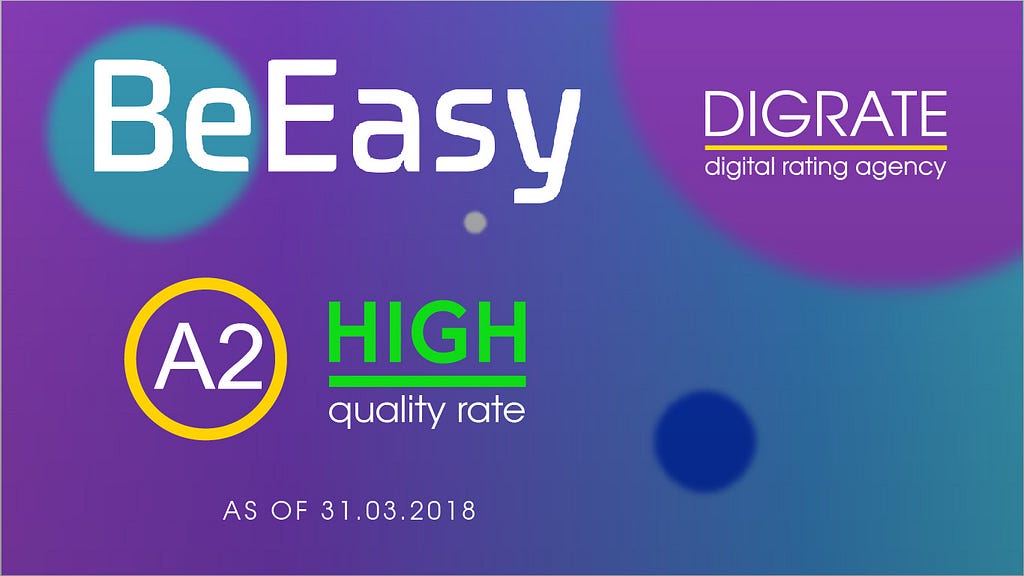
The first professional digital rating agency DigRate has assigned A2 investment attractiveness score to BeEasy project (High quality rate). Experts believe that the level of project development potential is above average, and the project demonstrates medium-to-high probability of long-term investment return. The project team plans to create a single platform of interconnected services for working with cryptocurrencies with a clear functional and user-friendly interface that will be accessible even for beginners.
The ICO will be held in April-May 2018.
BeEasy should become a universal complex ecosystem, ерфе includes services for convenient and effective activity in the crypto world. Line of products: mining pool, crypto exchange and crypto fund. Project’s ‘know-how’ innovative solution is providing the best possible links between different services and intuitively navigated interfaces for all user groups, that is important for involving new people in crypto economics.
The main company’s product is the EasyPool mining service. Experienced miners will be able to help the project with both the capacity of their data center and flexible settings for mining on the user’s personal equipment via the BeEasy mining-pool. Beginners will be attracted by low threshold for entering, a convenient interface, as well as the ability to mine not only cryptocurrencies, but real goods and services from the partner catalog within the EasyPlay service. The element of social responsibility and interaction with charitable foundations is an important project part, therefore, an agreement on partnership with the “Rybakov Fund” was concluded. The team also plaтs to establish partnership with the Red Cross and the Wildlife Fund.
The auxiliary EasyTrade module is aimed at experienced participants of the crypto-currency community and traders, the module will enable them to trade through classical exchange terminals and use algorithmic trading strategies through the API module. EasyTrade plans to develop a simple and transparent way of converting crypto assets into fiat currencies and creating portfolios.
The exchange will be connected to an automated liquidity management system (EasyFund) where the algorithm will implement portfolio management. Information about automated algorithms for managing incoming funds is missing.
The business model of the project is described in sufficient detail. The main sources of income, the advantages of internal ETKN tokens owning, the principles of cooperation with online and offline partners are indicated. There is a clear roadmap with a detailed description of the platform development. The team has already completed about 40% of the tasks set by the project. The development of the project is carried out in the time allotted for each stage of the roadmap. There is an operating version of the key EasyPool module. Nevertheless, DigRate experts note that the financial plan of the project needs to be finalized.
Settlements are possible in ETKN tokens and other cryptocurrencies. The incentive for using ETKN will be a 50% discount on services and purchasing power at cost price from the data center, also known as ‘cloud mining’. BeEasy will also provide the opportunity to mine a particular product (provided by a partner). The issuance of ETKN tokens within the crowdsale is strictly limited. The total number of tokens will be no more than 250,000 ETKN. The unrealized at the EaryBird, pre-ICO and ICO stages tokens are subject to destruction.
Soft cap is absent, and the hard cap is 3200 BTC (80% of all issued tokens) that looks inflated, according to experts. There are no tools (for example, the use of an escrow) that would guarantee the return of investments, if the stated usage of funds is not followed.
The project is not popular on social networks. Attracting a wide audience through traditional social platforms is critical for the development of the project since a significant part of the target audience are users who are unfamiliar with blockchain technology and are newbies in crypto industry. Social activity of the project in Telegram, Youtube, Facebook, Twitter, and BitcoinTalk is at an extremely low level. Nevertheless, the team declares that they are working on project’s popularity and promises a significant increase in subscribers by the end of the ICO.
Information about the project is published in many blockchain news resources. The BeEasy platform is actively promoted at various conferences and forums.
The team is balanced, and members’ experience corresponds to the project goals. The team consists of programmers, marketing specialists, as well as specialists in financial management. However, it cannot be said that the team has extensive experience in the implementation of blockchain projects. The Advisory Board consists of specialists with over 10 years experience.
DigRate experts believe that the team has sufficient resources, knowledge, experience and support to successfully implement the BeEasy project, whose mission is to contribute to the development of a decentralized economy by involving the maximum number of users.
A full with an investment evaluation can be found on the official website:
Follow us on , , and !

![Ethereum [eth/usd] price analysis: bulls lose control after constantinople hard fork](https://ohiobitcoin.com/storage/2019/03/Screen-Shot-2019-03-01-at-1.09.04-PM.png "Ethereum [eth/usd] price analysis: bulls lose control after constantinople hard fork")