Ripple came under attack during a UK Parliamentary hearing in the UK that discussed cryptocurrencies and blockchain technology on May 1.
Ripple Under the Spotlight
The attacks didn’t come from members of Parliament, but rather Martin Walker and FT Alphaville editor Izabella Kaminska who spoke before the Treasury Committee. The pair also submitted saying that within the crypto sector, , Tezos’ ICO and raise some red flags.
These ‘red flags’ were categorized as, ‘1) Investment classes that have little or no possibility of generating a positive return, except for investors who benefit from arrival of new investors bringing in additional funds, 2) Layers of complexity to hide the true nature, risks, revenue streams or beneficial owners of investments, 3) Structured to deliberately avoid (or attempt to avoid) the application of existing laws and regulations… and 4) Highly asymmetric information between investors and the organisers/beneficiaries of the scheme.’
Ripple raises ‘all four red flags,’ monero raises one red flag due to its anonymous nature according to the statement.
Martin Walker is the director for Banking and Finance at the Center for Evidence-Based Management, a nonprofit that provides resources and support to those interested in learning about evidence-based practice and decision making. While most of Walker’s experience has been in the IT and finance sector, Walker also was a former employee in product development for the blockchain-based startup . His involvement with the corporation was a brief nine months, from April 2016 to December 2016.
Walker: Ripple Offers “Little to Nothing”
Walker that “in terms of demonstrable benefits” has for financial services and banks, there’s “little to nothing.”
“All that it takes to make a credible idea into a fad is people just switch off their brains and stop thinking. Over 20 years in and around the banking industry — blockchain is a fad, but I have seen many fads in my career. If 10 percent of what I’ve heard in my career had come true, we would have these amazing banks that run for £1 a week.”
Walker states that when it comes to payments, doesn’t make things more efficient, but acts as an intermediary and increases the number of hoops you have to go through:
“Ordinarily, a bank would send a SWIFT message to another bank telling it to make payment from its account. Now what I’ve actually seen from some of the Ripple demonstrations is that we bring along the Ripple technology, you send a message, the same message up to your infrastructure goes into Ripple, and comes out the other side. So you’ve just added an extra layer of complexity.”
He also stated that it’s inaccurate to discuss blockchain technology as a singular entity since essentially each cryptocurrency is a tweaked version of the original blockchain by Satoshi Nakamoto.
Despite his negative outlook on both Ripple and blockchain tech as a whole, he does recognize that the hype surrounding it has provided a catalyst for banks, an industry typically known for its slow reception to change, to begin updating certain offerings.
Zagone: “There’s not a Direct Connection Between Ripple the Company and XRP”
Ripple’s director of regulatory relation Ryan Zagone rebutted Walker’s claims that the XRP token offered ‘no purpose,’ saying that “XRP is open source and it was not created by our company, so that existed as an open source technology. We created a company that was interested in modernizing payments and then began using that open-source tech to do so.”
Zagone also went onto :
“We didn’t create XRP … What we do have is we do own a significant amount of XRP, it was gifted to us by some of the open-source developers that created it. But there’s not a direct connection between Ripple the company and XRP.”
Lawyer Preston J. Byrne pointed out that the statement ‘there’s not a direct connection between Ripple the company and XRP’ does not make any sense on Twitter, pointing to the portal to buy XRP on the Ripple website, the 55 billion XRP in Escrow by the company, among other facts.
"There's not a direct connection between Ripple the company and XRP."
— Preston Byrne (@prestonjbyrne)
The price took a slight dip in light of the hearing, dipping to a low of $0.84 but has stabilized to around $0.85, after reaching a 24-hour peak of $0.87.
The full hearing can be found .
The post appeared first on .
The controversial darknet markets facilitate anonymous e-commerce on the unindexed part of the web, allowing users to pay with cryptocurrencies. Surprisingly, although the underground market may not be mainstream, it oversees billions of dollars in transactions in exchange for drugs, hacking services, and adult content.
Reddit’s DNM Plug Pull
The , without a doubt, is the largest, elaborately-built, e-commerce ecosystem operating outside the knowledge of the average person. However, for most who foray into its pseudonymous depths, an abject lack of information regarding “trusted” sites presents itself.
Earlier in March 2018, social forum, Reddit on r/darknetmarkets, a popular subreddit which shared information about reputed vendors, trustworthy sites, and security practices. The subreddit was perhaps the largest accessed source of information about the darknet markets on the world wide web, and its demise has users in a tizzy, with verified information nowhere to be found.
After controversial shutdown in 2013, observers of the industry questioned if the digital currency could survive without the support of the underground drug-markets. Afterall, the darknet significantly contributed to the pioneer cryptocurrency’s popularity and played an integral role in defining the utility of cryptocurrencies.
To fill the gaping hole of informational deficit, BTCManager took a dive into darknet research and is excited to share the most “verified” websites with our readers.
The List of “Verified” DNMs
Contrary to popular belief, the dark market extends to more than recreational substances and includes designer brand merchandise, credit cards, and even first class-upgrade points; all payable with cryptocurrency.
Referring to the Deep Dot Web (DDW) , which rates sites based on commission, security features such as 2FA, multisig, forced PGP, audience feedback, duration of business and product range, here’s a list of the dark web’s most visited e-commerce markets.

(Source: )
Regarded as the dark market’s “oldest” e-commerce website thus adding several magnitudes of credibility, Dream has been operating since 2013 and hasn’t been victim to a Silk Road-like takedown.
Any instance of a (rare) exit-scam by vendors is quickly reported to DDW, with the vendor promptly disqualified shortly after. The site screens all sellers and requires a verification process as a mandate. The site offers a variety of products, such as credit cards, branded accessories, and reportedly has over 63,000 recreational substances listed on sale.
Interested parties can pay with , , and privacy-centric , and parcels usually take a couple days to a couple weeks depending on shipping. Dream has a 4.1 rating from 1,600 customers on DDW, with most expressing a positive sentiment.
In case someone wishes to pull off a James Bond movie, Dream sells identities for only 0.8 BTC, complete with a passport, official documents, and registered citizenship.
(Source: )
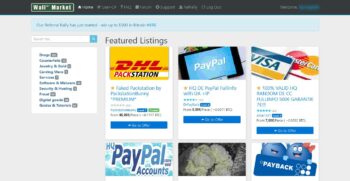
The decentralized world’s nemesis – the equity, derivatives, and security-laden Wall Street – actually has a namesake ally on the darknet, which is highly regarded.
Wall Street boasts of 3,000 vendors and over 400,000 customers who visit the marketplace who purchase recreational substances, banking accounts, and hacking software in exchange for bitcoin and monero. The site has a 4.2 rating on DDW, with most reviews expressing satisfaction from the Wall Street shopping experience.

(Source: )
Based in Russia, Point is a relatively new marketplace but quickly gained credibility in the community. Founded in 2015, the platform allows buyers to “pick-up” a delivery from a location of their choice, thus eliminating the lengthy shipping process if possible.
The site maintains a 3.7 rating on the DDW, with several customers reporting the site’s downtime since a couple of days at the time of writing. Nonetheless, Point facilitates the sale of credit cards, hacking services, branded products, alcohol, and recreational drugs, and accepts bitcoin, monero, and even litecoin.
Stay Smart! Stay Safe!
In case you are surprised with the small list, please note that the dark market features more than a 100 e-commerce websites, which are unfortunately questionable and have their corresponding ratings suggesting a below average customer experience.
The market is not full of only illicit e-commerce, as one can purchase legally harmless things like YouTube dislikes.

(Source: )
As advice to readers, BTCManager highly suggests the use of a VPN service to access the darknet, and to not download any questionable links – high probability of a phishing attack!
Disclaimer: This is intended to be an educational article, with no intention of promoting any of the mentioned sites or their products. BTCManager does not condone the use of recreational substances or other unethical services. Please check local city laws before making any purchase.
The post appeared first on .