Ripple Price Analysis: XRP Rally Unwinds But Not Likely Over
Ripple price gained traction and broke the $0.3400 resistance area before sellers appeared against the US dollar.
The price topped near the $0.3460 level and later started a sharp downside correction.
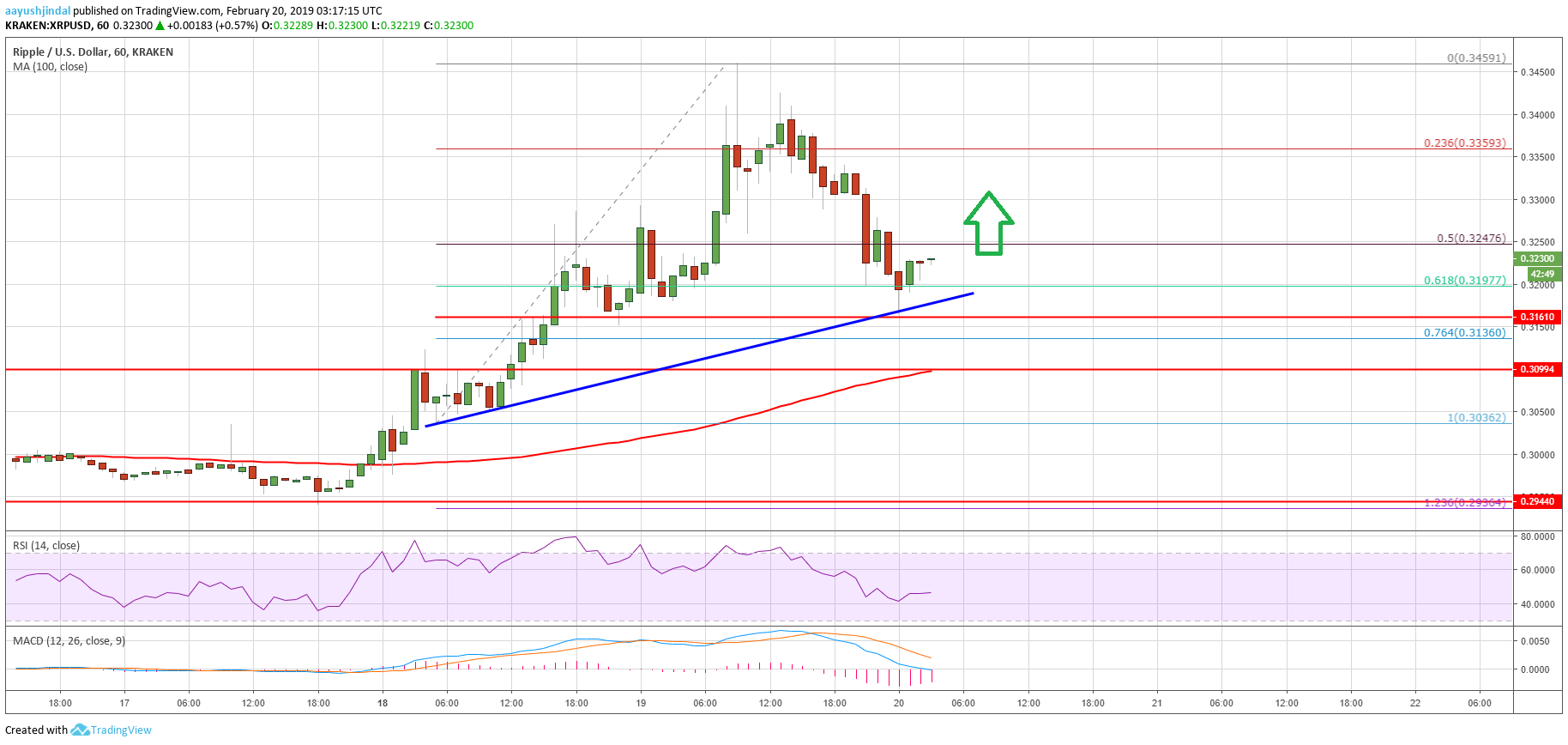
Yesterday’s highlighted major bullish trend line is intact with support near $0.3190 on the hourly chart of the XRP/USD pair (data source from Kraken).
The price is likely preparing for a fresh upward move as long as it is above the $0.3100 support area.
price rallied sharply before trimming most of its gains against the US Dollar and . XRP/USD remains supported on the downside above $0.3100 and it could bounce back soon.
Ripple Price Analysis
Yesterday, there was a in price above the $0.3200 resistance area against the US Dollar. The XRP/USD pair gained traction and broke the $0.3300 and $0.3320 resistance levels. It even broke the $0.3400 resistance and spiked above the $0.3450 level. The price topped near the $0.3460 level and later started a sharp downside correction. It declined below the $0.3320 support and the 50% Fib retracement level of the last wave from the $0.3036 low to $0.3459 high. Sellers even pushed the price below the $0.3250 support area.
However, the price found support near the $0.3160 level. The 61.8% Fib retracement level of the last wave from the $0.3036 low to $0.3459 high also acted as a support. Moreover, yesterday’s highlighted major bullish trend line is intact with support near $0.3190 on the hourly chart of the XRP/USD pair. Below the trend line, the next support is near the $0.3135 level. It coincides with the 76.4% Fib retracement level of the last wave from the $0.3036 low to $0.3459 high. The main support is near the $0.3100 level and the 100 hourly simple moving average.
Therefore, the price is likely to find a near the $0.3160, $0.3130 and $0.3100 supports. If there is a downside break below the $0.3100 support, the price might move back in a bearish zone. On the other hand, if the price stays above $0.3100, it could start a fresh upward move above $0.3300.
Looking at the , price remains well supported above the $0.3100 level. In the short term, there could be range moves, but the price is likely to climb higher once again above $0.3300. The main resistance is near the $0.3350 level, above which there are high chances of gains above $0.3400 in the near term.
Technical Indicators
Hourly MACD – The MACD for XRP/USD is slowly reducing its bearish slope.
Hourly RSI (Relative Strength Index) – The RSI for XRP/USD is moving higher, but it is still below the 50 level.
Stanford University hosted the fourth edition of the
conference over the weekend of November 4–5: “ 2017: Scaling the Edge.”
The annual conference, sometimes referred to as a “workshop,” has in its short history grown into somewhat of an institute within the bitcoin space. It aims to be the main stage for bitcoin’s technical and academic communities, with little room for commercial interests — and perhaps even less for the “scaling drama” that has grown to be the norm online.
“This is the place where we want to focus on engineering, not politics,” said Anton Yemelyanov, this year’s planning committee chair, as he introduced the event on Saturday morning. “We want everyone to have objective discussions from an engineering standpoint.”
The first two conferences were hastily organized one after the other in the second half of 2015, both in direct response to the new-at-the-time block size limit dispute and a looming hard fork through XT. The edition, the first of the two conferences, was instrumental in bringing together bitcoin’s technical community, which had up until that point mostly communicated through chat channels and mailing lists. And the second edition in introduced bitcoin’s mostly Chinese mining community onto the stage for the first time, quite literally. Faced with a contentious hard fork, the events were instrumental in building community among developers and across continents.
And the conferences proved pivotal in averting the crisis — at least temporarily. Hong Kong saw the introduction of, presented by engineer and major Core contributor Dr. Pieter Wuille. This innovation was included as a centerpiece in bitcoin’s scaling, proposed by Blockstream CTO and bitcoin Core maintainer Gregory Maxwell right after the conference, and was endorsed by large parts of the bitcoin ecosystem. It finally on the bitcoin network this summer.
Now, two years and three Scaling bitcoin conferences after the Montreal edition, another controversial hard fork looms. — maintained by former bitcoin Core contributor and CEO Jeff Garzik — is scheduled to hard fork next week as per the in order to double bitcoin’s block weight limit — an effort dubbed “SegWit2x.”
Yet, this upcoming hard fork did not demand much attention in Stanford. Apart from subtle remarks buried throughout some of the talks, the topic of SegWit2x was almost completely absent from the Scaling bitcoin program. Illustratively, Bobby Lee, CEO of and one of the few outspoken SegWit2x proponents on stage,even refused to take any questions on the hard fork after his invited talk — instead focusing on bitcoin’s meteoric price rise over the past years.
The Talks and the Science
Scaling bitcoin instead continued on the path set out last year at the, hosted in. With a broader scope than scaling alone, privacy and fungibility were prominent topics, while smart contracts, fees, mining and more were part of the program as well.
Perhaps the biggest innovations presented throughout the weekend, at least within the realm of features that could feasibly be implemented on bitcoin without rigorous protocol changes, were presented by some of the veterans (by now) in the space.
Tadge Dryja, co-author of and currently employed by the, presented “Discreet Log Contracts.” If the math checks out like he thinks it does, these could effectively realize trustless oracle systems, arguably offering a superior (being simpler) alternative to the bulk of advanced smart contracts. Put bluntly, think these kinds of solutions could make resource-intensive systems like Ethereum obsolete.
Along similar conceptual lines, Blockstream mathematician Andrew Poelstra presented “scriptless scripts.” Utilizing clever cryptography — specifically, signature aggregation — smart contracts could be anchored into a basic blockchain without needing to embed the entire smart contract code itself. Originally designed for the protocol, the concept could be leveraged by bitcoin, too.
And speaking of veterans in the space, Nick Szabo — partnered with (among others) Bloomberg contributor Elaine Ou — presented his proposal to broadcast bitcoin transactions over radio waves. Not so subtly referencing China’s recent, the two detailed how bitcoin could travel around the globe (and over the great firewall of China) without so much as needing an internet connection.
When the topic of bitcoin’s block size limit — the “original” scaling issue that spawned the conferences — came up at all, it was mostly in the context of propagation speed. Perhaps no coincidence, the two most relevant presentations on this topic were based on work by some of the people involved with previous hard fork attempts. The Unlimited team presented their test results on the “Gigablock” network, which they believe safely supports blocks that exceed current limits by several orders of magnitude. And UMass Amherst professor Brian Levine presented the “Graphene” block propagation protocol, co-designed by bitcoin’s former lead developer Gavin Andresen.
To the extent that next week’s hard fork was discussed, Anthony Towns’s presentation probably came closest. Towns detailed how support for future protocol changes could be cleverly determined through market dynamics. Though, while interesting, this type of solution will not be ready in time for the SegWit2x hard fork.
The Hard Forks and the Politics
Indeed, in contrast to some of the previous events, a sense of urgency was mostly absent in Stanford.
This could be in part because most of bitcoin’s technical community has by now roughly settled on a path forward — and SegWit2x is no part of it. Similarly, the question is not so much whether bitcoin will scale predominantly through second layers; for them, at least, it will. Rather, topics of research now focus on how these second-layer technologies can be optimized for performance, privacy and more.
Additionally, as a somewhat loosely organized volunteer effort, the team overseeing the conferences consists of slightly varying people from one event to the next. And resulting from a difference in vision for the 2017 edition, some of the earlier organizers as well as a segment of bitcoin’s technical communitywere absent for this round.
Perhaps as a result, the sense of community building typical for some of the previous events was not as prominent in Stanford. And the question of how to deal with a looming hard fork was a more central topic at the similar but more informal conference in Paris several weeks ago. In little over two years, Scaling bitcoin instead transformed from what is best described as an emergency summit to something perhaps more akin to a regular academic conference — even though an emergency summit would not have seemed entirely inappropriate at this point in time.
For a complete overview and videos of all presentations, visit . (Or follow for transcripts.)
BitcoinIRA.com Launches The World’s First 24/7 Self-Trading Platform For Retirement Accounts Sherman Oaks, Calif., December 5, 2018 / PRNewswire / — bitcoin IRA, the world’s largest and most secure cryptocurrency platform that allows customers to […]