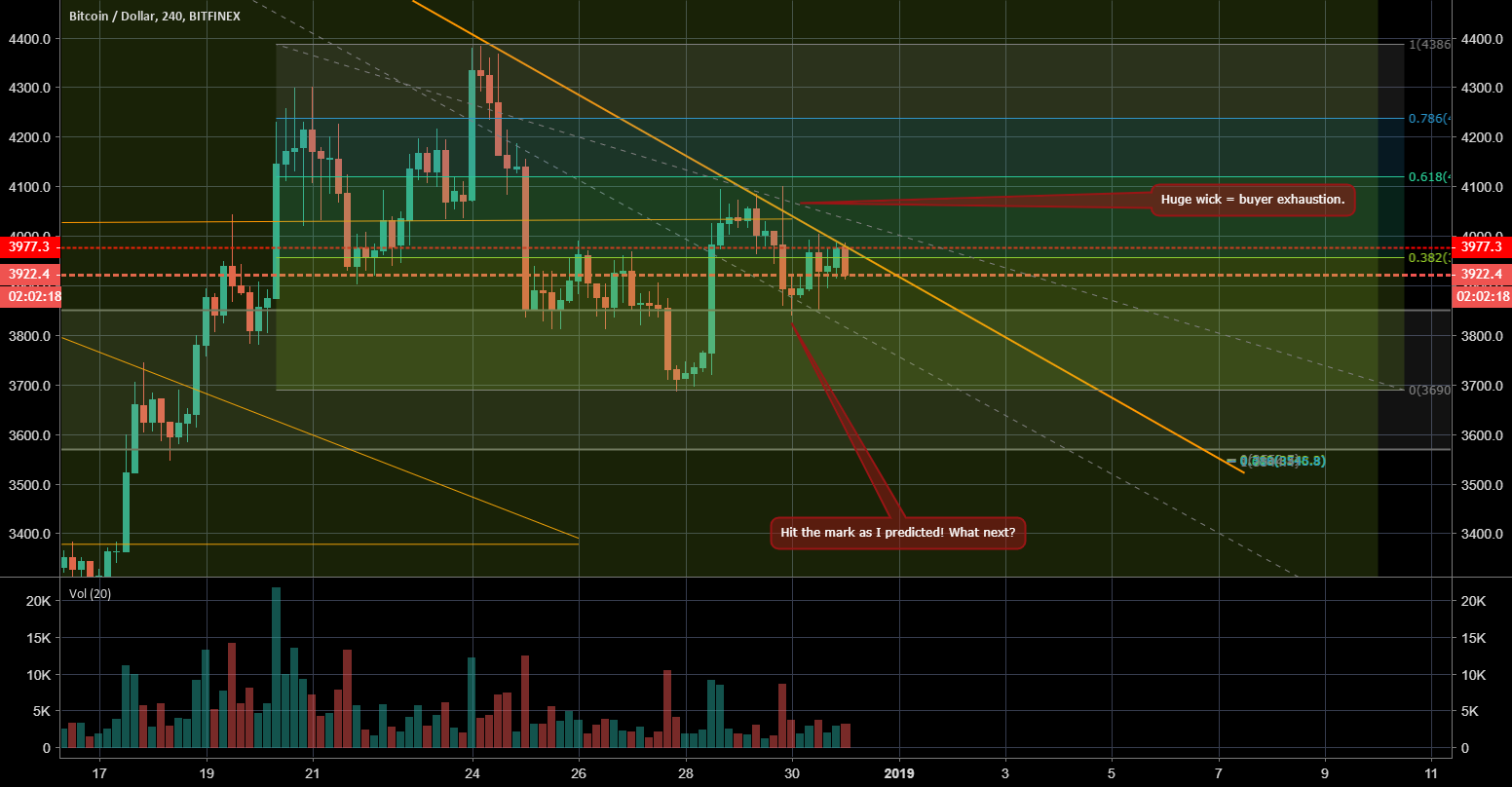
The down leg is holding for now on the 4hr. Here is a great article on the intimate details of and the market.
Manipulation
Even before the launch of the and there were many investors who were looking for a method to short . The introduction of an exchange listed contract was an open invitation.
Moreover, given that these were cash settled, hedge funds and crypto whales saw a lucrative opportunity for dubious tactics. This was even postulated prior to the launch by the Wall Street Journal as they talked about the risk of manipulation.
Indeed, it seemed quite suspicious that the price of reached its all-time highs just prior to the launch. It is entirely feasible that large investors were accumulating physical thereby increasing the Spot price and, subsequently, the future price.
Banging the “open” so to speak.
Collapse of Global Bitocin Markets After . Image via Tradingview
As the contracts opened up for trade, those same individuals started accumulating short positions in the cash market. They locked in expiry prices of close to $20,000 for contracts ending in January.
Then, they start banging down the price on the way to the close.
Those who had accumulated their holdings in the run up the open could now start selling them in the spot market. They locked in higher price levels on these physical holdings while tanking the price and profiteering in cash on the market.
Cash in, buy again. Rinse, repeat.
The and were aware of these risks and hence they decided to use exchanges that did full as the reference point for the prices. For example, the referenced a collection of 5 reputable exchanges including Coinbase, and Kraken. The referenced the Gemini Exchange.
However, there is no way to contain a large and opaque global market. Most of the trading was being done on offshore exchanges where there were less thorough practices. If global prices start falling, so will those on the reference exchanges.
In theory, it sounds plausible. But did it actually happen?
Correlation or Causation?
If one were to take a look at the peak and then fall, it seems to perfectly map the introduction of the contracts. While there was not an explosion in open interest when the contracts went live, steadily picked up when the started trading.
We need look no further than the comments by the bank of Francisco. They feel confident enough in their assertions that the markets had a significant impact on the markets. The piece states that:
“The new investment opportunity led to a fall in demand in the spot market and therefore a drop in price. With falling prices, pessimists started to make money on their bets, fueling further short selling and further downward pressure on prices.”
So, while they are not laying out a case for any sort of coordinated manipulation, they are explaining the exact dynamic that would take place if it were happening.
One can also observe the large uptick in the of the spot market on the expiry dates of the markets. As noted by Tom Lee of Fundstrat Global Advisors, this shows that traders could have been actively trading the physical market to impact on the cash market.
So while this is not decisive evidence of manipulation, it does paint a dire picture for the listing of Nasdaq cash and the impact that this could have to further drive unnecessary .
So what can be done about this?
Physical Delivery
is an asset that is incredibly easy to transfer. It is easier to transfer than shares, and even fiat currency.
Hence, it seems to be an ideal candidate for physically delivered futures . The counter-parties to the derivative contract will enter a contract as it was intended. They will agree to physically buy or sell the asset on expiry.
This will also mean that the individual who is shorting (selling) the in the future will have to place the into storage to physically send it to the buyer on the expiry of the contract. They cannot use that separately to create buying pressure in the physical market.
More transparency, more certainty, less . Physically delivered futures could actually contribute to a reduction of as businesses and investors secure guaranteed future prices for their eventual transaction.
So, when can we expect to see physically settled contracts?
You will no doubt have heard of the exciting products and technology that is being developed by Bakkt. This is a digital currency initiative that is being backed by ICE ( ).
One of the most important things that they will be launching is their physically delivered Bakkt (USD) Daily Contract. These call for delivery of one held in a Bakkt Warehouse.
The Bakkt Contract Terms. Image via ICE Exchange
This means that counterparties will store their physical at Bakkt which will be held in fully transparent manner prior to the expiry. The future seller cannot use that in any capacity in the physical market before termination of the contract.
These contracts will allow for block trades and will take advantage of ICE’s proven financial market infrastructure and technology.
The Bakkt futures are set to launch on the 24th of January next year. It will be interesting to see whether these products will be able to tame any of the that the cash helped spurn.
Conclusion
It has no doubt been a tough year for cryptocurrency markets. The community was hailing any sort of potential institutional adoption without consideration to the impact that it could have on the markets.
Cash were one of those products.
The markets are comprised of some really smart hedge funds, crypto whales and algorithmic traders. They knew the exact dynamics that cash could bring to the still nascent markets.
Whether they actively took advantage of this to enrich themselves, no one can really tell. What is clear though is that cash didn’t bring the avalanche of institutional adoption many were hoping for.
So, as we usher in the new year, let’s focus our attention on the types of financial products that actually bring value to the ecosystem and aid adoption.
Published at Mon, 31 Dec 2018 01:57:43 +0000


