The
rise of the distributed exchange has long been predicted by a wide
range of leading industry figures. Changpeng Zhao, CEO of
has been quoted as saying:
“I
believe that decentralized exchanges are the future. I don’t know
when that future will come. But we’ve got to be ready for it.”
However,
not all exchanges nor DEX’s are created equal.
When using platforms users can face many
issues from complicated interfaces and slow
transaction speeds to a lack of privacy, security, and
freedom.
Currently,
the vast majority of occurs on centralized exchanges such as
and . Users must rely on trusted third parties,
escrow services and derivatives which makes it almost impossible to
trade privately. The centralized nature of these platforms exposes
users to serious security risks too. It only takes a single breach to
jeopardize the assets of all users on these exchanges.
Decentralized
exchanges are now challenging the hegemony of the centralized
behemoths by allowing users to retain their own private keys
and, in turn, ownership of any
crypto assets held on the exchange. However,
the first-generation of DEX’s have been plagued by issues. They are
often slow, indirect, only moderately secure, and offer very little
support for users concerned about privacy.
Introducing
Resistance
Winner of best ICO at
the 2019 World Economic Forum in Davos, Resistance is a decentralized
exchange, ResDEX, driven and supported by its privacy-oriented
which uses the Resistance privacy coin, RES, as an
intermediary to facilitate private .
ResDEX
is a distributed exchange unlike any other. It is the first DEX
designed with a privacy-orientated powered by a democratic
and easily accessible operation which utilizes multiple reward
mechanisms.
Created
by a team of experienced developers with a background in
cybersecurity, the
Resistance core team includes the founder and core developer behind
the Linux operating system Whonix, as well as the founder of
Openwall, who is also responsible for creating the hashing algorithm
yescrypt, and the newly released yespower CPU-optimized hashing
algorithm, which is used by Resistance. Ivan Liljeqvist (AKA Ivan on
Tech), is onboard as an
advisor. Also on board is David Kravitz, a cryptographic mastermind
with 35 years of experience in the sector, Vice President of Crypto
Systems Research at DarkMatter, former IBM researcher, key
contributor to the Linux Foundation Hyperledger Project, and inventor
of the Digital Signature Algorithm (DSA).
A Wide Appeal
Resistance appeals to a
wide community because it incorporates the best aspects of many
different technologies. The simplicity of the Resistance
Desktop Application ensures Resistance is not limited only to
advanced users and can be easily adopted by the masses without
sacrificing usability.
Their focus on privacy
and anonymity attracts individuals that are passionate about the
ongoing : development of technology. Anyone, anywhere in
the world, regardless of skill level, can use ResDEX and it’s not
even necessary to have a bank account.
ResDEX
makes use of atomic swaps which enable fast, direct and private
trades without the need for a trusted
third party. ResDex and its
accompanying facilitates privacy through the use of its
native RES coin which acts as an intermediary and validates
transactions using zero-knowledge proofs.
Utilizing Resistance
InstantSwap enables you to perform trades on ResDEX in under a
minute. Normally a ResDEX trade requires both sides to wait for
confirmations on the underlying blockchains that the trades occur on.
The amount of time can vary significantly with a transaction
taking on average 10 minutes to confirm.
ResDEX InstantSwap
negates the need to wait. This is achieved by allowing users to
deposit RES coins into a time-locked contract for a certain period,
this decentralized collateral is locked in Resistance masternodes.
The funds remain inaccessible until the time-lock is released. Whilst
the RES coins are locked in the user is able to trade amounts less
than the equivalent market value of the deposits immediately. This
dramatically increases the speed at which trades can be completed on
ResDEX without compromising security, because there is no need to
wait for block confirmations.
The
Resistance team has already been granted developer access to the
Ledger Nano S, the world’s most popular hardware , by the
company’s founders and a limited edition Resistance version of the
is now available. This integration will give users the option
to transfer funds from ResDEX into one of the most secure and easy to
use multi-currency hardware wallets available today.
Unlike most public
blockchains, including and , that publicly
visible personal data on an immutable and distributed ,
Resistance gives users the option to shield their Personally
Identifiable Information (PII) by using private transactions. The
EU’s General Data Protection () and the California
Consumer Privacy Acts are now in effect and exchanges
and blockchains are under pressure to uphold each individual’s
right to alter or delete their own personal information. Resistance
was built with a fundamental principle of the in mind: the
user’s ability to control their PII. Users are therefore free to
decide if any PII is to be used on the .
Democratic Mining
The
Resistance CPU-optimized miner
makes it easy for anyone with a standard laptop
or desktop computer running MacOS,
Windows or Linux, to mine on the
Resistance . Block rewards and
transaction fees are split between masternodes, supporting further
project developments, Proof of Work
, and Proof of Research on whitelisted
BOINC projects that advance scientific research for the benefit of
humanity.
As
with and , the Resistance is built
upon a fast cryptographic hash for performance. The Resistance
also utilizes yespower as a separate Proof of Work hash,
similar to how uses scrypt. Yespower is based on scrypt and
the newer yescrypt. The is specifically designed for CPU
and favors the standard CPUs you’ll find in regular laptop
and desktop computers and offers no benefit to FPGAs or ASICs. This
means that anyone can mine on the Resistance without the
need for the high-spec rigs required to mine on other
blockchains such as , , and many other
.
If someone did decide
to build an ASIC for Resistance, the gains in efficiency would be
orders of magnitude smaller than an ASIC built for coins that are not
CPU-optimized. This makes fairer.
ResDEX
has low fees and the typical 0.15% exchange fee is paid for by the
taker. A proportion of these fees are used to support and develop the
platform further.
Currently,
ResDEX has a functional , testnet and a one-way Simplex fiat
gateway confirmed allowing users to buy on ResDEX using VISA
or Mastercard in USD, GBP, and EUR.
In addition, ResDEX has dedicated market makers who help ensure
liquidity stays high on the exchange and lets users perform trades
quickly at competitive prices. Anyone can become a market maker on
ResDEX and provide liquidity to the market. Resistance has dedicated
a lot of time and resources to developing the REST API that makes
this possible. As an added bonus, makers don’t pay fees on ResDEX.
Masternodes
Unlike regular nodes,
masternodes do not participate in . Instead, they perform vital
services and, as a result, receive a significant percentage of the
block reward. On the Resistance platform, masternodes will play a
pivotal role in ensuring the security and fluidity of the
decentralized
exchange. Masternodes will speed up the Resistance
network. Each masternode will host a full copy of the Resistance
and help achieve consensus quickly and efficiently.
Furthermore, masternodes enhance security on the by
helping to deter individuals who set out to falsify transactions.
Masternodes stabilize the Resistance network, and the more of them
there are, the more stable it becomes. That’s why they receive such
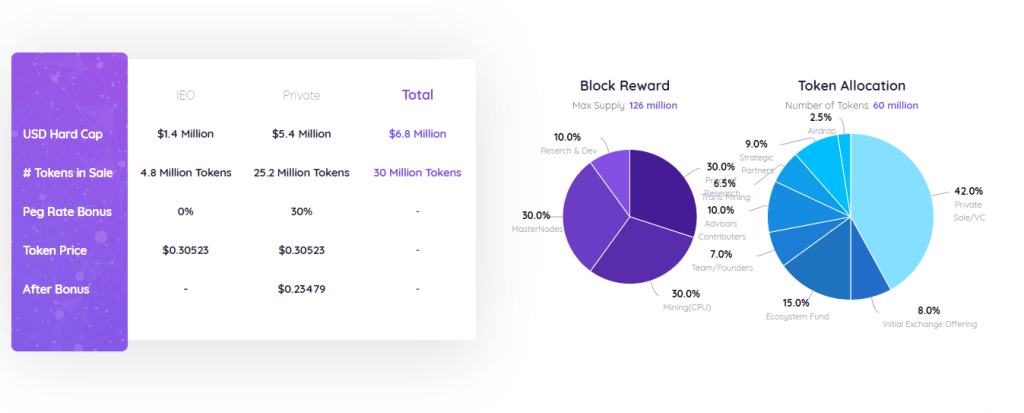
a large portion of the block reward as an incentive – 30% of every
block reward.
Right now, Resistance
masternodes fulfill a number of key roles including:
1 . Incentivizing
people to run full nodes on the Resistance network
2 .
Incentivizing users to hold on to their RES thus stabilizing the
currency
3. Holding the
collateral used in InstantSwaps
4. Voting on
governance issues after ownership of the Resistance platform has been
decentralized
It is crucial that many
Resistance users run full nodes that contain the entire current
Resistance . As Resistance grows and becomes more
competitive, many users will choose to join pools rather than
mine Resistance directly. When users start in pools rather
than on their own full nodes, the number of full nodes on the network
decreases. This pushes the network towards centralization, which is a
threat to blockchains that solely rely on Proof
of Work.
It is also
essential that the Resistance maintains a stable and
accurate value, and that it isn’t used by wealthy individuals to
“pump and dump” the Resistance coin supply. “Pumping and
dumping” is the process by which perpetrators acquire a large
number of coins at a low price, then
artificially increase the
value of that coin to create hype and, in turn, drive up prices.
When other potential
buyers see these huge price spikes, they are encouraged to purchase
coins. At that point, the perpetrators “dump” their coins for a
huge profit and the price tumbles. To help mitigate this issue, and
to control the stability of the coin, Resistance masternodes are
required to hold a certain number of RES at all times to maintain
masternode status. This helps motivate users to hold on to their
coins instead of or selling them. By supporting masternodes,
Resistance is laying the foundation for future improvements to the
network. Further down the line, ownership of Resistance will be
decentralized and handed over to the Resistance community. The
community can use the masternode framework to add support for
additional functionality, such as governance (voting), real-time
double spend protection, and platform development. Prior to this, as
mentioned, masternodes will also play a crucial role in InstantSwaps,
by holding the collateral used to execute these lightning fast
peer-to-peer trades.
10,000 RES is the
expected minimum stake required to be rewarded for running a
masternode. Investors will have the opportunity to receive
proportionally greater rewards (approximately) for larger stakes by
running multiple nodes and/or, possibly, larger node types. When
active, nodes provide services to clients on the Resistance network
and, in return, are paid for their efforts.
As this rewards
program operates on a fixed percentage, and the number of masternodes
will fluctuate, expected rewards will vary according to the current
total number of masternodes in operation.
Proof of Research
Reward splitting is a
key feature of the Resistance consensus algorithm. In addition to
Proof of Work and masternodes, participants can allocate their
computing power to Proof of Research for block rewards. When enabled,
users contribute computer time to Resistance’s whitelisted BOINC
projects. This allows users to receive a percentage of the block
reward whilst making a positive contribution to humanity. The share
of block rewards allocated to Proof of Research are split between the
members of the Proof of Research Resistance Pool (respool). The more
computational power an individual contributes, the greater the share
of the block rewards they receive. As the block reward split is 30%
to miners and 30% to researchers there is an incentive to perform
both these actions. Users can also specify that they wish to partake
in the option that has the fewest participants. This should ensure an
even distribution of miners and researchers.
BOINC is the world’s
largest and most powerful distributed computer network. They host a
wide range of research projects helping solve problems in
astrophysics, , climate change, humanitarian causes and more.
Resistance’s whitelisted projects will focus on causes such as
and Alzheimer’s research, nanotechnology, clean water
technology, molecular biology, and solar power.
Tackling Liquidity
Resistance recently
confirmed a partnership deal with Huobi, the world’s leading
company with an accumulative turnover in excess of U.S.
$1 trillion.
The deal will ensure
liquidity on ResDEX and allow for fast and reliable . In turn,
the partnership opens new possibilities for Huobi by giving the
organization access to new markets.
The partnership will
eventually give the Resistance exchange access to over 150
and 350 pairs. Initially, the digital asset
pairs available will include , , and the USD-pegged
stablecoin Tether with more coins added as soon as they are included
on the Huobi platform.
Poor liquidity has been
the weak link for most of the DEX platforms currently operating. With
slow , many first-generation DEXs have struggled to achieve
the levels of liquidity required. Low liquidity can also lead to
issues like price slippage, where the value of a currency changes
over the period of time it takes to complete a trade; unfair or
uncompetitive pricing; instability; slow transaction speeds; and
more.
Resistance has already
secured a number of other important partnerships too. As well
liquidity on the exchange provided by Huobi and hardware
support from Ledger, market making is facilitated by GSR, and TLDR is
responsible for assisting and mentoring the core team.
Privacy Focus
When a user wants to
initiate a trade on ResDEX, they open the ResDEX interface in the
Resistance Desktop Application and enable the coins they are
interested in . The user can then deposit coins into a special
exchange address derived from their exchange secret seed phrase that
only they know. This address is specific to the coin they are
and each coin has its own unique derived address.
A useful additional
feature is that users can add privacy to almost any ,
including , even if that currency doesn’t support private
transactions natively. Through the use of the Resistance
privacy-oriented , users can enable the privacy feature at
the click of a button. ResDEX will then automatically trade the coin
of your choice to RES and send RES in place of the original currency,
thereby adding a layer of privacy to the trade.
cannot be
considered truly fungible as it does not provide users with
sufficient privacy and anonymity. The transaction history of every
is publicly available on the for anyone to
scrutinize. Older coins may be associated with illegal or unethical
transactions and effectively become devalued in comparison to a new
coin with a fresh . Centralized
exchanges like , for example, have been known to block funds
based on the coins’ previous transactions. With zk-SNARKs, a form
of zero-knowledge proof used to facilitate private transactions on
the Resistance , it’s possible for RES coins to have no
public record or history. If users choose to send a coin through a
private transaction, its history is completely obfuscated.
The Token Sale
Resistance is in the
closing stages of its Private Sale. The platform’s Initial Exchange
Offering (IEO), a process similar to an ICO but conducted through an
exchange, will begin as soon as the Private Sale has ended.
Related
Published at Mon, 08 Apr 2019 14:07:00 +0000