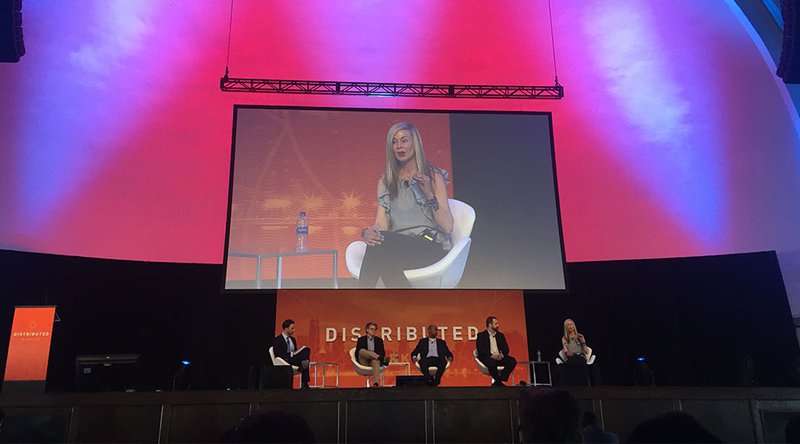
The conference took place in Chicago on April 23, 2018, and featured an array of blockchain and financial experts working to shed light on opportunities and changes happening in the cryptocurrency space.
Among the main goals of the conference was to educate attendees on how they could integrate blockchain technology into their businesses, thereby increasing cost-effectiveness and overall efficiency. A Blockchain Academy workshop and a hackathon were also available to give developers and entrepreneurs a chance to study blockchain macro cases and showcase their skills.
In a panel moderated by Joseph Bradley, entitled “Crypto Regulation: Striking a Balance Between Compliance and Growth,” speakers Colleen Sullivan of CMT Digital; Illinois state regulator Sean T. O’Kelly; Haimera Workie, senior director of FINRA’s Office of Emerging Regulatory Issues; and Tennessee blockchain lawyer J. Gray Sasser of Frost Brown Todd addressed the topic of regulation.
Perhaps the biggest issues hitting the crypto arena are regulation, and how tokens and virtual assets should be classified. The Commodities Futures Trading Commission (CFTC), for example, has jurisdiction over commodities like bitcoin and lists bitcoin futures on regulated interest exchanges.
The Securities and Exchange Commission (SEC), however, which works to regulate securities and all derivatives of securities, is now seeking to through Initial Coin Offerings (ICOs) as such, which could subject them to strict regulatory tactics that could seriously decrease their values. The SEC has since issued several subpoenas to virtual asset enterprises to better understand how certain tokens have been issued and marketed.
Sullivan was quick to tackle this issue. “All securities have to be traded on registered securities exchanges in the United States,” she told the audience.
She explained that the SEC first weighed in on cryptocurrencies in July of 2017, when it released an investigative report on the DAO, stating that certain tokens fell under the “securities” category per specific regulations. Presently, there are over 1,500 separate virtual tokens, and none are traded through securities exchanges the way they should be, as suggested by SEC standards.
Sasser also offered his insight, suggesting that if a token is pre-sold or offered through an ICO, it should technically qualify as a security unless it meets a certain level of functionality.
One of the primary arguments among those who stand against tokens classifying as securities is that they are used as payment methods by those investing in new coins, and, therefore, qualify as “utility tokens” due to their practical nature. Thus far, the SEC has been hesitant to accept this viewpoint.
Sasser said the issue and the industry itself is clouded with uncertainty.
“I’ve been doing these panels for a long time, and usually, my first answer to a lot of these kinds of questions is ‘I don’t know,’” he joked.
For the most part, Sasser believes the SEC has been clear in stating where tokens should fall, though they’ve failed to guide distributors along the way.
Sullivan further mentioned that states follow separate rules when it comes to governing cryptocurrency activity. Illinois, for example, has long refused to recognize cryptocurrencies as valid means of money transmission, but, according to fellow speaker O’Kelly, state regulators are beginning to reverse their overall views and are now attempting to attract blockchain startups and build Illinois as a possible tech hub.
Discussing “regulatory gaps” in the crypto arena, Sullivan explained that CFTC Commissioner Brian B. Quintenz is calling for the industry to “self-regulate,” as Congress has not yet taken the reins. She said that Quintenz is asking that blockchain and cryptocurrency leaders impose a self-regulatory organization that can enforce strict standards for other industry members to follow.
Sullivan mentioned that steps toward such an association have already begun, with a recent example coming from Tyler and Cameron Winklevoss of New York’s Gemini Exchange. They have proposed a , an industry-sponsored, self-regulatory organization for the U.S. virtual currency industry, which will set forth practical standards regarding how an exchange should be officiated, among other goals.
Sullivan believes Congress will eventually get involved, but suggested that maneuvers like these could cover the main ground until then.
In the meantime, the blockchain is presenting several new opportunities for recording data. O’Kelly, who says the government will always be indirectly involved in the verification process of blockchain transactions, says state representatives were recently approached by an organization that wanted to track the entire life of a car on the blockchain, including the change of owners along the way. That change of title would entail government-based authorization.
Sullivan concluded the discussion by explaining that, while the crypto market lacks solid regulation, the influx of institutional capital entering the space should eventually lead to a prime broker’s presence, thus paving the way to further stability and efficiency.
“I think as the regulatory environment becomes more clear in the next 12 months, we’re going to see a lot more capital,” she explained. “Right now, most changes in the industry have applied to retail.”
Note: Distributed Markets is an event held by BTC Inc, the parent company of BTC Media and bitcoin Magazine.
Photo credit: Allison Landy
Published at Thu, 26 Apr 2018 16:34:56 +0000
bitcoin[wpr5_ebay kw=”bitcoin” num=”1″ ebcat=”” cid=”5338043562″ lang=”en-US” country=”0″ sort=”bestmatch”]