So if both “sides” now have a nuclear button they can push, do we escalate from the proverbial civil war up to cold war status? Clearly all attempts at diplomacy have failed, so it’s pretty much a case of seeing who blinks first. Or, more likely, no one actually does anything and we carry on in stagnant mediocrity while the service deteriorates and the war of words carries on.
The only thing that gives me some comfort is that during the historical cold war,
it was a standoff between the communist and capitalist, and ultimately due to the
capitalistic system and all of its secondary effects on it’s subsystems, the
communists were unable to compete both technologically and financially.
So to determine who could win this “bitcoin coldwar”, it should follow somewhat
along those lines. In this case, the technological aspect would be developers and
the financial aspect would be the economic supporting structures like exchanges,
businesses, and etc. If those parts are strong, you can outlast your enemy over
long time periods. On the other side, the communist lost the historical coldwar
because their only assets were their large numbers of troops and massive
amounts of, yet cheaply made weaponry.
So from a historical coldwar perspective, either side will not ever “blink first”,
but one will eventually collapse and fall apart due to being unable to compete
with every aspect other than sheer force and numbers.
So, I think there are some interesting parallels that could be used to almost
always determine the outcome in “bitcoin coldwars”. According to our current
“coldwar status” and the “assets on both sides” is not likely that BU would be
able to over take Core in a safe manner. So, the only results will either be BU
collapsing over time or BU causing an intentional non-consensus hardfork
(preemptive nuclear strike with hopes of non-retaliation).
Published at Fri, 31 Mar 2017 18:06:45 +0000
[wpr5_ebay kw=”bitcoin” num=”1″ ebcat=”” cid=”5338043562″ lang=”en-US” country=”0″ sort=”bestmatch”]
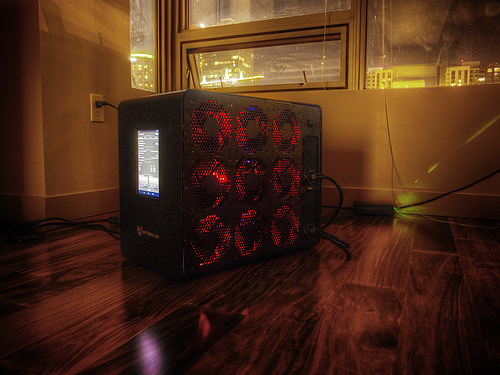
This discontinued 500GH/s bitcoin miner from Butterfly Labs is a mix of good and not great. It’s also not mine for so many reasons. Anyway the 50lbs. cardboard box this was shipped in includes the miner, two power cables, and foam with an alarmingly strong chemical smell. The contents will be addressed later but right now yes, the miner mines like a demon. Rated at 500GH/s, it’s averaging around 450GH/s or slightly more.
The custom case came in flat black and has two power supplies that both must be turned on to run. It’s a stand-alone unit that requires no monitor, keyboard, or a host computer. It has a built-in WiFi and a tablet ingeniously repurposed into a front panel touchscreen running Andriod. It requires two 10 amp lines, is as noisy as a hair dryer next to your ear from 10 feet away, and runs hot enough to save the Titanic from an oncoming iceberg. This is all expected and if GH/s is all that matters then that’s all there is to this miner. But this unit is no turn-key solution and it shows issues that goes beyond hardware.
The case is incredibly unfriendly to work with utilizing screws that are not standard among PCs save for laptops. Worse than that is the inconsistency – some screws are loose while others have been over-torqued. Either could have been caused from vibrations during shipment but the flush hex screws are not doing it any favors. But wait, why would anyone want to take apart this miner? Other than visual inspection to make sure everything is still attached after shipping, a USB extension cable has to be connected to the USB header cable located inside the case in order for the miner to work at all because Butterfly Labs left it disconnected. This was discovered after spending some time going through the online forums.
I mean if my Wheel Stand Pro imported from Poland came with several pages of instructions and clear technical illustrations, then something that cost as much as a real entry-level rally car should have at the very least a "thx!" hastily written on a sticky. The online instructions in getting started with configuration settings are excellent but the set up and troubleshooting are incredibly difficult to search for. They must be prospected manually by wading through the forums.
The touch screen was another issue. Disconnected from power the touch screen will drain its internal battery unless it’s shut down via the menu. Easy peasy but to turn it back on a long Loki-pokey stick must be inserted in a circular opening on the right hand side of the case. This will hit a small button on the side of the touch screen inside the case. Back in the dark age of personal computing accessing a power supply switch deep inside my old 386-SX was solved by Packard Bell using a button attached to a long S-rod. If the touch screen button was too fragile for that kind of engineering it could have been mentioned on a slip of paper. Instead it felt like I was rooting around for the Autobot Matrix of Leadership.
Even the power requirement is left for the mining operator and the fuse box to discover. Will normal house electrical wiring do or will it need a lightning rod connected to a flux capacitor? A thin, solitary paper and a screenwriter scrawling over it in between waiting tables is not much to ask. Butterfly Labs have limited resources for customer support but basic questions should be taken care of before they hit support.
The miner is having issues just about every time it boots up from a scheduled maintenance shutdown. It could be that running on unfiltered lines and the unit itself may have been refurbished is giving us additional problems. It’s still mining like a beast and at the end of the day that’s all that matters, until something breaks.
-Update: Corrected 400GH/s to 500GH/s.
-Update 2014-08-11: Other than a week or two of scheduled downtime the miner is still mining with no issues.
-Update 2014-09-23: Federal Trade Commission in civil suit against Butterfly Labs for engaging in alleged fraudulent and deceptive practices.
By vmax137 on 2013-12-23 19:54:15