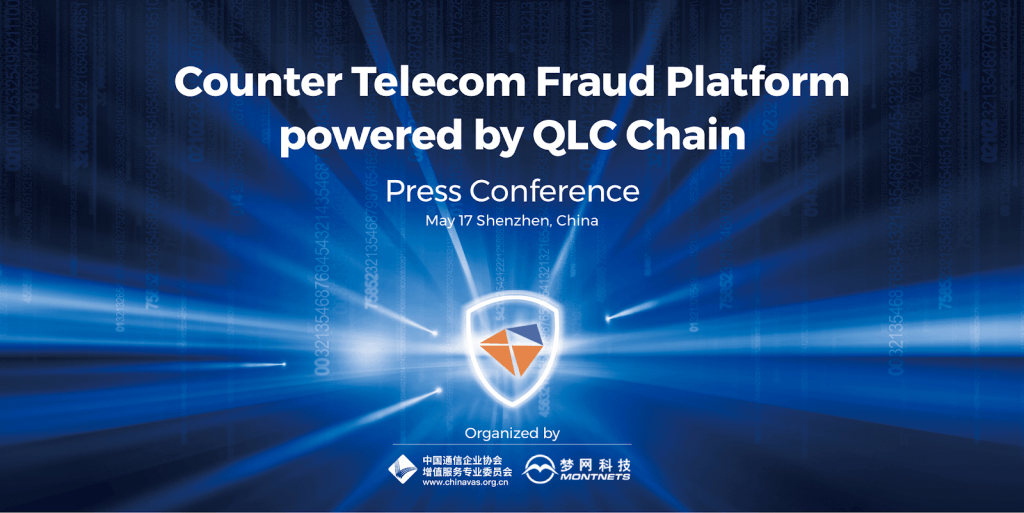
Leading Chinese cloud communications provider, QLC Chain, has announced the launch of its Counter Telecom Fraud Platform, which went live on May 17th.
19 May 2019, Shenzhen, China – . The platform, which officially launched on World Telecom Day, (May 17th) will offer financial institutions the means to build an Application-to-Person (A2P) messages ledger via QLC Chain, granting clients the ability to check and validate the authenticity of the message sender. As a result, users will no longer fall into the trap of phishing messages, disguised as trusted numbers.
, and China Association of Communication Enterprises (CACE) joined hands to deliver this platform. It is available for China’s financial institutions to deploy immediately and to provide this value-adding service to their customers.
Blockchain Technology has been acclaimed for enhancing security in the digital world, however, there are few projects that have brought actual benefits to people’s daily life. As one of the leading public chains that focus on providing blockchain powered solutions to the telecom industry, QLC Chain takes a huge step in bringing the real application into the general public’s everyday scenarios.
How Telecom Fraud Hurts Banks and Their Customers
A2P messages are everywhere and very often applied as a critical security procedure. For example, the banks which are sending transaction authentication numbers; exchanges sending verification messages; 2FA confirmations.
On most of these occasions, these financial institutions (banks, exchanges, insurers) are bearing the risks if their customers are defrauded. The guilty parties use pseudo base stations to ask customers to transfer money to a “safe account”, click on a link to collect “awards”, or to pay for a “utility bill”.
In China, the total number of fraudulent text messages rose from 650 million in 2015 to 1.82 billion in 2018. According to the statistic, there are about 1.6 million people engaging in telecom fraud in China. In the United Kingdom, the 2018 total, which equals to the annual GDP of the Philippines in 2018.
This year, the fraudsters also boarded the AI train, making robocalls to defraud people. First Orion, a company that provides spam call filters to various carriers, predicted that nearly half of all calls to mobile phones will be.
QLC Chain Solution
can provide a trusted environment for financial institutions to prevent SMS fraud, telephone fraud, and website content fraud.
Nowadays, the fraudsters disguise their numbers or pretend to be the authorized ones to send fraudulent messages. In this way, the traditional counter fraud methods – passively reporting a fraudulent number, maintaining a blacklist – won’t be effective. Most individuals are more susceptible to be defrauded by the phone numbers which they are familiar with and believe to be from a trusted source.
Through the distributed consensus mechanism of blockchain, QLC Chain provides a trusted platform as following, not tampering, and not relying on a single node.
With this new Counter Telecom Fraud Platform, with trusted message records. In addition, the fraudsters messages won’t be recorded.
For example, if a bank using the QLC Chain platform receives a message from the bank number about “security risk and needs to change password, they can then use the Bank’s mobile App which integrates the checking function, input their own mobile number and message content. The App will send an inquiry to QLC Chain, asking if the message exists. If it is indeed from the bank, the Mobile App will display detailed information with the timestamp, transaction ID, or another similar method.
This is an infallible source traceability platform based on Blockchain technologies, maintained by decentralized nodes of QLC Chain.
To find out more information, please visit the website:
Follow QLC Chain on Twitter:
Find QLC on Facebook:
Check out their Medium channel:
Chat with QLC Chain on Telegram:
Meet the QLC Chain Team on LinkedIn:
QLC Chain YouTube Video:
Media Contact Details
Contact Name: Toya Zhang
Contact Email: t
QLC Chain is the source of this content. Virtual currency is not legal tender, is not backed by the government, and accounts and value balances are not subject to consumer protections. This press release is for informational purposes only. The information does not constitute investment advice or an offer to invest. Token sales are only suitable for individuals with a high risk tolerance. Only participate in a token event with what you can afford to lose.
This is a paid-for submitted press release. CCN does not endorse, nor is responsible for any material included below and isn’t responsible for any damages or losses connected with any products or services mentioned in the press release. CCN urges readers to conduct their own research with due diligence into the company, product or service mentioned in the press release.
Published at Thu, 23 May 2019 18:14:06 +0000
![Is it over for bitcoin [btc]?!? $btc hits 15 month low & vcs quitting! Can crypto realistically be saved?](https://ohiobitcoin.com/wp-content/uploads/2019/01/7JMVQE.jpg "Is it over for bitcoin [btc]?!? $btc hits 15 month low & vcs quitting! Can crypto realistically be saved?")

