June 7, 2026

Capitalizations Index – B ∞/21M

Play-By-Play Analysis — While Bitcoin Walks The Tightrope! (BTC)

Play-by-play analysis — while bitcoin walks the tightrope! (btc)

Play-By-Play Analysis — While Bitcoin Walks The Tightrope! (BTC)

Play-by-play analysis — while bitcoin walks the tightrope! (btc)

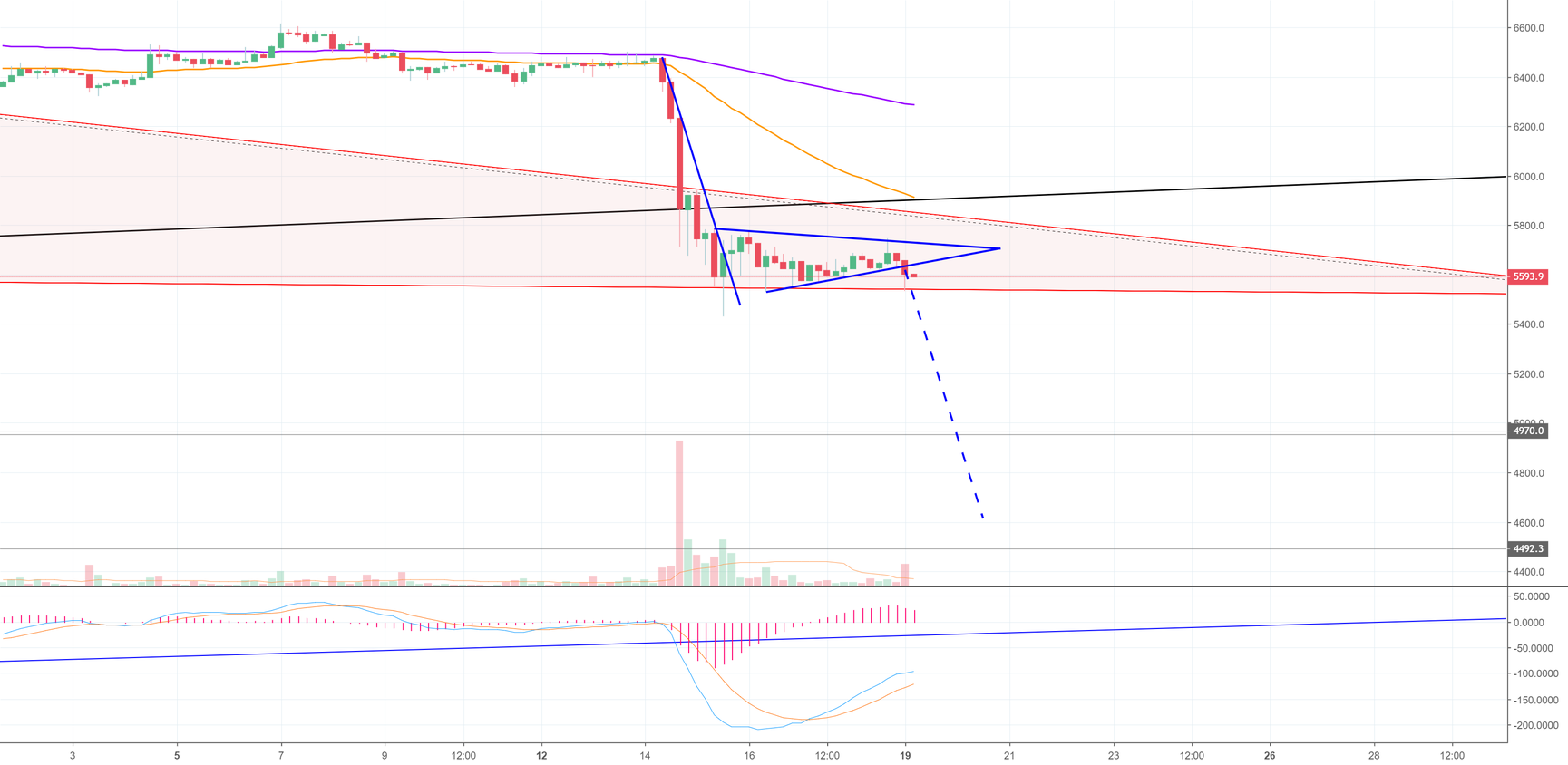
Hi friends! Welcome to this update analysis on bitcoin! Let’s get right to it! Looking at the four hour** chart, you can see that BTC             has been going nowhere fast, after last week’s selloff. Technically, this is a bear flag consolidation (in blue.) The bottom of the flag is a little sloppy, but these things don’t have to be perfect. You can see that the current candle has dropped below the flag (if you draw it as a pennant ) with an uptick in sell side volume . However, the bottom of the triangle is holding strong. It’s pretty clear that the bottom of the triangle is the line in the sand. If the bears are able to produce a breakdown, it will be the first step in a series of events that will likely lead to much lower prices.

Assuming that the current candle is a breakdown candle from the bear flag , we can use the height of the flagpole as a gauge of maximum fall potential. Interestingly, you can see that it puts the price of BTC             down around my first two targets. Target number one is at $4970 and target number two is at $4492. The size of the current bear flag projects a potential decline to around the $4600 area, which is very much inline with the major downside support levels that I have discussed in recent analyses. However, for this to really be set in motion, the bears need to close below the red triangle. Then, the selling is very likely to accelerate.

We’re looking at the four hour chart, because it’s my favorite time-frame for looking at intraday action like this. I am a huge fan of the 4 hour MACD , when trying to determine short-term swings. As you can see, the MACD is starting to flatten out, and if the sellers continue to push down toward the bottom of the triangle (as they appear to be doing) it should produce a bearish crossover on the MACD . Crossovers on the 4 hour MACD can be very powerful timing indicators, particularly when they are confirmed by other technical factors. In this case, we are falling from a bear flag , after a rapid decline, under critical rising support, and inside of the apex of a symmetrical traingle. Bearish , bearish , bearish . At this point, a four hour MACD bearish crossover, coupled with a breakdown from the triangle, will be a great sell signal. My eye is set on the aforementioned targets, should the proposed breakdown occur. Right now, the bulls need a miracle, and we all know how likely that is.

I’m the master of the charts, the professor, the legend, the king, and I go by the name of Magic! Au revoir.

***This information is not a recommendation to buy or sell. It is to be used for educational purposes only.***

-JD-

Published at Mon, 19 Nov 2018 04:13:07 +0000

Previous Article

EXO Trading Competition for Everyone​

Next Article

Bitcoin Cash Hard Fork Battle: Who Is Winning the Hash War

You might be interested in …

Re: 西部农民工"返乡潮"调查:60后回归 90后不远行

Re: 西部农民工"返乡潮"调查:60后回归 90后不远行 21世纪经济报道 记者 李果 成都报道 2017年春运期间四川省交通运输部门将发送旅客1.4亿人次,同比下降7%,减少客流超千万人次。这是四川省春运史上首次出现客流量明显下降,其中原因之一,是外出务工人员减少所致。 2月20日的成都是一个阴天,大年已过,成都地区最大的劳动力市场——成都市锦江区人力资源市场内人潮涌动。 45岁的夏德平已经连续三天来到这里,他望着电子屏幕上不断更新的招工信息,心里打着算盘。 “要是再没有好的工作,就回顺德去。”夏德平对21世纪经济报道记者说。他几乎是西部“第一代”农民工的典型:17岁跟随自己家乡——四川省仁寿县的打工大军来到广东“找活路”,尝尽艰辛,最终学得修车手艺,如今已带出徒弟无数。 但随着年纪增长,夏德平回乡就业的想法日渐迫切,“落叶归根,何况家中老父还需赡养”。 与夏德平不同,22岁的陈萍根本没有想过要去东部沿海务工,“高中毕业又上了几年技校,在成都找一个工作并不难”。 “60后”与“90后”农民工均不再愿意出省务工,成为目前东部沿海地区技术工人缺乏的因素之一。据中国国家统计局数据,从2012年末到2015年末,外出农民工较上年增长比例逐年下降,增长率分别为3.0%、1.7%、1.3%及0.4%。 但与此同时,无论是就近务工或者返乡创业,西部农民工未来的就业情况并非坦途。 东部沿海不再是打工首选 夏德平有些骄傲的对21世纪经济报道记者摊开双手,常年做汽修,黑色的油迹不再能被洗净,成为另一种肤色,“别人问我汽车修得怎么样,我就把手伸过去给他们看。” 夏德平说话的时候总是夹杂着普通话,接近二十年在广东顺德的打工经历,多少对他有所改变,也影响了他对“好工作”的定义。 对于“好工作”,夏德平用了几个指标:“工资不少于8000元,包吃住,每周休息一天半”。 工资8000元,这已经低于他在顺德的工资,但三天来夏德平总是碰壁。其中原因之一,是随着大量农民工从沿海返回,人力资源的紧缺度缓解,用工单位有了更多的选择和议价空间。 来自四川省统计局的数据也显示,目前四川省“缺工”与“招工难”并存,企业用工结构性矛盾依然明显,求职者对薪酬期望过高、符合岗位要求的应聘者较少,分别占到总体影响因素的45.9%和29.5%。 尽管做好了再回顺德的准备,但夏德平仍希望可以在成都找到工作,这几天他不断在调低自己的要求,工资“再低一点也可以接受”。 至于选择回乡就业的原因,夏德平说,除身体状况外,年事已高的父亲需要赡养也是重要因素——这几乎是第一代农民工选择回乡就业的主要因素:首先是自己普遍到50岁左右年纪,身体状况不再能够承受高强度工作,养老是第一需求,不再追求高工资;第二是父母年事已高,不具备劳动力,需要就近就业,方便赡养老人。 事实上,整个西部地区的农民工正在加速回流。21世纪经济报道记者从贵州省就业工作联席会议制度办公室获得的数据显示,截止到2016年12月底,贵州省农村劳动力返乡创业就业90.65万人,比去年同期增加9.75万人,增长12.05%。 另外,一个数据也客观反映了这样的现象:来自四川省经信委数据显示,2017年春运期间四川省交通运输部门将发送旅客1.4亿人次,同比下降7%,减少客流超千万人次。这是四川省春运史上首次出现客流量明显下降,其中原因之一,是外出务工人员减少所致。 四川省社科院副院长郭晓鸣称,农民工回流将是未来一个趋势,就四川省而言,四川省基础设施建设投入、电子和新材料等产业的快速发展,吸引在外农民工回流,“除非整体经济情况出现重大变化,否则这些现象会在未来相当一段时间内继续,也可能成为一种趋势。” 大量的90后农民工也选择不再外出务工,陈萍刚刚从成都的一家制鞋工厂辞职,来成都市锦江区人力资源市场,是希望找到一份“更体面”的工作,她的兄弟姐妹中,除表哥在广东打工外,其余均选择就近工作。 21世纪经济报道记者通过采访后总结了如下因素:第一是随着经济发展,西部的就业机会随之增加,同时工资收入差别缩小;第二是和父辈相比,90后的农民工受教育程度更高,有能力适应具备技术含量的工种;第三,父辈为其积累了一定财富资源,大多数90后农民工不再背负沉重的家庭负担;第四,部分90后农民工,经历过长期和父母分别的“留守”时期,不希望该现象再发生在其子女身上,因此也选择就近就业。 陈萍也注意到身边另一个现象:同龄“农民工”不再去沿海打工的另一个原因,是为生二胎做准备。 她对21世纪经济报道记者称:第一是和大城市居民相比,乡村或三四线城市的房价与生活水平对其产生的压力相对较小,使其有能力生育二胎;第二,目前农村地区对于教育质量的重视程度相对偏低,“农村教育质量低,但学费也低,能够负担两个小孩的学费”。 自主创业面临“融资难题” 大量农民工回原籍就业,也对当地的新增就业岗位的扩张能力提出考验。如2017年春节后,四川省金堂县已经在各乡镇和工业区开了13场巡回招聘会,据各用工单位提供的数据,今年361个企业预计有近万个就业岗位,目前与企业签订了意向就业的有2960人。 在开展形式多样的招聘会的同时,自主创业成为西部地方政府近年热推的举措。来自四川省人力资源和社会保障厅的数据显示,2016年,该省免费发放《农民工返乡创业政策宣传手册》13万册,制作返乡创业政策解读动漫宣传片,举办多期返乡创业政策培训班,组织力量赴省内外川籍农民工集中的园区、企业开展返乡创业专项宣传活动,为支持农民工返乡创业营造了良好的社会氛围。 据粗略统计,2016年全省全年新增返乡创业农民工7.1万人,创办企业1.8万个,实现产值140.5亿元,2月16日,四川还召开了表彰大会,对返乡创业先进个人进行嘉奖。 但尽管近两年西部从省到县市,均出台了一系列支持农民工回乡创业的政策,但数量仍偏少。如贵州2016年返乡的90.65万农民工中,选择创业的人数仅7.11万人。 […]