Plagiarism, Identity Theft, and False Promises All Too Common in Cryptocurrency Market
· May 19, 2018 · 8:00 am
A Wall Street Journal analysis of 1,450 cryptocurrency offerings has unveiled unchecked plagiarism, rampant identity theft, and false promises of impossible financial gains.
‘Lies, Damn Lies, and Statistics’
Though it might not come as much of a surprise to those more intimately familiar with the cryptocurrency space, a Wall Street Journal of 1,450 documents for digital coin offerings as unveiled 271 indicators of fraudulent tactics — including “plagiarized investor documents, promises of guaranteed returns and missing or fake executive teams.”
Investors have reportedly dumped more than $1 billion into the flagged projects, with $273 million already claimed as losses.

Red Flags
Plagiarism is one of the most rampant signs of fraudulent activity in the cryptocurrency space. The Wall Street Journal explains:
Of the 1,450 white papers downloaded from three popular websites that track coin offerings, the Journal found 111 that repeated entire sections word-for-word from other white papers. The copied language included descriptions of marketing plans, security issues and even distinct technical features such as how other programmers can interact with their database.
Swiss-based UTrust has had its whitepaper plagiarized numerous times – something CEO Nuno Correia already knows. “We get a lot copies of our white paper,” Mr. Correia told The Wall Street Journal, “My picture, my description, my team, even our website was copied.”
Even high-profile projects like TRON (TRX), the 10th most valuable cryptocurrency by market capitalization, has been accused of plagiarism by many in the blockchain space, including Ethereum founder Vitalik Buterin.
8. Better white paper writing capability (Ctrl+C + Ctrl+V much higher efficiency than keyboard typing new content)
The Wall Street Journal also found that “at least 121 of the projects didn’t disclose the name of a single employee and several of them listed team members who either didn’t appear to exist […] or were real people who said their identities were being used without their knowledge.”
Companies promising unrealistic returns – such as weekly payouts or doubled returns – without any risk are also running rampant in the cryptocurrency space, despite such practices being prohibited by the US Securities and Exchange Commission.
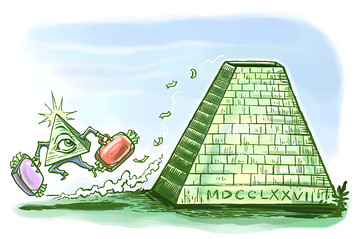
All of these red flags should be serious “warning signs for investors,” Bradley Bennett, a former enforcement chief at the Financial Industry Regulatory Authority, told The Wall Street Journal. Bennett explained:
There are going to be some legitimate players that emerge from this but it’s going to be a handful – a lot of it looks like penny-stock fraud with lower barriers to entry.
What do you think about the rampant fraud currently present in the cryptocurrency marketplace? Do you think this trend will continue, or die out as the cream rises to the top? Be sure to let us know in the comments below!
Images courtesy of Shutterstock, Bitcoinist archives
UPS and Inxeption Transforming B2B E-Commerce with Blockchain Technology United Parcel Service (UPS), an American multinational delivery and supply chain management firm, has joined forces with Inxeption, a blockchain powered industrial-strength e-commerce platform, to make […]
This is a re-write of “”. Please note: Everything in this article is just advice based on our best understanding of the current situation.
Gold
(also referred to as Bgold, and trading under the ticker BTG) November 12, 2017. Since the bitcoin blockchain technically forked on bitcoin block 491407, anyone who held bitcoin (BTC) on October 24, 2017 should have an equivalent amount of BTG attributed to their bitcoin private keys.
In our, we explained how to secure your private keys so you could be sure to access your BTG and B2X. The B2X fork has since been by the leaders of that project, however, and it currently seems very unlikely to happen in any serious way.
As such, this follow-up article explains how you can claim (and potentially use) your BTG — only your BTG.
Be Careful
Good news: bitcoin Gold enforces strong replay protection. This means you can’t accidentally spend your BTC when you mean to spend BTG or vice versa.
As such, if you don’t care about BTG at all right now, you don’t need to do a thing. You can just keep using bitcoin as you always have. If you ever change your mind (and don’t lose your bitcoin private keys in the meantime), you can still claim your BTG at any point in the future.
Likewise, if you want to hold onto your BTG long term, you also don’t need to do anything right now. You can keep using BTC as if nothing happened; just make sure to never lose your private keys.
(In both these cases, however, it could come in handy to keep a record of the bitcoin addresses that stored your bitcoins at the time of the split. This is not strictly necessary, but your future self may thank you if you do it. You should be able to find this information in your wallet of choice, though where you find it may differ a little bit from wallet to wallet. Alternatively, you could move all your coins to a new address. If you then look up all your transactions since October 25, 2017, and note which addresses spent coins since that date, you know which addresses held coins at the time of the split.)
Now let’s assume you do care about BTG right now, at least enough to want to sell your share. (1 BTG is trading around 0.02 BTC at the time of writing of this article, so you could earn a 2 percent “dividend” on your BTC if you decide to sell.)
If you followed the advice outlined in our beginner’s guide, the good news is that you should be in full control of your bitcoin private keys. This means you now hold BTC as well as BTG.
The bad news is that it’s not necessarily easy or safe to claim your BTG. If you’re using insecure (or even malicious) software, you may accidentally expose your private keys. And because these are the same private keys that secure your BTC, this exposure could lead to your BTC being stolen. You stand to lose much more from losing your BTC than you stand to gain from selling your BTG.
Therefore, you are going to want to take your time and make sure you understand what you are doing well enough to do it without exposing your private keys. Your BTG isn’t going anywhere.
Accessing Your Coins
In our beginner’s guide to surviving the Bgold (and SegWit2x) forks, we explained how to secure your private keys and recommended different wallet options. Here, you can find, per option, how to access your BTG.
Note that while it’s not strictly necessary in all cases, it’s probably best to first move your bitcoins (BTC) to a new address, or even a whole new wallet with a new seed, before you even touch your BTG. This way you don’t add any security risks, while it’s potentially also a bit better for privacy. (More on this below.)
Paper Wallet
The first recommendation in our beginner’s guide to surviving the Bgold (and SegWit2x) forks was to use a paper wallet. This advice was given in the context of storing your coins long term in particular. But if you want to access your BTG, you can, of course, do this right away.
However, the point of a paper wallet really is that your private keys are not stored in any device that could be hacked. Therefore, if you’re going to upload your private key into a bitcoin Gold wallet, you should definitely create a whole new paper wallet with a new private key for your bitcoin (BTC). It’s probably best to then first sweep your private keys with a bitcoin (BTC) wallet, and then send the coins to this new paper wallet for BTC.
and are two wallets that allow you to sweep bitcoin private keys. Look for the “sweep” option in the menus of these wallets; that’s where you can scan the QR-code displayed on your paper wallet. (Alternatively, you could type in the private key.) Once you’ve done this, send the bitcoins to the new paper wallet.
Once your bitcoins are stored safely on the new paper wallet (ideally after at least one confirmation), the old paper wallet still holds the BTG.
Now, the same trick must be repeated to access your BTG. Electrum does not support BTG, but Coinomi does. Coinomi also published a explaining exactly how to access your BTG. This includes instructions for paper wallets.
Regular Wallet
Our second recommendation was to use a regular wallet, as listed on.org.
How to access your BTG if you were using a regular wallet differs from one wallet to the next. But in most cases, Coinomi is once again the best wallet to import your keys into. While originally written for bitcoin Cash, explains exactly how to make that switch for a number of wallets. (Just mentally replace “BCH” for “BTG” wherever relevant.)
Full Node Wallet
Our third recommendation was to use a full node wallet, like Core or Knots.
These wallets store your private keys in a dedicated folder on your computer. You can make a backup of this folder using the menu in your wallet and select “Backup wallet.” Once you’ve done this, you should be able to import this backup into the bitcoin Gold full node, Gold Core.
But once again, it’s a lot easier (and possibly even safer) to export your private keys from your bitcoin full node and import them into the Coinomi mobile wallet. While originally written for bitcoin Cash, explains how to do that for BTG as well. (Just mentally replace “BCH” for “BTG” wherever relevant.)
Hardware Wallet
We also recommended using a hardware wallet to keep your private keys secure — though we also noted that these wallets don’t necessarily make it easy to access your BTG.
Indeed, at the time of writing, no hardware wallet has enabled access to BTG. However, and have published blog posts indicating that they will be working on it. If you use either of these wallets, keep an eye out for announcements on their social media or blogs. and have also published blog posts on the Bgold fork, suggesting they might support it; but they don’t support it yet. Keep an eye on their social media and blog to see if that changes.
If you did not follow our advice and instead stored your BTC in any other wallet, or on an exchange, or anywhere else, you may or may not still be able to claim your BTG. In this case, you’ll have to figure out for yourself whether this is the case or not, and how to do so. This may, once again, be of help for some wallets. (Just mentally replace “BCH” for “BTG” wherever relevant.)
Using (or Selling) Your BTG
Once you have claimed your BTG, you can use it however you please. Just like any other altcoin, you could, for example, sell it for BTC or perhaps spend it somewhere if it’s accepted for payment, etc.
If you decide to sell your BTG, there are a number of exchanges where you can do this. The bitcoin Gold website lists most of them. (Which of these you decide to trust is up to you; we’re not giving any particular advice.)
But there are three more factors to keep in mind before doing so.
The first factor is privacy. Your public keys (which are linked to your BTC and BTG addresses) are identical for BTC and BTG. This means that whenever you spend your BTG (for example, to send them to an exchange), you do not only reveal your BTG addresses but also your BTC addresses. This can, in turn, reveal a lot about your current holdings as well as your past and future transactions and can even, by extension, reveal other data about people or entities you transact with. Make sure you are comfortable with giving up this privacy if you are going to send your BTG to an exchange or anywhere else.
The second factor is mostly theoretical at this point but worth a quick mention nonetheless: security. By revealing your public key when spending BTG, you strip away one layer of cryptographic security, even for your BTC addresses. This doesn’t mean that your BTC are insecure right now, but there is an increased chance that your BTC won’t be secure at some point in the (far) future when this particular cryptographic standard is weakened. It is, therefore, best to move your BTC to a new address, at least some time within the next couple of years.
The third factor was already mentioned but bears repeating: If you’re using insecure software to claim your BTG, your BTC may be at risk. It’s probably best to move your BTC to a new address or even a whole new wallet with a new wallet seed before you even start meddling with BTG — regardless of which wallet you were using. That way, if you do mess up with insecure BTG software, you shouldn’t lose your BTC.
So, to Recap …
1. You don’t have to do anything if you don’t want to, and there is no rush. If your private keys are secure, your BTG is secure.
2. If you want to use your BTG in any way, it’s probably best to first move your BTC to a whole new address that you control, or even to a whole new wallet generated from a new seed. (But don’t lose your old private keys or seed: These still hold your BTG!)
3. Once you know what you’re doing, upload your private keys into a bitcoin Gold wallet, like Coinomi. Then you can keep it, spend it, perhaps send it to an exchange to sell or whatever it is you want to do with your “free money.”
bitcoin [BTC] could not have gone from $0 to what it is today without bubbles, says Shapeshift CEO bitcoin’s [BTC] unprecedented rise in 2019 caused the entire cryptoverse to erupt in joy, with many claiming […]