Introduction: Pchain is the worlds first native blockchain system that supports Ethereum Virtual Machine (EVM), which is the software infrastructure underpinning Ethereum smart contracts, while utilizing multiple side-chains and transaction sharding for maximum scalablity, cross-chain functionality (ERC20, BCH and others coming), and finally smart contract invocation. Pchain is the true next generation solution for scalability, interoperability and sharding.
The Pchain solution:
Pchain is a combination of projects like Rootstock (sidechains), Polkadot (cross-chain interoperability) and Zilliqa (sharding) all in one project.
1. Sidechains — Rootstock operates as a sidechain (a separate blockchain that exists alongside another blockchain) that has the purpose of bridging Ethereum’s smart contract functionality to bitcoin. This is an exciting feature as it allows for greater scalability and faster transaction times due to the extra bandwidth provided by the sidechain. What this means is that rather than just operating as a single sidechain like Rootstock, the PChain solution consists of multiple derivative chains running in parallel on a scale not possible with the kind of single-stranded structure operated by Rootstock.
Whilst other blockchains have attempted such a multi-chain solution, they have fallen down due to not being compatible with EVMs. This means they have had to rely on traditional languages such as NodeJS and Java, which don’t allow for effective pricing mechanisms or traceability.
2. Interoperability– PChain is not just solving the issue of scalability, but also the issues of interoperability as it offers cross-chain functionality to a wide array of public blockchains, including bitcoin, Ethereum, bitcoin Cash and a host of others in the pipeline. The scope of the project is therefore far beyond not just Rootstock but also more complete interoperability solutions like Polkadot, which uses a one-size fits all approach, where PChain can support the smart contract call of non-native tokens.
3. Sharding –Finally, PChain is one of the first along with the likes of Zilliqa to pioneer the technique of sharding to improve performance.
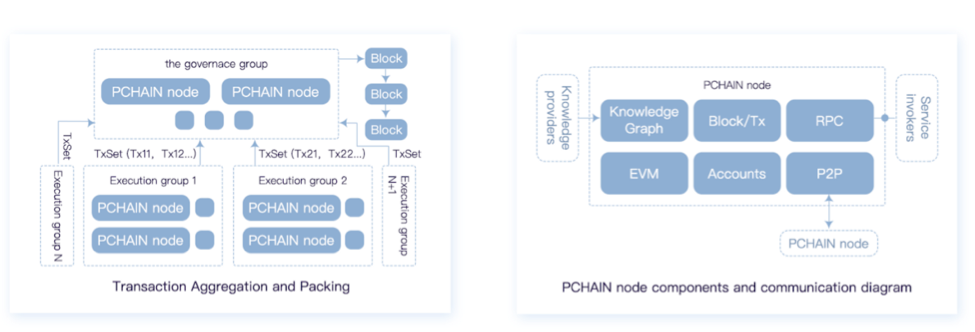
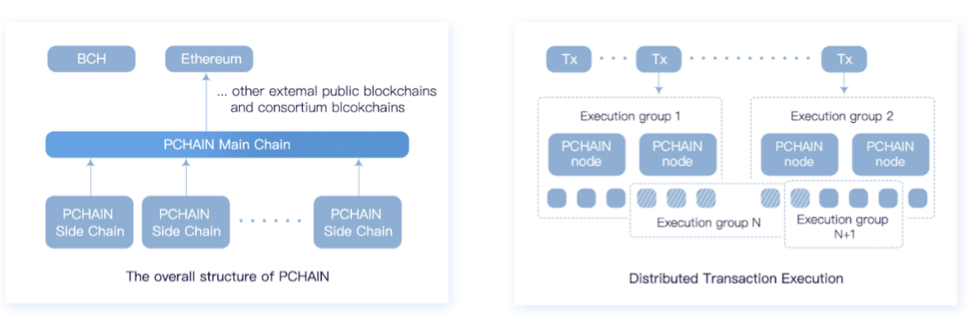
Pchain claim to be able to have smart contracts invoked for non-native tokens, such as BTC, ETH, BCH and more to be added soon. This is achievable by Pchain nodes running EVM software and connecting to other chains via the Pchain provided toolkit. There will be two types of nodes: regular ones that do computation, and qualified nodes that also do governance (requires staking of their PCH token and approved membership of their Governance Group). Regular nodes get split into distributed execution groups, the results of which are consolidated and verified by the governance group and then broadcast to the entire network.
As smart contracts or dApps are deployed on Pchain, multiple side-chains will be created in addition to the main chain, which will record data related to the specific smart contract or dApp. This will allow Pchain to scale and avoid data hungry dApps from crushing overall performance, and also generally improve performance via transaction-level sharding with a PoS consensus mechanism
Pchain Key Features summary:
· Native Multichain Platform:Pchain is the first native multi-chain system in the world that supports Ethereum Virtual Machine (EVM), which consists of one main chain and multiple derived chains
· Consensus with Hierarchical Sharding Pipeline:POS based multi layer sharding mechanism with a novel pipeline design that tremendously improves the performance of transactions
· Smart Contracts based on Smart Data:A new Oracle mechanism based on the knowledge graph makes it easier to encapsulate smart contracts. W3C compliant smart data effectively addresses the issue of non-intelligence in smart contracts
· Cross Chain Invocation and Transactions:The smart contracts of Pchain can be easily invoked with other nonnative Tokens (ERC20) by using the provided toolkit.
Partnerships:
Partnerships in the pipeline with a consortium of 11 Chinese commodity exchanges, equity exchanges, and financial asset exchanges. Also the Chinese Computer Federation, the Harvard Innovation Lab, the North America Blockchain Association, IEEE, and The University of Queensland.
Other significant partnerships include:
– PChain and ChinaLedger are in the final stages of completing a partnership. ChinaLedger is also partnering with the Chinese government on multiple projects, giving PChain opportunities to forge all important government partnerships going forwards.
– PChain have a partnership with the China Federation of Logistics & Purchasing (CFLP), who are a government mandated agency, whose mission is to harness advances in technology for the logistics and procurement sector.
– Dr. Feng is also Chief Scientist of the Blockchain Application Committee of the CFLP, in one of his many roles on key Chinese Blockchain committees. This gives PChain unrivalled access to industrial applications, for which they are uniquely able to provide solutions to given the scalability of their solution.

Team & Advisers:
· Dr.Feng (Jeff) Cao (CEO, Vision & Science):Considered the “Godfather of Chinese Blockchain” and the “Chinese Vitalik”. The inventor of the 1st International Block-chain patent from China and executed China’s first ever blockchain transaction. Link to 1 of 20+ patents from IBM can be found here . Dr Feng Cao is also the Co-Founder of ChinaLedger, the most influential block-chain alliance of China, The Chief Scientist of Block-chain Application Committee in China Federation of Logistic and Purchasing (The 1st Gov Association in Industry), Ex-Chief Scientist of Internet Finance and co-chair of the patent review board in IBM Research China.
· Steven Lv (Architecture):Master of Computer Science from Tsinghua University. Worked in SAP Shanghai Lab, CTO Shanghai Wanchain
· Ruosong Xu (CMO):former chief marketing officer of GXS (Gong Xin Bao). Worked for HUAWEI, China Mobile and Tong Dun Technology with extensive experience in the age of big data, credit risk control, communication and IoT
· Zhihong Chong(Knowledge Graph): Associate professor in the college of computer science and engineering at Southeast University.Visiting scholars of University of New South Wales in Australia and University of Illinois Research Center in Singapore.Theoretical and applied research and development of blockchain, big data, knowledge graph and deep learning.Led and participated in the National Natural Science Foundation, National 863, the national key defense projects, and more than 10 enterprise cooperation projects such as HUA WEI, China Electronics Group and Focus Technology Co. Ltd.
· Frank Ma (Blockchain Storage and Optimization): Master of Computer Science from Xi’an Jiaotong University.Senior software engineer and expert of core blockchain technologies.10 years working experiences at Global Top 500 companies with focus on database systems and distributed systems.US patents in database area and has rich experiences in system development and performance optimization.
· Kevin Zheng: (In-memory Data Management):Professor of Computer Science with University of Electronic Science and Technology of China, PhD degree in Computer Science from The University of Queensland in 2012.Spatial-temporal databases, uncertain databases, social media analysis, in memory computing and block-chain technologies . The recipient of Australian Discovery Early Career Research Award in 2013, and Best Paper Award of International Conference on Data Engineering (2015)
· Zhenjie Zhang (Query Speedup and Indexing): PhD degree of computer science from National University of Singapore, a senior research scientist at the University of Illinois Advanced Digital Science Centre. Database query, indexing of high dimensional data mining and causality analysis, data mining and machine learning in privacy protection, high speed data stream processing, and elastic cloud computing technology. President Award of National University of Singapore in 2008
Advisors have not yet been announced.
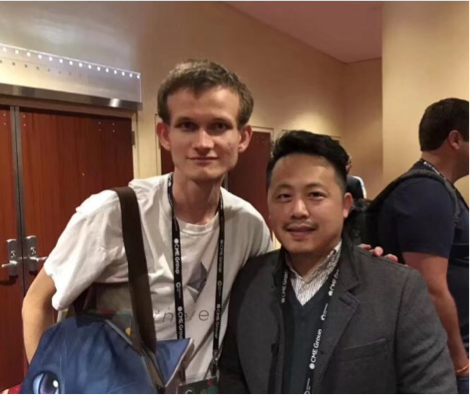
Pictured: Vitalik Buterin and Dr. Feng Cao
Community and Marketing:
· Telegram: has 7,370 members and growing
· Twitter: 1000 followers. Pictured below $PCH’s Jeff Cao alongside $NEO’s @dahongfei March 30th2018.
· Medium: 87 followers
· Github: 17 followers and 21 contributions to public Github (Private Github to be released post test-net in Oct)
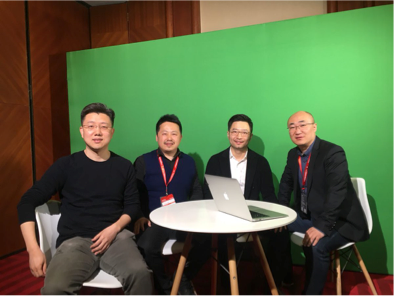
Seated are Wang Hao (Founder, Beijing Zhiding Technology), Jeff Cao (Founder, PChain), Da Hongfei (Founder, Onchain, NEO) and Meng Yan (CEO of Bo Chain Gateway, VP of CSDN) at the BTA Conference
Road Map
According to the project, Pchain will come with lots of features applicable to smart contracts, including distributed artificial intelligence, digital asset transaction, and/or a notary system.
· March 2018: Pchain White Paper completed
· September 2018:Complete the development of the Pchain core system, which supports account system and deployment of smart contract. Publish technical white paper. Test net of main chain online.
· March 2019:Publish the Mainchain on the major network. Complete documentation of external API and wiki.
· June 2019:Expand the capabilities of knowledge graph and Data Block-chain. Support external development interfaces
· September 2019:Introduce several block-chain application projects to form Knowledge Graph Blockchain Alliance.
As outlined above, Pchain is still in R&D whitepaper stage. In regards to release of a prototype, CEO Jeff Cao: “Different people have different understanding on prototype/MVP so we don’t claim we have one by now. Precisely speaking, we have implemented some key modules and are in phase one of internal integration. The test environment is built with initial test cases developed. We are adopting an iteration dev module, that means we can release a runnable “prototype” at any time in April”.
Pchain public Github shows 21 contributions in the last year. Pchain have mentioned that they have a private Github depository that they will set public after the test net is online (September 2018).
Token Utility:
The primarily demand for the token will come about from transaction costs to be settled in PCH. These transaction costs will be required to pay for invoking smart contracts over the blockchain.
Token metrics:
Pchain is in active pre-sale now, ICO date yet to be announced (expected late April)
· Token ticker: PCH, ERC20 token.
· Price per token is yet to be announced
· Exchange listing expected in May
· PCH total token supply: 2,100,000,000 (2.1bn)
· Token sale: 35% (15% pre-sale and 20% main sale) for 50k ETH hard-cap (approx. $20m)
· Token allocation as follows: Team & early contributors 25%, Community building 25%, POS mining, (incentive for proof of stake) 15%
Allocation of funds:
1. 65%. Pchain system R&D, including wages, software and hardware procurement
2. 20%. Carrying out marketing campaign, including wages, promotion expenses
3. 10%. Carrying out operations
4. 5%. To cover legal and compliance expenses
Conclusion:
PChain if successful, will be a truly technical breakthrough as the world’s first multi-chain solution to be compatible with EVMs. Pchain will operate at a level of speed, scalability and interoperability that other blockchains cannot compete with and offers the first solution that will be able to sustainably serve large scale industrial applications of blockchain technology.
While there are no named Advisors yet and the team is currently lacking on the marketing front, investment and partnership from the likes of Torque Capital will help make up for this. Torque are experts in marketing and the Pchain Telegram group has already grown from a few thousand to over 6,000 in a matter of a week. Finally, the Pchain team is world class and is lead by the “Vitalik” of China, the renowned Dr. Cao Feng, with direct ties to the government and a number of local commodities exchanges. The team also already has several large partnerships in the works (ChinaLedger, CFLP, North America Blockchain Association etc), and with the test net due out in September, Pchain is well on track.
Rating
Applications 9
Security 8.5
Blockchain 9
Scalability 9.5
Website 7.0
Community 6.5
Research and Development 7.5
Partnerships 7.5
Total 8.0
Basics:
Ticker: PCH Ethereum
Type: ERC20
ICO Token Price: no ICO yet (expected late April)
Exchanges: none yet
Website:
Telegram:
Public Github:
Twitter
Instragram:
Medium:

This week a group of Rhodes Scholars headed to the ZhenFund offices in Beijing for discussions with several successful Chinese innovators.
The Rhodes Scholarships are the oldest and most celebrated fellowship awards in the world. They have inspired countless leaders including former President of the United States, Bill Clinton, and are highly regarded internationally. The Rhodes Scholarship also set the precedent for numerous other prestigious fellowships including the Fulbright program.
At the event, IOS Foundation CEO Jimmy Zhong spoke about the challenges startups face in the age of the internet and also discussed the ways he believes blockchain will enable an entirely new iteration of commerce to develop by enabling micropayments and cutting out middlemen.
 IOST CEO Jimmy Zhong lecturing Rhodes Scholars about the challenges facing the blockchain industry
Zhenfund is one of China’s most respected venture capital firms, and has maintained a close relationship with IOST since our inception. Yusen Dai, currently a partner at Zhenfund, also serves as an advisor for IOST. Yusen has a wealth of experience with internet services as he formerly co-founded . Under his leadership, JuMei grew from a small company to a multi-billion dollar entity in only 4 years. It is currently the largest online cosmetics retailer in China and one of the largest Chinese e-commerce companies.

Over the past few months, we’ve seen countless new DEXs in the works. This is a good thing: the market is finally waking up to the failure of centralized exchanges. However, centralized exchanges still dominate this market.
To shift this paradox, we’re building a decentralized exchange that has all the speed advantages of a centralized exchange combined with all the security advantages of a decentralized exchange.
In order to be competitive, DEXs must have the following characteristics:
Instant trustless tradingGreat user experienceBlockchain interoperability
Trustless trading is possible using atomic swap technology and smart contracts. Atomic swaps address trustless trading and interoperability, but fail to provide a great user experience for two reasons.
Transactions can take minutes to be confirmed on their blockchains.Users will have to pay high blockchain transaction fees.
This constrains trading volume, liquidity, and jeopardizes the user experience. Users want security but not at the expense of trade transaction speed. This is why we are focusing on building an instant and trustless trading model with an amazing user experience with our upcoming release next month.
Introducing The Altcoin.io Side-Chain
This scaling problem is currently being solved by introducing a second layer of side-chains specifically made to support the transactions needed in each respective application. This idea was proposed by Vitalik Buterin and Joseph Poon in their Whitepaper.
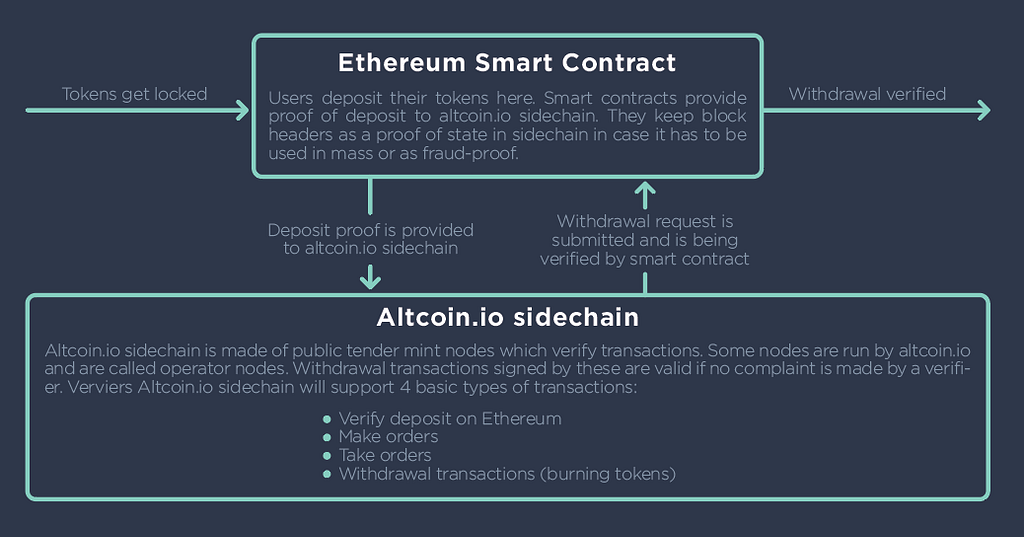
Plasma consists of a smart contract on the Ethereum network which locks value and provides proof of locked value to the side-chain (i.e. tokens). Once tokens are locked in smart contracts they become available for users to transact on the side-chain. Because this side-chain is specifically created to serve the needs of a specific application it’s running, in this case the Altcoin.io DEX, it can support far more transactions.
Another reason it is so scalable is because consensus is reached by using Proof Of Authority (PoA). In other words, an operator (i.e. an Altcoin.io main node) signs transactions and commits them to blocks.
Preventing Fraud and Double Spending
Fraud and double spending are prevented in side-chains by having verifiers watch over all transactions being committed to blocks and reporting bad behaviour. By rewarding verifiers with transaction fees (altcoin.io exchange maker taker fees in this case), they’re economically incentivised to ensure all transactions are valid.
If verifier nodes spot fraudulent or malicious behavior on the operator side, they will trigger a “Mass Exit” by reporting it to users who’ll then exit the exchange by unlocking their value from smart contracts after providing proof of ownership from the latest legitimate state in the side-chain. The smart contract verifies these using side-chain block headers which are being submitted regularly to the Ethereum network.
Ensuring Security & Full Token Control
In addition to the above, our next release will include a “Mass Exit” mechanism to use as a disaster recovery which will enable users to exit from our exchange in the unlikely event there is a hack, unexpected server downtime, or malicious behavior without ever losing any crypto assets.
Altcoin.io will be using as a consensus mechanism in the side-chain. Tendermint is perfect for creating side-chains and we are building deposit, withdrawal, and mass exit mechanisms on top of Tendermint Core.
As we get closer to launch we’ll be providing more technical details.
But What About Liquidity?
Many people looking to build a decentralized exchange or wallet lack the knowledge and technology to do it, and rush to a white paper just so they can afford the expertise to make their vision a reality. We all face the same challenges, so it makes sense to work together.
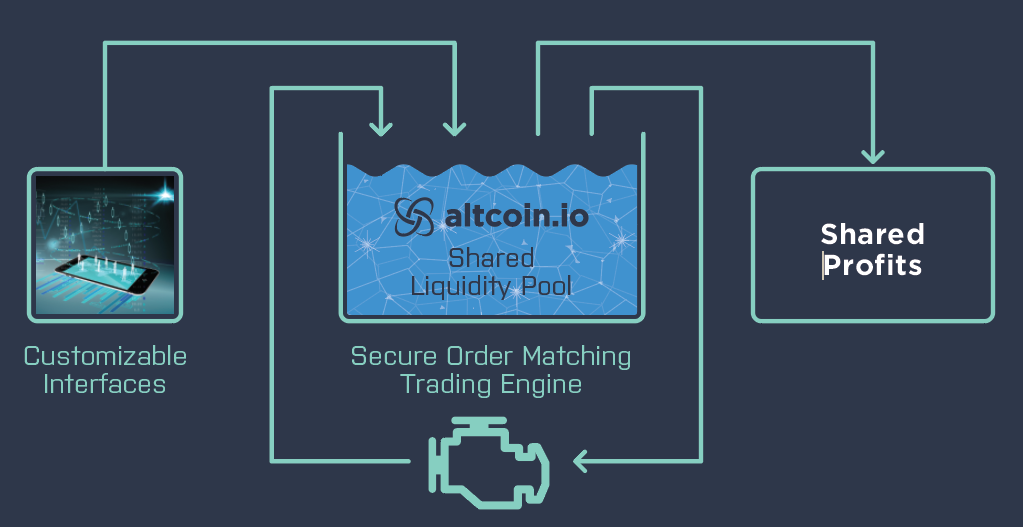
So, we’re building the next version of our exchange in a way where we can easily supply our secure trading engine and you customize the exterior however you’d like. You can add extra features, change the UX/UI, mold the exchange to your brand, and cater everything to your existing traders.
We’ll touch on this more later but the goal here would be to help power potentially 100s of decentralized exchanges and solve the fragmented liquidity issue that all exchanges face today.
Stay tuned for more details as we continue to focus on what matters — development and innovation above anything else.
Altcoin.io Team
Want to stay up to date with Altcoin.io updates? Follow us on , like us on, preregister on our , or join our channel.
was originally published in on Medium, where people are continuing the conversation by highlighting and responding to this story.
![2019 will be massive for bitcoin [btc]! Will altcoins survive? How vc “cartels” destroyed crypto in 2018](https://ohiobitcoin.com/wp-content/uploads/2019/01/pWfpVM.jpg "2019 will be massive for bitcoin [btc]! Will altcoins survive? How vc “cartels” destroyed crypto in 2018")
