This proud father explained to reporters, first hand, “Yes, it is true. He was genuinely born a Hacker. When he was born, the first thing he did was point to my Bluetooth earpiece. Then he started to take it apart! He was not even a day old!”
“The next thing we knew, he was walking at an early age, straight to my computer. By the time he was 3, he started to make his own computers out of old staplers and chewing gum. The crazy thing is that they worked! The Commodore 64 was nothing next to the ‘Andrew Special’, as we used to call them. At one point we must have had about 100 of them around the house, and we decided to start giving them away to our family and friends. They are still operating, to this day — all of ‘em.”
Dan Hacker, the father of Andrew Hacker, CEO of Thought.live, is very excited for his son and his upcoming ICO. But for interesting reasons. He saw his son’s future develop before his very eyes.
“I myself was never into computers, but when Andrew started to come to my work at the age of 6, he was doing my work for me. He could program before he could read. I started to worry whether I can even work at my computer anymore, but when Andrew started to fix my Excel equations and upgrade my computer to the latest specs with paperclips — all before he was 8 — I thought to myself that this could be a good thing. ”
“The word about my boy’s computer smarts spread quickly, and people started to call him ‘Young Hacker’. My wife was not quite happy about it, and we even thought about changing our last name, but then it dawned on me. I understood that the name was like a prophecy, or a calling. We knew he would never join the dark side, but stay on the good side, and our family name would be perfect for him. Like Thor!”
“Now that Andrew is a well-known Cybersecurity Expert, in Residence at Harrisburg University, and one of the most recognized faces in this field, he has attracted a lot of attention from the media. He is one Hacker to be proud of!”
“Now he has a company called Thought and is doing something with AI. I don’t know much about artificial intelligence, but I understand it is kind of like the “Terminator”, but Andrew has assured me that as long as he’s working on AI, we won’t need to call on the services of Mr. Schwarzenegger.”
“He’s also doing something called an ICO, and I’m not exactly sure what that means either, but it must be big. Apparently, even the university likes it and supports Andrew. Apparently, they are quite picky about the projects they support.”
“From early on I knew my son would do great things. I’m really proud of his accomplishments, and I support him with all of my heart. I know he’s going to change the world for the better and will only let friendly machines take over the world.”
Andrew Hacker, CEO and Founder of Thought explains, “Thought is a blockchain and AI start-up, backed by Harrisburg University of Science and Technology. Thought is fundamentally changing the way data is processed by embedding AI into every small piece of data. This makes otherwise ‘dumb’ information smart. Data becomes able to act on its own, eliminating the need for external applications, and thus makes data processing faster and cheaper.”
“Thought also solves some major issues with the current AI technology. It makes AI more transparent and accessible, and makes sure that the machines are kept under control, so we won’t need to create a revolution against the machines and bother Arnold Schwarzenegger, making my dad happy.”
Thought’s ICO is live now.
Sign up at to receive a 5% discount from the 1st of April to the end of the ICO on the 30th of April.

was originally published in on Medium, where people are continuing the conversation by highlighting and responding to this story.
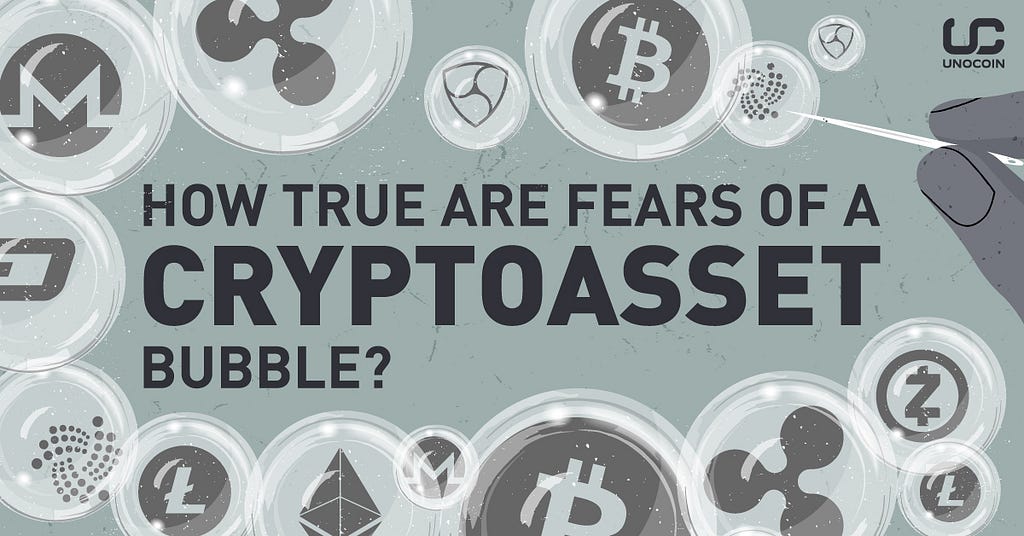
Any conversation around crypto coins focuses predominantly on two themes: the financial and technical aspects. The underlying ledger technology and encryption algorithms have fascinated academia, industry experts and even people at the grass root level across. Simultaneously, the financial aspects of cryptoassets have intrigued pundits and economists across the globe. Many enthusiasts would jump at the opportunity to champion the concept and the entity of a cryptoasset.
However, there are others who would either steer away from investing time and money in the crypto market or voice concerns about an impending doom that they believe might envelope the cryptoassets. Although the fears stem from some valid reasons, not all their fears can be justified in reason. The rocketing prices for bitcoin have helped the market capitalisation of cryptoassets touch $500bn. This naturally makes many wonder if we’re in the midst of a bubble.
Fears lurking around the concept
Industry experts have succinctly categorized the fear around cryptoassets in two classes: financial and technical. While the financial skepticism generally talks about it being a bubble, the technical side is that coins will be lost, stolen/hacked, or just be subjected to fraud. Creative theft, hacking and other technological caveats form the bulk of concerns around this space for most people. The underlying Blockchain technology is also being scrutinized by many others in this space.
However, more than the people who express some doubts about the same, there are others who are more than happy to welcome the technology in various other applications. John Monarch, CEO of , a blockchain based logistics software company, , “It’s a new asset class that has taken the world by a storm since bitcoin first hit the scene. The volatility in the market might add fuel to the fear, but the excitement around the base technology seems to be outpacing that. I’d say most people actually involved are more happy about the evolution of cryptoassets and blockchain than they are fearful.”

It can be compromised using selected, targeted Cyber Intrusion practices leading to a hack with malware or ransomware. Additionally, it is believed that unregistered wallets and transactions are safer from a hack than registered ones.
Many cryptoassets have not been audited by their regulators and in 2018 they might be stated in examples of financial audits and failed stories. Many investors suspect their coin miners or exchanges might be shut down due to non-compliance of regulations and rules. A part of the fear also comes in when governments across countries have publicly banned digital assets thus, having zero recourse or refund.
bitcoin is not underpinned by a central bank. It allows users to bypass traditional payment systems when transacting — a premise that has naturally caught the imagination of many, leading to a price surge of more than 900% in 2017. Created by ‘miners,’ bitcoin often has to deal with fears of an economic bubble.
The rising skepticism hovers around investors as bitcoin becomes treated less like a asset and more like a store of value, open for speculators making huge bets on how far the value can rise. Economists have also compared bitcoin’s meteoric rise with past bubbles like the . The also foreshadows a devastating collapse for coinage that has no intrinsic value to the investors beyond what was ascribed to it by a community of creators.
Are the fears justified?
Despite having ‘bubble-like’ qualities in the cryptoasset space, . They see credit in the fact that the price of cryptoassets could be affected only if something unfortunate were to happen to the protocol that underlies it. Experts explain that the cryptoasset price fluctuations are not the same thing as an artificially hiked price or “bubble.” It is the result of a technological or community failure, but not on the chance of market failure.
When bitcoin upgraded to Segwit it did not necessarily align with Satoshi Nakamoto’s vision that bitcoin should be a scalable, peer-2-peer cash system. On the other hand, it converted bitcoin into a settlement layer, which might cause some charm to the asset. In either case, people hope that Segwit will work well for bitcoin in the long run. The hope is that they would not see a technological failure that takes the cryptoasset down.
This just goes on to establish that cryptoassets are susceptible to failures and crashes. It is just that these potential crashes are not the result of a “bubble.” They would occur because the community failed to make the crypto coin economically viable. When it comes to the technology, Blockchain has invaded all niche tech-spaces — from IoT to Big Data analytics. Every industry is talking about incorporating Blockchain in their operations and functioning owing to the benefits it offers in terms of a decentralized and secure system of interconnected systems. With promises of that kind, Blockchain technology is bound to stay and develop over time.
Also Read:
was originally published in on Medium, where people are continuing the conversation by highlighting and responding to this story.
If you are new to cryptocurrencies and blockchain technologies, bitcoin might be the only investment option on your menu. But as you embark on the crypto-scene you could be understandably overwhelmed when you encounter two to three thousand different cryptoassets available for sale and trade.
So, how do you determine which cryptoassets are worth investing in? Here’s a guideline of questions I ask myself to help identify a project as potentially worthwhile as opposed to a passing fad or a $#*!coin.
Origins and History:
· Who are the developer(s) and key people involved in creating and supporting this project? Do they have associates or social/financial connections that propose to be beneficial to the project?
· Which blockchain/platform does this asset utilize (bitcoin, Ethereum/ERC20, etc.)? Alternatively, is it currently operating on its own platform (as a native asset)…or is it planning to make such a move in its future plans?
· Has the cryptoasset’s platform been involved in any forks or other redirective movements? What was the underlying issue instigating the divergence of directions? Was it resolved/improved? What was the impact of the process on the cryptoasset?
· How has capital been raised to fund this project? Crowdfunding? ICO and pre-ICO? Donations? Other creative avenues?
· What is the overall (big picture) price history of this cryptoasset? What analysis or insight might explain prior plateaus and/or volatility?
· What is the current circulating supply? What is the present market capitalization, and how does it relate to the anticipated performance of the project/cryptoasset? What is the typical volume range?
· What is the level of transparency in this project? Furthermore, have there been any prior security breaches or fiduciary malfeasance?
Features:
· What is the level of decentralization of this project? How important is decentralization to the project’s mission/stated purpose?
· What is the level of democratization of this project? How important is democratization to the project’s mission/stated purpose?
· What is the level of privacy/anonymity and security provided by this project?
· What relative speed does the project/blockchain operate under? How quickly are transactions/blocks processed?
· What are the applicable fees to utilize this project’s network? Any incidental fees/costs?
Project Vision and Direction:
· What are the highlights of the project/cryptoasset’s whitepaper?
· What service or good is being offered (target use case)?
· To whom (demographics of target use case customers)?
· Under what conditions?
· What means will be used to bring this good/service to the market?
· What is the overall benefit proposed by this project?
· What specific goals/milestones/benchmarks are proposed in the roadmap? Do the goals and timelines/deadlines seem feasible and concrete?
· What partnerships or collaborations are being cultivated to expand and optimize the [international/global] reach of this project?
· Which human and societal future demands or values are addressed by this project?
Structure:
· What type of protocol does this project utilize? How is it similar to and different from other protocols (in comparable use case applications)? What is the consensus process/mechanism and what are the fundamental guidelines or limitations?
· What is the distribution schedule for this cryptoasset?
· When will tokens/coins be released? All at once or delayed release schedule?
· How will tokens/coins be released? Air drop? ICO?
· How many tokens/coins will be released? Initially, and ultimately?
· To whom? Are reserve portions held back by owners/developers/future plans?
· What is the incentivization plan for this cryptoasset? Mining? Pre-mining? Staking?Bounties? What others ways can an investor increase his/her holdings without additional capital?
· What tangible and/or virtual infrastruture is in place (or to be put into place) for this project?
· Which exchanges/trading platforms offer this cryptoasset?
· Which wallets can be used in conjunction with this cryptoasset?
These should bring you to a basic, well-rounded understanding of the project/cryptoasset. Some of this information is readily available and can be researched directly. However, for a deeper scrutiny into the future prospects of a cryptoasset, the following considerations will require both critical thinking skills and a mind open to a future of exciting possibilities.
Further considerations for a creative and critical analysis of the viability of the new cryptoasset:
· How does this proposed project improve the current (possibly outdated) architecture/infrastructure/system?
· What future innovations could potentially be built on this platform/model?
· To whom will this project provide benefit and/or cost-savings?
· What other sectors/government/industry might be affected/impacted/interested/involved?
· What future demands/values could this project or cryptoasset address?
· Assuming this project, as a decentralized and democratized cryptoasset, proposes a “shared representation of value…” Value of what? Is this value applicable beyond the crypto-currency?
· What is this project/cryptoasset’s greatest competitive advantage?
· What is its most obvious weakness? What would cause it to fail?
· What is the strongest criticism of the project? And who is discussing it (Reddit, Discord, Telegram, Slack, Medium)?
· What are the uncertainties associated with this project? How can ambiguities be addressed?
· What are the potential legal or regulatory issues that could interfere with (or advance) this project?
Armed with this background research and analysis, you should be able to carry on an intelligent conversation about the project/cryptoasset, but more importantly, you will have a fundamental understanding of the both the basis of your investment choice and the level of risk you are accepting.
Due diligence is crucial for maintaining a healthy crypto portfolio. Hopefully this article helps you make informed investment decisions in a market with projects that can disappear just as quick as they appeared, but please remember that the statements in this article do not constitute financial advice.
Want to chat? Follow me on twitter @Triblincanto
Please support Bilibit to be listed on KKCOIN. Thank you!