Team ZPER is back with more great news!
The long-awaited official dates for our ICO main sales are finally RELEASED!
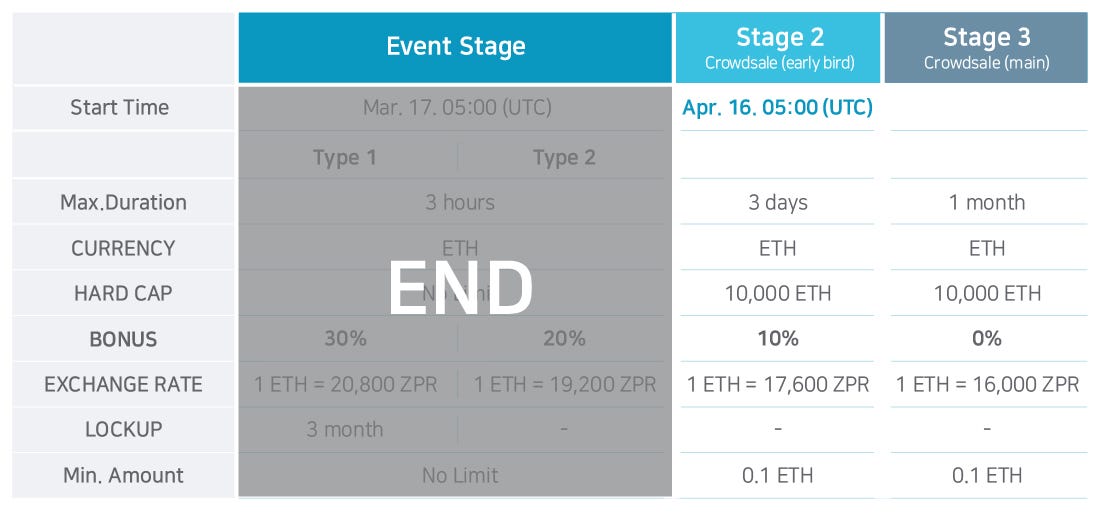 ※ If the hard cap for stage 2 is reached before the duration ends, Stage 3 starts the following day 05:00 (UTC)Early bird Crowdsale
4. 16 05:00 ~ 4. 18 05:00 (UTC)
Main Crowdsale
4. 19 05:00 ~ 5. 16 05:00 (UTC)
ZPER Air-Drop : ZPER Telegram : Homepage : Facebook : Twitter : Onepager : Whitepaper : 

IDchain is a blockchain ID structured as the DNA chain. The objective pursued by IDchain is to increase the accountability of each individual in a society and reduce thereby the leaks of financial resources coming from free-rider actions such as tax evasion or insurance frauds. As I will explain later, the structure of this Blockchain will be similar to the one adopted by the human DNA.
What is a blockchain?
A blockchain — the technology underlying bitcoin and other cryptocurrencies — is a shared digital ledger, or a continually updated list of all transactions. This decentralized ledger keeps a record of each transaction that occurs across a fully distributed or peer-to-peer network, either public or private. A blockchain’s integrity hinges on strong cryptography that validates and chains together blocks of transactions, making it nearly impossible to tamper with any individual transaction record without being detected (Morrison, n.a.).
What are the pain points addressed by this solution?
With the application of the blockchain technology, the following four pain points can be addressed: tax evasion, health’s costs, insurance’s cost, and identity fraud’s costs. In what follows I will illustrate why these four pain points are highly relevant for the modern society.
Starting from tax evasion, the Internal Revenue Service of the U.S. government has calculated that between 2008 and 2010 tax evasion has cost the U.S. government $458 billion each year (Internal Revenue Service, 2016). Another way of look at this problem is that only 81.7% of tax owned find their way to Internal Revenue Service on time (Fortune, 2016).
Health costs are another relevant issue nowadays. It has been estimated that in 2014 the American Center for Medicare and Medical Service has saved $ 210.7 million through identified cases of healthcare related fraud. This has been possible thanks to the application of predictive analysis. Blockchain technology is relevant to tackle this issue since it guarantees full anonymity of the data and therefore incentivizes the sharing of personal information. This data, which collectively constitutes the so called “big data”, is at the base of predictive analysis (Tahir, 2015).
Analyzing the pain point of insurance costs (exclusive of health insurance), it is estimated that frauds in this sector costs to the average American family from $400 to $700 a year. These costs could be drastically tackled if data of all insured would share their data to improve predictive analysis (Fortune, 2015).
Last but not least comes identity fraud, which in 2014 has generated $15.4 billion costs in the U.S. Identity fraud allows individuals, for example, to carry out financial activities in name of another person (U.S. Department of Justice, 2015).
How is IDchain a disruptive idea?
The application of blockchain technology to collect, protect, and analyze data regarding each citizen is disruptive since it increases transparency without endangering the protection of one’s privacy. So far, each of the above mentioned four pain points has been addressed with individual documentation, data collection, and investigation. The solution I am presenting tackles all those pain points through a single, digital technology.
Is there any similar solution already applied?
Estonia has already developed the concept of digital identification and citizenship. An E-resident is allowed, among other things, to: digitally sign documents and contracts, encrypt and transmit documents securely, establish and administer a company online, manage and e-banking account, and declare Estonian taxes online (Estonian ICT Export Cluster, 2016).
Furthermore, different companies or open platform such as Blockstack, Airbitz, and RSK are already offering services based on the blockchain technology to increase trust and accountability for contracts, payment, and personal identification (Skinner, 2016) (RSK, 2016)
This demonstrates that the technological know-how and infrastructure are already available or at least easily developable. However, no example of an aggregation of a person’s data on such a scale and in this form of a blockchain has been presented so far.
Which is the most important data to start with?
The blockchain developed for each individual would collect information regarding the following four categories: tax and fiscal data, health data, license data, and identification data.
Tax and fiscal data would cover all the tax payments, from the earnings to the assets owned by a person to check for eventual tax evasions. The same concept could additionally be applied for each enterprise as a countermeasure to fiscal fraud, tracking all the payments going in and out of the enterprise.
Health data would comprehend insurances stipulated and medical records of each individual. The objectives here are many: avoiding insurance frauds, improving pricing strategy of the insurance companies through big data analysis, and simultaneously boosting the medical research through access to a bigger database of medical cases without compromising the privacy of individuals. On the last point, the individual should decide whether sharing with or selling its data to medical companies.
When it comes to license, any type of permit to work or conduce is meant. This would assure that only those people who are authorized can actually carry out activities such as medical studio or a financial activity.
Last but not least, come identification documents. Biometrical data and travel visa would be stored on the same card, allowing for a highly secure digital identification process applicable to access various services, and protecting individuals from identity theft. Companies like ShoCard are already offering such services (ShoCard, 2016).
How does IDchain protect you from a breach into your data?
The most disruptive concept of this idea is the way that blockchain would be coded. This idea can be defined as human based not only because it puts the individual at the center of the attention by increasing its accountability, but also because it is inspired by the human DNA. In particular, by the way that the DNA is expressed.
The code of life, in fact, has a very peculiar structure, which suits perfectly the following requirements: high security and protection of privacy, and smooth accessibility to the data for accredited agencies and institutions.
DNA is opened exclusively where the information is contained, whereas all the remaining code is left packed together. This practice allows for an efficient and effective replication of the necessary DNA code and protects the rest of the chain from external influences. Similarly, the blockchain containing all the information of each individual can be read in its entirety, but it will be structured in such a way that each governmental agency or private institution could have access only to those data concerned with its activities. For example, the tax agency could only have access to tax and fiscal data, nothing more than that. This approach assures an additional level of privacy.
IDchain, the one and only
Of course, to ensure that the privacy protection is increased, no other storage of information outside of the blockchain are set up.
No one left behind
If this idea is applied to each member of a state, independently from the role of this person, then transparency among society would boost, reducing thereby those costs generated by free riders who decide not to follow the law in its entirely.
What are the assumptions necessary for this technology?
The necessary assumptions to apply the technology as presented in the previous paragraphs are: decreasing data storage prices, controllable volume of exchanged data, competent users to secure their private keys, simple utilization to guarantee smooth functioning, consensus among the by honest majority, and long term acceptance of blockchain technology (IBM, 2016).
Especially in highly populated countries, this type of data collection would generate high amount of data which forces data miners (writers of blockchain) to provide themselves a conspicuous storage capacity. This is necessary to avoid a monopolization of the writing process by big corporations or single institutions, which would increase the chances of fraudulently manipulating the blockchain. At last, a strong majority of citizens should lobby for the application of such a technology, in order to push a government to set it up.
Conclusion
Through the application of blockchain as presented above, I believe that the strong technological know-how we have developed as a global society so far could once more be applied in favor of the common good. In a society that is lacking social bond, one that suffers from the raids of free-riders, IDchain brings transparency, privacy and security for a more just society.
Sources
Estonian ICT Export Cluster. (2016). Estonian e-residency. Retrieved from e-estonia.com:
Fortune. (2015, 12 05). How big data is changing insurance forever. Retrieved from fortune.com:
Fortune. (2016, 04 09). Here’s How Much Tax Cheats Cost the U.S. Government a Year. Retrieved from fortune.com:
IBM. (2016, 10 02). blockchain for identity management. Retrieved from slideshare.net:
Internal Revenue Service. (2016, April). Tax Gap Estimates for Tax Years 2008–2010. Retrieved from irs.gov:
Lewis, A. (n.a.). A gentle introduction to blockchain technology. Retrieved from bravenewcoin.com:
Morrison, A. (n.a.). Blockchain and smart contract automation: Blockchains defined. Retrieved from pwc.com:
RSK. (2016). Welcome to the Internet of Value. Retrieved from rsk.co:
Science Focus. (2011, July 18). How long is your DNA? Retrieved from sciencefocus.com:
ShoCard. (2016, October 08). identity management on the blockchain. Retrieved from shocard.com:
Skinner, C. (2016, August). 12 standout startups focused on blockchain identity. Retrieved from banknxt.com:
Tahir, D. (2015, 02 25). Predictive analytics play new role in fraud detection, but critics want more. Retrieved from modernhealthcare.com:
U.S. Department of Justice. (2015, September). Victimos of identity theft, 2014. Retrieved from bjs.gov:

At present, the popularity of blockchain technology is quite astonishing. While it is not only brushing aside the ordinary people’s use of their Social Newtorking Service account, it also keeps the crypto thought leaders awake, deeply anxious and sleepless at three o’clock in the morning.
As the blockchain presence on the Internet gains strength and momentum, the reality on the ground is that it is weakened by the day. An embarrassing fact is that the blockchain technology has been slow to kick start its utility from the ground up. It means that we are unable to use it in our daily life and there are not many Decentralised Application (DApp) that has been successfully released using blockchain technology.
Since Ethereum was created in 2015, technology geeks and users are expected to implement blockchain technology using Dapps for daily usage. However, four years on, developers have deployed a plethora of projects using the Ethereum platform, but many are not good enough to be remembered.
The reasons for it are due to high transaction (TX) fees and ultra-low transactions per second (TPS) throughput per block created on the blockchain.
As is commonly known, the Gas mechanism is essentially used in transactions. It is the basis for transacting in the entire Ethereum platform. It guarantees the stable operation of the Ethereum ecosystem under three elements: security, rational utilisation of computing resources, and miners.
Ethereum uses Gas for calculating transaction cost, and any other incidental costs. It prevents excessive usage of resources and useless transactions hogging the network. It also prevents the malicious trading attacks. While at the same time, Ethereum is essentially a distributed ledger, all operations are considered as a transaction by default. For developers and smart contracts creators the cost is heavy. According to statistics, a smart contract call from the DApp costs approximately $1–3 each time it is executed on the blockchain. Imagine a scenario of developing a social networking software Dapp on Ethereum, and users are required to pay a TX fee when they do routine operations like commenting, retweeting and collecting information. It is obviously that such a DApp will not be looked at favorably by anyone. Consequently, this Dapp has no market prospect.
Another important reason is the network congestion problem on the Ethereum Mainnet. At the moment, the TPS of Ethereum is 8–15 per second, and imagine how many transactions are created every second on the Ethereum Mainnet, Therefore, one will quickly realise that the Ethereum blockchain has a serious scaling problem.
At present, Ethereum has a high market capitalisation. Due to inherent design flaws, Vitalik Buterin proposed a subdivision technology. On one hand, this implementation is difficult, but on the other hand, it takes a long timeframe to deliver it, These gives the other blockchains an opportunity to overtake Ethereum’s market capitalisation.
In 2018, whoever is able to provide the underlying technology for large-scale commercial use will be able to attract a large number of DApp developers. It will be able to compete with Ethereum.
Depending on the market sentiment and faith in 2018, we rely on capital control to stabilise the price of the fait currency. However, it will not last for a long time. When the game is up, you will see who is caught out. Bear market sentiment is actually a good time to choose gold from sand. The general blockchain that can survive and go far in the future can only be achieved by technology which really drives the practical application.
A general chain that enables DApp to ‘hit the ground’ running, in addition to security, also needs to resolve the problem of handling high transaction fees, network congestion and the issue of scalability.
At present, there are two common chains that can resolve the handling fee and network congestion problem well by realising zero TX fee and high throughput by TPS.
EOS.
The white paper of EOS states that TPS level can reach millions. Later after questioning by many people, EOS has changed to several thousand per seconds. It has a very surprising speed which is at least more than one hundred times faster compared to the Ethereum transaction speed. At the same time, the EOS is free of charges when used by ordinary users, namely zero TX charge.
The reason why EOS can achieve high TPS is because it uses Masternodes, and any transaction requires only those 21 nodes to verify and pass. To this point, the founder Vitalik Buterin repeatedly attacks the system for not being safe enough, because it is not decentralized enough, it is sacrificing safety to meet efficiency.
EOS’s main network is expected to be completed in June this year. We will see how secure it would be.
Another general blockchain that can achieve zero TX fee and high TPS at the same time is the hard fork of Ethereum called EtherZero. This chain is not well-known at the moment. It is more well-known abroad than domestically.
Zero TX fee in EtherZero is derived from its logical design. It retains the gas mechanism of the Ethereum, but does not deduct the cost in each operation, thus preserving the advantages of the gas mechanism and preventing DDOS attacks. At the same time, it designed some transaction thresholds and restrictions to prevent garbage trading.
For high TPS throughput, the masternode double-layer network mechanism is adopted, which is divided into the Masternode layer and the bookkeeping layer. The transaction is verified by the Masternode and returns the transaction result. The Masternode layer then broadcasts the transaction to the bookkeeping layer, packaging the block, and TPS can reach the 10,000 level.
The kecaak algorithm is adopted for the authentication mechanism of the Masternode layer in the EtherZero architecture. It randomly selects 10 masternodes among all the Masternodes. So as long as 6 of them have verified the transaction, the verification process is completed. Because the Masternode is selected randomly according to the hash head of the block, the algorithm will not allow cheating in the logic. There is no problem with security. It is also worth mentioning that EtherZero plans to adopt sharding technology to solve the problem of wasting Masternode resources found in DASH cryptocurrency system.
It is reported that in June this year, EtherZero will also complete the construction of the double-layer network and the actual outcome remains to be seen. If it did what it promises in the WP, EtherZero’s future is unlimited.
After the battle of the cryptocurrencies in 2017, the whole cryptomarket needs to be reorganised and reshuffled, Their respective technology is the only way to ‘shuffle the cards’.
In the not too distant future, whoever got Dapp for the day to day running is a strong contender to win the battle. I am looking forward to a general chain that will allow the blockchain technology to actually deliver and meet people’s daily use. When that happens, a new world crypto order begins.
At present, the popularity of blockchain technology is quite astonishing. While it is not only brushing aside the ordinary people’s use of their Social Newtorking Service account, it also keeps the crypto thought leaders awake, deeply anxious and sleepless at three o’clock in the morning.
As the blockchain presence on the Internet gains strength and momentum, the reality on the ground is that it is weakened by the day. An embarrassing fact is that the blockchain technology has been slow to kick start its utility from the ground up. It means that we are unable to use it in our daily life and there are not many Decentralised Application (DApp) that has been successfully released using blockchain technology.
Since Ethereum was created in 2015, technology geeks and users are expected to implement blockchain technology using Dapps for daily usage. However, four years on, developers have deployed a plethora of projects using the Ethereum platform, but many are not good enough to be remembered.
The reasons for it are due to high transaction (TX) fees and ultra-low transactions per second (TPS) throughput per block created on the blockchain.
As is commonly known, the Gas mechanism is essentially used in transactions. It is the basis for transacting in the entire Ethereum platform. It guarantees the stable operation of the Ethereum ecosystem under three elements: security, rational utilisation of computing resources, and miners.
Ethereum uses Gas for calculating transaction cost, and any other incidental costs. It prevents excessive usage of resources and useless transactions hogging the network. It also prevents the malicious trading attacks. While at the same time, Ethereum is essentially a distributed ledger, all operations are considered as a transaction by default. For developers and smart contracts creators the cost is heavy. According to statistics, a smart contract call from the DApp costs approximately $1–3 each time it is executed on the blockchain. Imagine a scenario of developing a social networking software Dapp on Ethereum, and users are required to pay a TX fee when they do routine operations like commenting, retweeting and collecting information. It is obviously that such a DApp will not be looked at favorably by anyone. Consequently, this Dapp has no market prospect.
Another important reason is the network congestion problem on the Ethereum Mainnet. At the moment, the TPS of Ethereum is 8–15 per second, and imagine how many transactions are created every second on the Ethereum Mainnet, Therefore, one will quickly realise that the Ethereum blockchain has a serious scaling problem.
At present, Ethereum has a high market capitalisation. Due to inherent design flaws, Vitalik Buterin proposed a subdivision technology. On one hand, this implementation is difficult, but on the other hand, it takes a long timeframe to deliver it, These gives the other blockchains an opportunity to overtake Ethereum’s market capitalisation.
In 2018, whoever is able to provide the underlying technology for large-scale commercial use will be able to attract a large number of DApp developers. It will be able to compete with Ethereum.
Depending on the market sentiment and faith in 2018, we rely on capital control to stabilise the price of the fait currency. However, it will not last for a long time. When the game is up, you will see who is caught out. Bear market sentiment is actually a good time to choose gold from sand. The general blockchain that can survive and go far in the future can only be achieved by technology which really drives the practical application.
A general chain that enables DApp to ‘hit the ground’ running, in addition to security, also needs to resolve the problem of handling high transaction fees, network congestion and the issue of scalability.
At present, there are two common chains that can resolve the handling fee and network congestion problem well by realising zero TX fee and high throughput by TPS.
EOS.
The white paper of EOS states that TPS level can reach millions. Later after questioning by many people, EOS has changed to several thousand per seconds. It has a very surprising speed which is at least more than one hundred times faster compared to the Ethereum transaction speed. At the same time, the EOS is free of charges when used by ordinary users, namely zero TX charge.
The reason why EOS can achieve high TPS is because it uses Masternodes, and any transaction requires only those 21 nodes to verify and pass. To this point, the founder Vitalik Buterin repeatedly attacks the system for not being safe enough, because it is not decentralized enough, it is sacrificing safety to meet efficiency.
EOS’s main network is expected to be completed in June this year. We will see how secure it would be.
Another general blockchain that can achieve zero TX fee and high TPS at the same time is the hard fork of Ethereum called EtherZero. This chain is not well-known at the moment. It is more well-known abroad than domestically.
Zero TX fee in EtherZero is derived from its logical design. It retains the gas mechanism of the Ethereum, but does not deduct the cost in each operation, thus preserving the advantages of the gas mechanism and preventing DDOS attacks. At the same time, it designed some transaction thresholds and restrictions to prevent garbage trading.
For high TPS throughput, the masternode double-layer network mechanism is adopted, which is divided into the Masternode layer and the bookkeeping layer. The transaction is verified by the Masternode and returns the transaction result. The Masternode layer then broadcasts the transaction to the bookkeeping layer, packaging the block, and TPS can reach the 10,000 level.
The kecaak algorithm is adopted for the authentication mechanism of the Masternode layer in the EtherZero architecture. It randomly selects 10 masternodes among all the Masternodes. So as long as 6 of them have verified the transaction, the verification process is completed. Because the Masternode is selected randomly according to the hash head of the block, the algorithm will not allow cheating in the logic. There is no problem with security. It is also worth mentioning that EtherZero plans to adopt sharding technology to solve the problem of wasting Masternode resources found in DASH cryptocurrency system.
It is reported that in June this year, EtherZero will also complete the construction of the double-layer network and the actual outcome remains to be seen. If it did what it promises in the WP, EtherZero’s future is unlimited.
After the battle of the cryptocurrencies in 2017, the whole cryptomarket needs to be reorganised and reshuffled, Their respective technology is the only way to ‘shuffle the cards’.
In the not too distant future, whoever got Dapp for the day to day running is a strong contender to win the battle. I am looking forward to a general chain that will allow the blockchain technology to actually deliver and meet people’s daily use. When that happens, a new world crypto order begins.
Tron (TRX) is currently still basking in the glory of and the Justin Sun live-stream on the 31st of March, less than 8 days ago. The live-stream was then followed by the Technical team explaining and answering questions about the Tron project. To add icing on the cake, from the prestigious Hupan University which has Jack Ma as its Principal and co-founder. The other co-founders are 8 prominent entrepreneurs and distinguished scholars whose main aim was to groom up-and-coming entrepreneurs in the ever chaining world of global business that is shaped by technology.
Evidence of the ever evolving technology space is the Tsunami-like growth of blockchain and cryptocurrencies. Tron has lead the way in terms of project developments and excitement in the blockchain space.
What has gone under the radar, is that the Tron platform based on Ethereum, has functional Decentralized apps already running on it. These DApps will in turn be migrated to the final Tron Network that is slated for release on May 31st.
currently have 100 Million existing users with Peiwo leading in popularity with 30 Million constant users. Peiwo is an anonymous chat application available for download on Android and iOS. By being anonymous, users can be themselves 100% and find new friends.
Another DApp is Game.com that provides a new world of gaming to help digital currencies provide entertainment service applications and promote the rapid development of blockchain technology by means of entertainment content. Gifto is another DApp that enables community participants from different platforms to work together to create, review, and customize a wide range of high-quality virtual gifts for content creators around the world and leverage the power of blockchain technology to create a decentralized ecosystem.
Odyssey is a DApp with the mission of building the next-generation decentralized sharing economy & Peer to Peer Ecosystem. The sharing economy is further expanded by the OBike DApp that is a stationless bike sharing platform, providing a hassle free, more sustainable, healthy, tech-friendly, and economic mode of transport. Mico which is a mobile social networking platform for the global market.
The Kitty live DApp amplifies live-streaming around the world. GSC (Global Social China) is the world’s first new generation of social network chain that owns hundreds of millions of social users. Another DApp that uses Tron is Baofeng Xinging which helps blockchain businesses deploy massive nodes rapidly.
With the TRON community on Mainnet, the sky is the limit for the Tron Project.
The post appeared first on .