July 25, 2026

Capitalizations Index – B ∞/21M

NVIDIA CEO: “Cryptocurrency Is Here to Stay”

Nvidia ceo: “cryptocurrency is here to stay”

NVIDIA CEO: “Cryptocurrency Is Here to Stay”

Nvidia ceo: “cryptocurrency is here to stay”

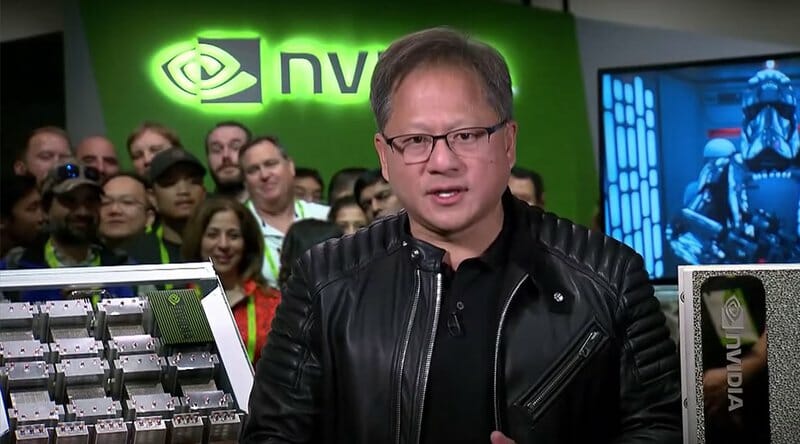
Speaking with Mad Money host Jim Cramer, NVIDIA CEO Jensen Huang recently claimed that “cryptocurrency is here to stay,” and he “doesn’t see the craze ending anytime soon.”

Though itfirst came to fruition in 2008, bitcoin gained a solid taste of mainstream popularity in 2017 when its price began rising faster than anyone had anticipated. The year started with a single bitcointrading at nearly $1,000, though things ended on a higher notewhen the currency nearly grazed the $20,000 mark.

Since January 2018, bitcoin and other virtual currencieshave experienced serious drops in their prices, but Huang is convinced that cryptocurrency remains as popular as ever.

“Cryptocurrency will be here,” he stated in the interview while discussing the future of finance. “The ability for the world to have a very low-friction, low-cost way of exchanging value is going to be here for a long time.”

NVIDIA is a technology company based in Santa Clara, California. Some of the enterprises’ staple products are its graphics processing units or GPUs. These small processors, Huang explains, were some of the main reasons the company first decided to get involved in cryptocurrency last year.

The GPUs have a powerful ability to mine virtual currencies, and blockchain technology requires computers that can be distributed “all over the world” while remaining immutable and safe. Thus, Huang felt his company’s productscould be greatly beneficial to cryptocurrency miners:

“The reason why cryptocurrency became such a popular thing on top of our GPUs is our GPU system is the world’s largest installed base of distributed supercomputing. Our processor serves as the perfect processor to enable this supercomputing capability to be distributed, and that’s the reason why it’s used.”

Interestingly, Huang noted that while the chips were no doubt powerful and crucial to the mining industry, he and his fellow executives are “not ready to move” on this just yet. For the time being, NVIDIA is primarily involved in the gaming business, data centers and self-driving cars, and cryptocurrency and mining operations account for only small portions of the company’s profits.

In fact, NVIDIA currentlyhas no alleged involvement in bitcoin, per Huang’s comments at a recent GPU technology conference. He said its processors are predominantly used to mine ether, which accounted for roughly 6 percent of the company’s GPU sales in 2017.

“Ethereum ‘ether’ was designed as an algorithm to ensure no singular entity (or a few entities) has the power to control the ether,” he said. “It was designed so that the algorithm requires the type of computing capabilities — the type of processing capabilities — that are made possible by GPUs in a distributed system. The GPU is popular with Ethereum because the GPU is the single largest distributed supercomputer in the world. It is the only supercomputer that is literally in everyone’s hands, and no single entity can control the currency.”

He says that the influence of cryptocurrency isn’t likely to affect how they do business in the present, though he’s very confident this could change in the future:

“Gaming is a much bigger business; data center is a much bigger business; our professional graphics is a much bigger business, and, of course, in the future, everything that moves will be autonomous, and we’ll have autonomous capabilities, and that’s going to be a much bigger market, but cryptocurrency gave it that extra bit of juice that caused all of our GPUs to be in such great demand.”

Published at Mon, 02 Apr 2018 21:28:46 +0000

bitcoin[wpr5_ebay kw=”bitcoin” num=”1″ ebcat=”” cid=”5338043562″ lang=”en-US” country=”0″ sort=”bestmatch”]

Previous Article

Ethereum Community Considers Hard Fork To Fight ASIC Miners

Next Article

Future Tech Expo Announces Latest Headline Speaker: Randi Zuckerberg, Former Facebook Executive

You might be interested in …

Ubitquity launches funding round on seedinvest crowdfunding platform

Ubitquity Launches Funding Round on SeedInvest Crowdfunding Platform

Ubitquity Launches Funding Round on SeedInvest Crowdfunding Platform Ubitquity Launches Funding Round on SeedInvest Crowdfunding Platform April 13, 2019 by Priscilla Russell Enterprise-ready blockchain recordkeeping platform Ubitquity has announced it will hold a fundraising round […]

Microsoft Office Can Now Verify Docs on the Bitcoin Blockchain

Microsoft is continuing its Blockchain journey by integrating Stampery into Microsoft Office Outlook with cross-compatibility.


Office Applications Verify Docs On bitcoin, Ethereum

Stampery, which provides verification of documents against both the bitcoin and Ethereum blockchains, will be accessible for verifying emails without users leaving Outlook itself.

“Stampery provides this functionality today by creating hashes of documents submitted through the web and storing them on the Ethereum and bitcoin public blockchains. To enable this capability, Stampery provides a RESTful API that is accessible from applications,” a dedicated release about the integration from Microsoft explains.

In this project, we leveraged this secure API to create a convenient add-in to Microsoft Outlook that performs like a near-native feature to stamp/certify an email without leaving Outlook or even the specific email that you are viewing.

Removing Centralized Trust

Microsoft adds that while various solutions already exist for document certification online, these involve signature storage via a centralized entity, thus placing trust at a weak point.

“An alternative to relying on a single entity (commercial, public, government, etc.) to keep such proof of identity safe is to create a hash of the document and send that hash to the publicly accessible blockchain, such as bitcoin,” the release continues.

“Once the hash data is present on the public blockchain, the document can’t be changed without invalidating the hash. This approach guarantees both the document’s privacy and the data’s availability for future validation purposes.”

The solution is compatible with products across the Office suite. “In a more general sense, anyone wanting to certify and verify any digital asset could reuse and build upon this knowledge, too,” Microsoft adds, noting the code for the Office implementation is open source and available on GitHub.

Microsoft ‘Will Signal UASF’

The move comes as a source claims Microsoft would “by default” support a user-activated soft fork (UASF) on the bitcoin network.

In a tweet Tuesday, Daniel Buchner, the corporation’s head of decentralized identity, said that such signalling would occur across “all (bitcoin) full nodes and clients used in Microsoft’s open source decentralized identity implementations.”

//platform.twitter.com/widgets.js

Asked whether this would mean following a minority chain, Buchner said in a response that it would be “any chain’s version (it’s a cross-chain system) that best preserves/enhances the decentralized state of IDs rooted on it.”

Will Microsoft’s Stampery integration and UASF support boost bitcoin adoption? Let us know in the comments below!


Images courtesy of Microsoft.com, Shutterstock, Twitter

The post Microsoft Office Can Now Verify Docs on the Bitcoin Blockchain appeared first on Bitcoinist.com.