February 17, 2026

Capitalizations Index – B ∞/21M

NVIDIA CEO: “Cryptocurrency Is Here to Stay”

Nvidia ceo: “cryptocurrency is here to stay”

NVIDIA CEO: “Cryptocurrency Is Here to Stay”

Nvidia ceo: “cryptocurrency is here to stay”

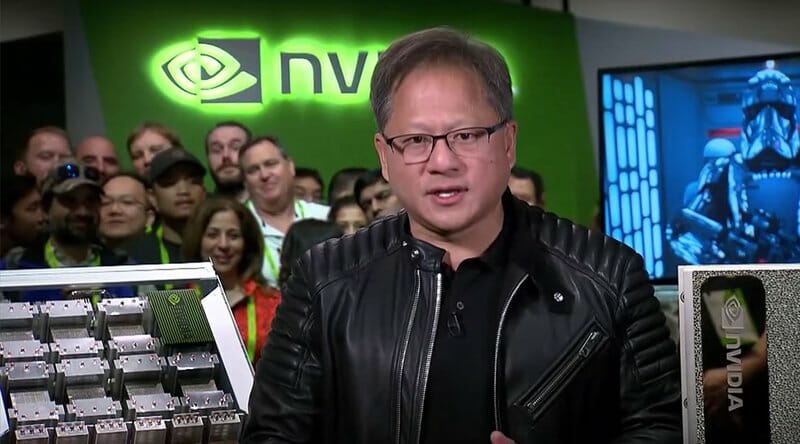
Speaking with Mad Money host Jim Cramer, NVIDIA CEO Jensen Huang recently claimed that “cryptocurrency is here to stay,” and he “doesn’t see the craze ending anytime soon.”

Though itfirst came to fruition in 2008, bitcoin gained a solid taste of mainstream popularity in 2017 when its price began rising faster than anyone had anticipated. The year started with a single bitcointrading at nearly $1,000, though things ended on a higher notewhen the currency nearly grazed the $20,000 mark.

Since January 2018, bitcoin and other virtual currencieshave experienced serious drops in their prices, but Huang is convinced that cryptocurrency remains as popular as ever.

“Cryptocurrency will be here,” he stated in the interview while discussing the future of finance. “The ability for the world to have a very low-friction, low-cost way of exchanging value is going to be here for a long time.”

NVIDIA is a technology company based in Santa Clara, California. Some of the enterprises’ staple products are its graphics processing units or GPUs. These small processors, Huang explains, were some of the main reasons the company first decided to get involved in cryptocurrency last year.

The GPUs have a powerful ability to mine virtual currencies, and blockchain technology requires computers that can be distributed “all over the world” while remaining immutable and safe. Thus, Huang felt his company’s productscould be greatly beneficial to cryptocurrency miners:

“The reason why cryptocurrency became such a popular thing on top of our GPUs is our GPU system is the world’s largest installed base of distributed supercomputing. Our processor serves as the perfect processor to enable this supercomputing capability to be distributed, and that’s the reason why it’s used.”

Interestingly, Huang noted that while the chips were no doubt powerful and crucial to the mining industry, he and his fellow executives are “not ready to move” on this just yet. For the time being, NVIDIA is primarily involved in the gaming business, data centers and self-driving cars, and cryptocurrency and mining operations account for only small portions of the company’s profits.

In fact, NVIDIA currentlyhas no alleged involvement in bitcoin, per Huang’s comments at a recent GPU technology conference. He said its processors are predominantly used to mine ether, which accounted for roughly 6 percent of the company’s GPU sales in 2017.

“Ethereum ‘ether’ was designed as an algorithm to ensure no singular entity (or a few entities) has the power to control the ether,” he said. “It was designed so that the algorithm requires the type of computing capabilities — the type of processing capabilities — that are made possible by GPUs in a distributed system. The GPU is popular with Ethereum because the GPU is the single largest distributed supercomputer in the world. It is the only supercomputer that is literally in everyone’s hands, and no single entity can control the currency.”

He says that the influence of cryptocurrency isn’t likely to affect how they do business in the present, though he’s very confident this could change in the future:

“Gaming is a much bigger business; data center is a much bigger business; our professional graphics is a much bigger business, and, of course, in the future, everything that moves will be autonomous, and we’ll have autonomous capabilities, and that’s going to be a much bigger market, but cryptocurrency gave it that extra bit of juice that caused all of our GPUs to be in such great demand.”

Published at Mon, 02 Apr 2018 21:28:46 +0000

bitcoin

Previous Article

Menlo Ventures Select BitPay as Its First Institutional Crypto Investment

Next Article

George Webb Delivers Imran’s Bitcoin To Rahm

You might be interested in …

Mastercard Blockchain Now Open for Payment Processing

Mastercard has opened up their own blockchain to allow payment transactions to be carried out between selected banks and merchants, but this process uses fiat currency and not bitcoin or other cryptocurrencies.


Quite a few companies have taken a keen interest in what blockchain technology has to offer, and one of these corporate entities is Mastercard, the massive credit card provider. Mastercard has spent the last few years developing its own blockchain, and now the Mastercard blockchain has been opened up as an alternative method of paying for goods and services. The major difference found in the Mastercard blockchain is that it does not use its own cryptocurrency. Instead, it uses real world money.

Mastercard Blockchain Open for Business

The Mastercard blockchain is now open for specific banks and retailers to use as a payment processing system. So far, participation in this blockchain is by invitation only. The last week has been a busy one for Fortune 500 companies and blockchain technology. IMB opened up their own blockchain earlier in the week. Probably the most intriguing aspect of the Mastercard blockchain is that it does not use its own cryptocurrency, which is something that even the IBM blockchain does.

Justin Pinkham, a senior vice president at Mastercard Labs, says:

We are not using a cryptocurrency, and we are not introducing a new cryptocurrency, because that introduces other challenges—regulatory, legal challenges. If you do a payment, then what we can do is move those funds in the way that we do today in fiat currency.

Why the Mastercard Blockchain Could be Very Successful

Some people may look at the Mastercard blockchain and shrug, but there are some factors in why it could be very successful. The first such reason is that Mastercard is lord and master of a vast financial empire, so to speak. It has a settlement network that counts 22,000 banks and financial institutions from all over the world. Few other entities have such a global reach. Another important factor is that the Mastercard blockchain only uses fiat currency, which reduces costs as there’s no need to convert one form of cryptocurrency into another and then, eventually, cash.

This reduction in cost is also amplified by reducing fees for cross-border payments. Normally, a payment that crosses national borders would have to pass through different sovereign banks, racking up fees with each step. The Mastercard blockchain would remove those steps entirely, thus making the payment less expensive and probably faster. Eventually, Mastercard’s blockchain could be used for other items, such as luxury goods to provide “proof of provenance.”

Overall, this is an interesting development. Could the lack of a cryptocurrency tie-in fire a shot across the bow of other blockchains? One also wonders how the energy use for a single transaction on the Mastercard blockchain compares to current credit card transactions and bitcoin. A Dutch bank recently reported that the average energy cost for a bitcoin transaction was 200kWh, and the cost for an Ethereum transaction was 37kWh. By comparison, a credit card transaction only incurred an energy cost of 0.01kWh.

Do you think the Mastercard blockchain will have a major impact? Does the fact that it does not use a cryptocurrency have long-lasting ramifications? Let us know in the comments below.


Images courtesy of Wikimedia Commons, Pixabay, and Flickr.

The post Mastercard Blockchain Now Open for Payment Processing appeared first on Bitcoinist.com.

[2017-02-28] ET: Bitcoin's top rival Ethereum is up 90% in 2017

[2017-02-28] ET: bitcoin's top rival Ethereum is up 90% in 2017 bitcoin’s top rival Ethereum is up 90% in 2017 and readying its next big move http://economictimes.indiatimes.com/markets/stocks/news/bitcoins-top-rival-ethereum-is-up-90-in-2017-and-readying-its-next-big-move/articleshow/57395363.cms Marco Streng’s computer servers are what make Ethereum […]