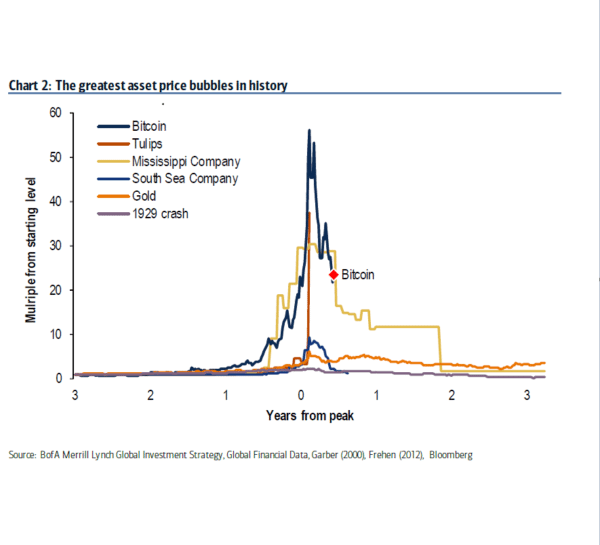
bitcoin doomsayers have once again called it too early. Bank of America Corp., the second-largest bank in the US by total assets, announced that “the greatest bubble in history is popping”. Somehow, . The price of bitcoin has broken above the $8,000 mark and has steadily collected gains over the weekend. Yes, this could be just a simple short squeeze before the very imminent demise of the cryptocurrency market, but what has history taught us?
bitcoin is one of “the greatest bubbles in history”, Michael Hartnett, chief investment strategist at Bank of America Merrill Lynch, wrote in a note Sunday. Hartnett leads a research group that concluded the bitcoin bubble has already burst. Equipped with an X (Years from Peak) and Y (Multiple from starting level) chart, the group says the cryptocurrency peaked in December, when it reached $20,000, and is on a ‘post-peak’ mode.
To back up the ‘solid reasoning’, Hartnett’s team compared its price behavior to other famous bubbles in history: the 1929 crash, Gold, South Sea Company, Mississipi Company, and of course, the Tulip Mania in 17th century Netherlands. The much-disputed race for the biggest speculative bubble in history clearly has a winner: bitcoin. The digital currency was able to nearly multiply its value by 60 at its peak. That is 150% the value of tulips at their ‘best’.
That was an interesting chart, but does it serve as evidence that ? Of course not. I guess they claim the bubble has burst because bitcoin has fallen over 65 percent from its December peak. But how seriously should we take such light analysis? Any differently than the Or the ? Or the ?
“bitcoin, briefly the world’s favorite cryptocurrency, is in trouble. It plummeted from a peak of around $33 per unit in June to just $2.51”, said the Economist on a piece called “The Bursting of The bitcoin Bubble” in 2011.
CNN’s “bitcoin Bubble May Have Burst”, dated 2013, makes a similar point. “The price of Bitcoins has plunged more than 70% in the past two days, sparking a rush of activity that overwhelmed trading platforms and suggested the bubble in the virtual currency has burst”, it said.
In 2015, the news agency proved it didn’t learn the first time: “bitcoin lost more than 60% of its value last year. The digital currency has already plunged another 30% in the first few days of 2015 — and that includes a 30% rebound on Thursday!”, said CNN in its article entitled “Will bitcoin Ever Rebound?”.
I just picked these three pieces at random. The list could go on and on. This reminds me of David Meade, a Christian numerologist who . Who knows, maybe this time he’s right.
Re: Martin Armstrong Discussion iamnotback Re: Miner cartel, Bankster cartel, or an altcoin? Your choice? Some ground rules have to be explained so that readers can make sense of this, so they can clearly discern […]
Decred : bitcoin’s Big Brother Comment, Like & Subscribe!!! Find out more about Decred https://www.decred.org/ Want to buy decred? Use coinbase & then Binance Create a coinbase account https://www.coinbase.com/join/59e2c50556816d014b17efa6 Create a binance account https://www.binance.com/?ref=11186528
Bitcoinist spoke with Landry Ntahe, head of operations at , a London-based bitcoin ATM startup that currently holds the number two position by market share in the UK.
Today, BCB ATM has 16% of the bitcoin ATM market share in the UK with in London where their Lamassu machines can be found. With an aggressive strategy of expansion to other UK cities and beyond, it’s planning to take over this nascent industry by undercutting their competition, offering customers much lower fees when buying bitcoin.
While the number of bitcoin ATMs has already the 1,000 mark, the is thriving in particular, with new machines being added every month. Besides simply buying bitcoin, BCB ATM is aiming to provide additional services through their machines such as sending money abroad, topping up mobile accounts and more, which should help bring bitcoin closer to mainstream adoption.
Bitcoinist: What has been your biggest challenge in running a BTM business?
Landry Ntahe (LN): Lack of awareness of bitcoin in the elder generation, which makes them reluctant to place a BTM in their establishment. More needs to be done to educate others about cryptocurrency and blockchain technology. That’s why we’re here to bring online currency to the high street.
Bitcoinist: What competitive advantage are you relying on to become the number one BTM company?
LN: We are always working hard to find new ways of bringing our services to the masses. Our next plan is altcoin adoption across our ATM network.
Bitcoinist: How big is your team?
LN: We have a core team of 5 from different working backgrounds including a young apprentice as well as agents throughout the UK.
Bitcoinist: Have you considered producing your own machines?
LN: We leave the hardware to the manufacturers, our main focus and interest is on the software and developing relationships with the manufacturers to suggest features that we feel would be should be implemented in the future to improve the services offered.
Bitcoinist: What features do you feel should be added besides buying bitcoin?
LN: We’d like to merge everyday payment services such as topping up your mobile phone with our BTM’s. We would like to see everyday household bills paid with our machines. That is gas, electricity, Internet, phone etc.
Bitcoinist: How are you able to offer your customer 4% fees compared to your competitors’ 8%?
LN: With strategic planning to reduce overall overheads and costs as well as a risk strategy to manage volatility and also working very closely with an upcoming Lithuanian based exchange who we met at the recently held bitcoin & Blockchain conference in Moscow.
Bitcoinist: Does that mean you’re looking at Russia to grow your BTM network?
LN: We have been approached by a few countries to expand our network but we have made a promising friendship with a development team along with a manufacturing company in Russia.
Bitcoinist: Are you currently only focusing on London however?
LN: We’re currently open to any city in the UK. We have an installation due in Birmingham coming soon. We’re also in talks with CoinFestUK to get a BTM installed and assisting a venture to increase awareness in Manchester.
Bitcoinist: What’s your market share threshold that you’d like to reach before expanding into other cities?
LN: Our plan is that we want to expand to every major UK city within the next 18 months.
Bitcoinist: Are your machines one-way or two-way as well?
LN: We currently have one-way machines but our new two-way machines are due to be installed at one of our Central London locations next week.
Bitcoinist: From a business standpoint, is one type more profitable to operate than the other; or does it depend on location?
LN: From online studies and articles, there is a higher demand for one-way BTMs. However, we would like to stay ahead of the game and have taken a business decision to install 2-way machines moving forward. We couldn’t say as of yet if it would be more profitable but in our opinion location is the key factor in determining sales and profit.
Bitcoinist: What do you look for in a location or merchant when placing a machine?
LN: Presentation of the establishment, open attitude towards cryptocurrency or willingness to learn about.
Bitcoinist: What does one need besides cash to buy bitcoin from your BTM? Is there a buy limit?
LN: Our current policy doesn’t require any identification such as passport or driving license at the point of sale. But we are currently working with developers to find a way of implementing this without the need of a physical ID to comply with KYC procedures. The buy limit currently is £600 per transaction.
Bitcoinist: Who is the typical BTM customer?
LN: We wouldn’t know, that’s the beauty of bitcoin, anonymity!