
Newsflash: Bitcoin Price Breaks Beyond $8,000 to Hit Two-Month High
Advertisement
bitcoin price is now trading above $8,000, a figure unseen in over 60 days.
The price of the world’s first and largest cryptocurrency spiked over $200 in the early trading hours of Tuesday (UTC) to hit a high of $8,043 (Bitfinex), a figure unseen since trading levels on May 22.
At press time, bitcoin is trading to the dollar at $8,018 after days of sustained momentum that sees the value of the cryptocurrency make gains after hitting a 2018-low of $5,755 on June 24, a month ago to the day.
As by CCN yesterday, the bullish sentiment follows breaking a major resistance level at $7,800 and it remains to be seen if bitcoin can find $8,000 as a key support level in the short-term.
Key to bitcoin’s resurgence is the in daily trading volumes with data from Bitfinex showing over $350 million in the BTC/USD trading pair over a 24-hour period.
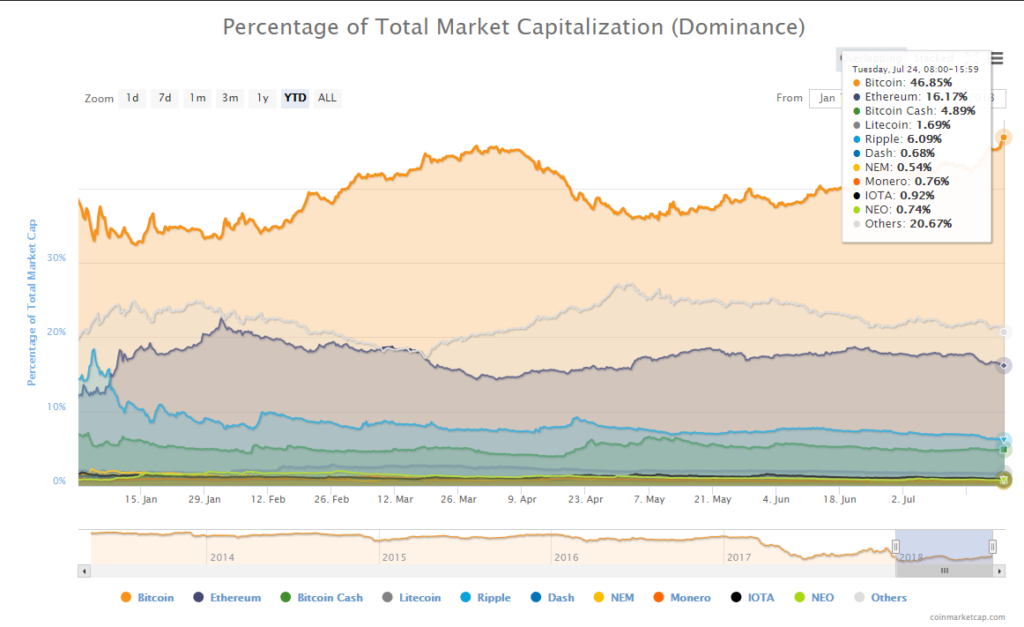
bitcoin’s gains also coincide with its dominance in market capitalization across the cryptocurrency ecosystem, now standing at a new 2018-high of 47.5%. While bitcoin is still down over 50 percent from 2018’s high above $17,200 in January, its value has gained nearly 20% in a 7-day trading period.
Blockstream’s Samson Mow and Paycase’s Joseph Weinberg unveiled the Liquid network yesterday at the Blockchain Association of Canada’s Government Forum in Ottawa, as a step forward in the ongoing bitcoin scaling debate.
The Liquid network is a federated sidechain designed to provide new features and benefits to exchanges, users, and businesses by leveraging a sidechain which will process transactions more quickly and efficiently than the main bitcoin blockchain.
Sidechains like the Liquid network offer automated real-time audit, a secure open protocol, and unforgeable secure tokens, all of which can be used over the open internet.
Samson Mow, Chief Strategy Officer with Blockstream told bitcoin Magazine:
“There’s a preference from some people to scale on-chain with block size increases, but that’s a technical dead-end. Scaling off-chain with sidechains means leveraging proven technology that’s already available, and will be far superior to static blocksize increases for trivial on-chain scaling gains.”
Mow explained:
“Sidechains allow for new innovations in security models and features, plus the added benefit of faster and more cost efficient transactions – if more businesses were utilizing sidechains for use cases involving recurring transactions, they would take some pressure off the main bitcoin blockchain.”
He noted that there are strong indications that cryptographic federations and sidechains in general are a good solution to better distribute networks that currently hold the potential for centralized systemic risk.
“In the case of Liquid, it will also improve bitcoin interchange liquidity, and accelerate trading and security for a large percent of today’s global and currency-paired BTC trading,” added Mow.
Mow explained that Liquid networks or “Liquid” represents a point-to-point sidechain that provides near-instant, secure transfer of assets (bitcoin initially), all while user and exchange environments remain separate from the movement of the underlying value.
Paycase CEO Joseph Weinberg told the audience that they have been working with users, enterprises, financial institutions and others on solutions that leverage strong federations.
“Sidechains become even more interesting when you have multiple sidechains from an interoperability perspective. As you tokenize the world, you see this marketplace of all assets being liquefied and then rapidly traversed, similar to how currents move liquid water around the world.
“It’s this frictionless flow and interoperability that our economy here in Canada and our geo-political and economic partners around the world are really well positioned to adopt and champion into the mainstream.”
Strong Federations and Sidechains
In order to function, a Liquid network requires explicit trust of a group of parties, governance guarantees whereby you have rule adherence and a network of many participants responsible for network consensus.
While accelerating trading in bitcoin, this system will build an infrastructure that leads to a “trustless” exchange for users.
Best use cases include cryptographic assets, central bank currency issuance, land titles/registries, credit issuance and settlement between large institutions.
Mow noted that what Lightning Networks can do for smaller transactions, the Liquid Network can do for larger transactions between companies and exchanges.
Currently, Liquid Beta participants include Bitso, Bitfinex, Bitt, BTCC, Coins.ph, Streami, Paycase, The Rock Trading, Unocoin and Zaif. Discussions continue with other partners.
Bank of Canada Is Interested in Liquid Networks
While in Ottawa, Mow and Weinberg met with representatives from the central Bank of Canada. Weinberg told us:
“We met with the Bank of Canada and had some great discussions with them about blockchain technology, and use cases and systems like Paycase’s cross-border transaction platform Traverse and Blockstream’s Elements platform.
“There is a sense that the media misrepresented the Bank’s recent comments on the Jasper experiment, which was actually a well-balanced and accurate assessment of the technologies they’ve trialed to date. I think they’re still very much interested in evaluating blockchain technology.”
Weinberg added: “We are also working on other sidechain initiatives that leverage strong federations and confidential assets via the elements project both in Canada and globally that require multi-participant governance guarantees and explicit trust.”
He added that they are excited going forward, not just about Liquid networks but the whole interoperation and weaving of different technology stacks in the ecosystem to enable new use cases and leverage all the great layers of the blockchain stack that are being built around the world.
Kaspersky Calls for Less Government Control of bitcoin and More Collaboration Russian cybersecurity expert Eugene Kaspersky has said cryptocurrencies can be a success, but only if governments stop trying to control them or alternatively when […]