We built the Blockchain Wallet because we’re driven by a relentless passion for making crypto easy to use. We want everyone to be able to use it, not just invest in it.
We believe that owning and controlling your own private key is the single most important aspect of using crypto. Without a private key, you aren’t using crypto – you’re just speculating and you’re missing the defining part of crypto: user controlled, sovereign money.
It was enabling that exact need that underpinned the development of the Blockchain Wallet six years ago. The mission? Make it easy for every user to have their own private key, to get users away from storing funds at exchanges and “bitcoin banks”, and to enable everyone to be their own bank.
Fast forward six years and we’ve achieved a few things that we’re proud of:
Building the first cross-platform, non-custodial, and cross-chain wallet
Signing up 30 million wallets in 140 countries globally
Powering over $200 billion in consumer transaction volume and over 80 million consumer crypto transactions in the last two years alone
Championing the cause of financial sovereignty and user-control with regulators around the world. (We’ve spent thousands of hours and millions on education and outreach.)
Helping our users store millions of BTC, BCH & ETH coins and generate over a quarter of bitcoin network traffic alone
Most importantly, it’s been a honor and privilege to be the first place tens of millions of people turn in order to actually use crypto and hold their own keys.
But there’s a lot still to do.
At the end of the last bull run, we did a serious self-assessment and asked ourselves, what do users need that we aren’t delivering today? We identified four common requests and frustrations:
Better, faster ways for new users to get their first crypto and make their first transaction
More storage types, like hardware, as users’ balances increased
More assets as users want to store and use an increasingly diverse asset set
Better, more reliable sources of liquidity as trading and investing across assets continues to increase
Satisfying these demands meant building a huge extension of our platform, at scale. We’ve had our heads down much of this year doing exactly that and starting today we’re excited to begin delivering new solutions to you, beginning with two new capabilities.
First, we’re launching Swap by Blockchain: a next generation trading product with best-in-class liquidity and execution, powered by our new machine trading software platform that ensures best execution across assets. Blockchain Wallet users will now have access to exchange-like prices without giving up control of their keys or their crypto. And trade limits will increase from hundreds to thousands of dollars of crypto per trade.
While the system currently has deep liquidity drawn from a variety of sources, we plan to add more liquidity sources over time, including decentralized exchange protocols. We’ve rebuilt our risk and KYC systems, so that you can onboard with ease, in minutes. Swap ensures our users stay liquid and can trade at the best prices in the market, regardless of overall market volatility and challenges. We’ve started rolling Swap out today and everyone will have access over the next two weeks.
Secondly, we’re launching Lockbox: a hardware vault in your pocket, built in partnership with hardware leader Ledger. Lockbox is simple to use and is even more secure thanks to a locked endpoint that prevents phishing and spoofing attacks. It’s hardware made easy, with a setup that takes just a few moments thanks to our custom hardware-software integration.
With Lockbox you’re able to check your balance and receive transactions, on mobile and web, without the inconvenience of having to plug your device in every time. In an industry first, you’ll also be able to trade directly from your Lockbox while still maintaining your keys. In conjunction with Lockbox, we’re also excited to let current Ledger device owners seamlessly pair with the Blockchain Wallet and trade directly from the Ledger device they already own.
And we have more coming this year, including additional assets and new products within the Blockchain Wallet that will bring you new, faster, and better ways to get started in crypto.
We’re here to build a new financial system and the Blockchain Wallet is your passport to that new world. Store crypto, trade crypto, transact with crypto and most importantly truly own and control your crypto.
We’re dedicated to building the functionality you want, without compromising your control of your key. Your crypto is yours, and it should stay that way.
Key Highlights:
price may fall to $0.069 price level;
Cardano may resume its uptrend movement;
traders should look out for buy stops to initiate long trades.
ADA/USD Price Long-term Trend: Bearish
Supply Zones: $0.080, $0.088, $0.094
Demand Zones: $0.075, $0.069, $0.062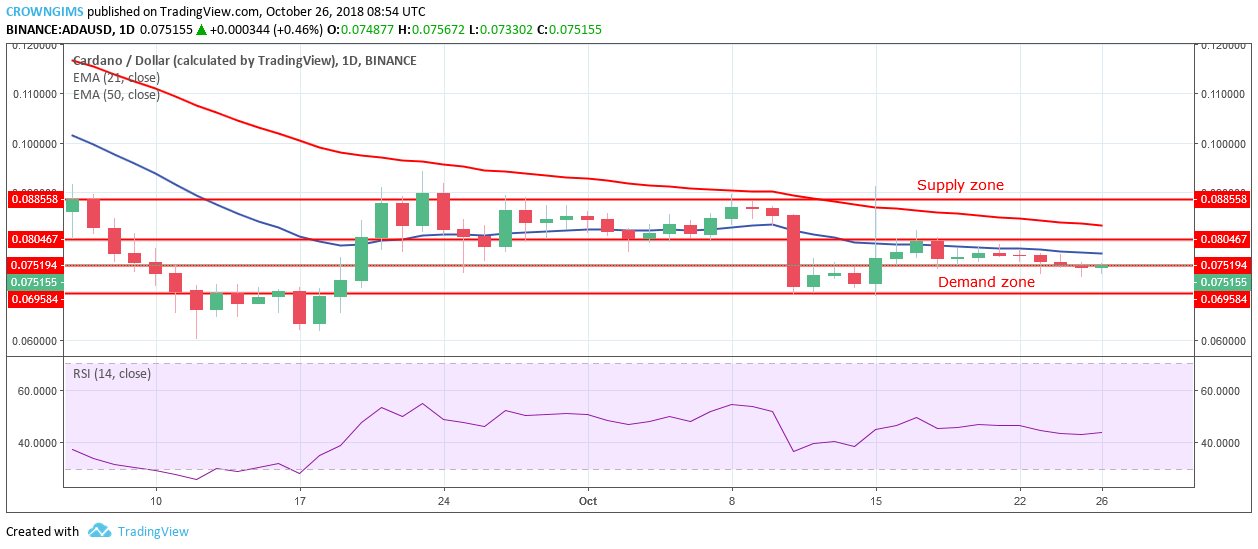 ADA continues in its bearish movement on the long-term outlook. ADA price started falling after the sudden increase that occurred on the October 15; the bulls enter the market with high momentum and pushed the pair to the north with the formation of massive bullish candle that broke the supply zones of $0.080 and $0.088 and exposed the supply zone of $0.094.
The continuation of uptrend movement was rejected by the bears’ strong momentum and the price was pushed to the demand zone of $0.075. ADA price started falling gradually and now it has broken down the demand zone of $0.075. It is now exposed to the demand zone of 0.069.
Should Cardano price fall to the demand zone of $0.069, and the bulls defend this zone, ADA price will bounce to the north towards the supply zone of $0.080. Traders may setup buy stops to initiate long trades.
The price is below 21-day EMA and the 50-day EMA which indicates that the price is falling.RSI is above 40-level pointing towards the south indicates that there are possibilities for further downward movement.
ADA/USD Price Medium-term Trend: Bearish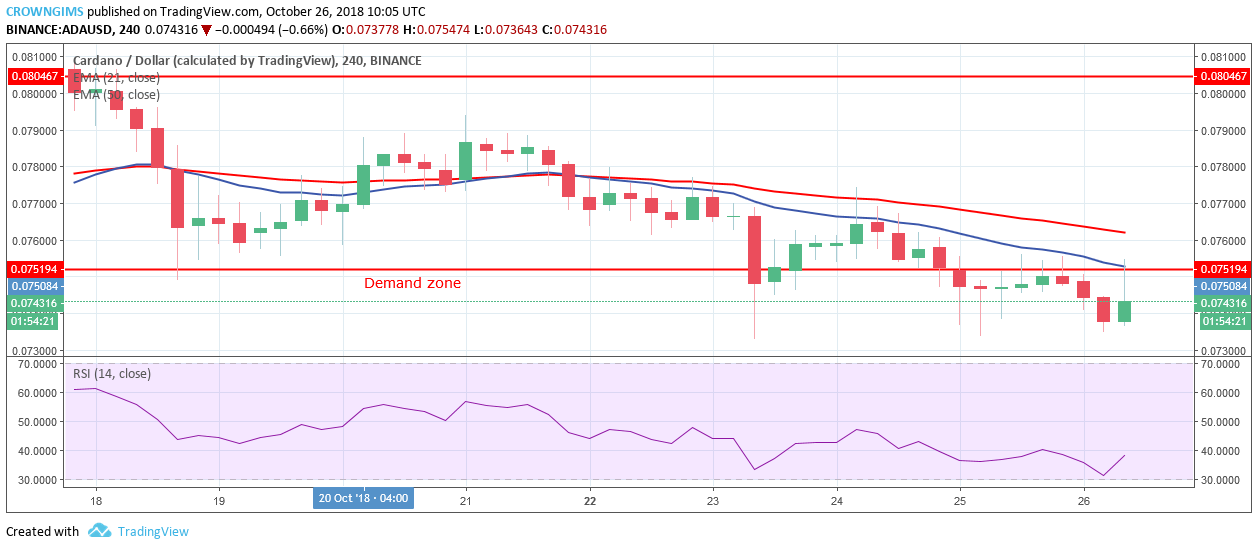
On the 4-H chart, ADA is in its bearish trend. Ada price started falling on October 21, on the medium-term. It is clearly seen on the chart that 21-day EMA crosses 50-day around that period. It has been falling gradually, broke the demand zone of $0.075. In case the bears increase their pressure and sustain it, the coin will find its low at the demand zone of $0.062.
In case the demand zone of $0.075 holds, the price will bounce to the north and break the strong supply zone of $0.080, ADA will resume its uptrend movement towards the supply zone of $0.088.
21-day EMA has crossed the 50-day EMA downside and the price is below 21-day EMA and 50-day EMA, the two EMAs are the distance from each other which indicates downtrend is ongoing.
Nonetheless, the RSI period 14 is on 30levels with signal lines point to the north, which indicates buy signal which may be a pullback.

In this edition of The Daily, we cover the U.K. Royal Mint’s decision to freeze a plan to issue digital gold tokens. We also look at a new Australia Post ID verification service, as well as a warning by the Maltese financial regulator about a cryptocurrency investment platform.
Also read:
Mint Scraps Virtual Coin Plan
 The Royal Mint has shelved a plan to issue digital gold tokens similar to so-called stablecoins. The move came after decision to pull out of an agreement to provide a trading platform for the project, as well as the U.K. Treasury’s refusal to approve plans to allow the coins to be traded on an undisclosed cryptocurrency exchange, Reuters reported, quoting multiple sources.
The state-owned mint first announced the plan to produce up to $1 billion of digital gold coins in 2016. The intention was to provide investors with an alternative to buying and trading physical gold. The launch of Royal Mint Gold (RMG) was initially expected in the fall of 2017, but the mint later postponed the plan until spring of this year. However, CME — which has invested in fintech startups and recently launched contracts — decided to walk away from the project, following changes in the U.S. exchange operator’s management team.
Earlier this year, the Royal Mint attempted to save the RMG project by securing an agreement with an unnamed cryptocurrency exchange. However, the U.K. government reportedly blocked the proposed partnership on the grounds that it would be too risky. The Royal Mint said in a statement that it would revisit the plan “if and when market conditions are right.”
Cryptocurrency Exchanges Adopt
Australia Post’s Digital ID Service
 State-owned Australia Post is now offering a digital identity service that allows users to register with online platforms in minutes and verify their identities without uploading multiple documents. Several cryptocurrency trading businesses have already adopted the Digital ID service.
Cameron Gough, general manager of the Digital ID project, said the technology gives people more control over the personal data they are expected to share with companies and other organizations. He said it could also appeal to investors who have thus far been reluctant to undergo certain verification procedures.
“Most people hand over their driver’s license to prove they can legally go to a bar, but all that is needed is a name and birth date — not that information plus your full residential address,” Australian news outlet Micky quoted Gough as saying.

The Digital ID team is currently working with Australian cryptocurrency trading startups Coinjar and Coin Loft. And Digital Surge, a Brisbane-based bitcoin exchange, has already integrated the technology into its platform. Josh Lehman, director of Digital Surge, said the service has allowed the company to sign up and verify new customers much faster than before. is now available on the Apple App Store and Google Play.
‘Dubious Scheme’
 The Malta Financial Services Authority (MFSA) has issued a warning about Primetradingbot, a cryptocurrency trading company that claims to legally operate from the crypto-friendly Mediterranean nation. The regulator said the online platform is not licensed on the so-called “Blockchain Island” and described it as a “dubious scheme.”
“Although this entity purports to operate from an address in Malta, the MFSA does not believe this to be the case,” it said, as quoted by Malta Today. “The MFSA wishes to alert the public, in Malta and abroad, that Primetradingbot is not licensed or otherwise authorized by the MFSA to provide any investment or other financial services which are required to be or otherwise authorized under Maltese law.”
The regulator said that Primetradingbot offers what is advertised as a high-yield, bitcoin-related investment program. It warned about potential financial losses and has advised traders against dealing with the trading platform.
What are your thoughts on today’s news tidbits? Tell us in the comments section below.
Images courtesy of Shutterstock, Royal Mint.
Make sure you do not miss any important bitcoin-related news! Follow our news feed any which way you prefer; via Twitter, Facebook, Telegram, RSS or email (scroll down to the bottom of this page to subscribe). We’ve got daily, weekly and quarterly summaries in newsletter form. bitcoin never sleeps. Neither do we.
The post appeared first on .