
August 10, 2026

Capitalizations Index – B ∞/21M

New Bitcoin Trading Volume Metric Offers Clearer View of the Market

New bitcoin trading volume metric offers clearer view of the market

New Bitcoin Trading Volume Metric Offers Clearer View of the Market

New bitcoin trading volume metric offers clearer view of the market

Step aside CoinMarketCap, your time may be up; there’s a new straight shooter in town with reliable bitcoin trading volume metrics. Following recent research and criticism of CMC’s data collection methods, a New York-based alternative has stepped into the fray.


bitcoin Trading Volume Overexaggerated

CoinMarketCap has, for a long time now, been the go-to place for all kinds of cryptocurrency metrics. In fact, it is a top-500 website globally.

Initially, as the name suggests, it listed cryptocurrency prices, ranked on their total market capitalization. The problems arose when it began ranking exchanges based on daily trading volume – as reported by the exchanges themselves.

An exchange which ranked highly could command increased token listing fees; after all, who wouldn’t want their token to be exposed to all that traffic. So it was beneficial for an exchange to report higher volume than it actually processed, through wash-trading or simple misreporting lying.

As a result, according to CMC data, 15% of bitcoin’s entire market cap changed hands in the last 24 hours. As it does every day.

Uncovering Fraudulent Exchange Volumes

The fightback against these volumes began with reports from the Blockchain Transparency Institute (BTI). Through a continually developing methodology, the Institute highlighted ever increasing evidence of wash trading. In December, it detected fake volume in 70% of the top 10 exchanges listed on CMC, with actual volume being less than 1% of that reported in some cases.

Then last week, in a presentation to the SEC, Bitwise claimed that 95% of reported volume was fake. This led CMC to admit that concerns are ‘valid’, and announce a forthcoming set of tools to increase transparency.

New ‘Real 10’ Metric Filters Fake Volume

However, NY-based metrics and data provider, Messari may have beaten CMC to the punch. They this week added a ‘Real 10’ volume metric to their OnChainFX dashboard. This gives a daily trading volume figure based on only the ten exchanges Bitwise found not to fake volume.
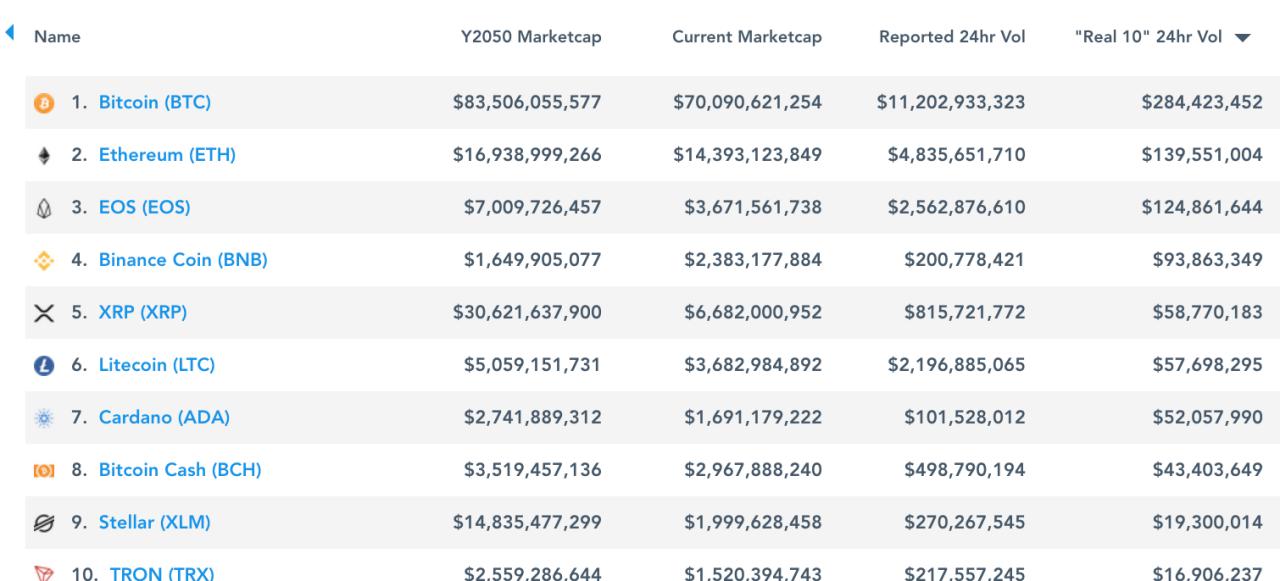
New bitcoin trading volume metric offers clearer view of the market

Also, announced, although not yet added to OnChainFX, is a ‘Liquid Market Cap’ metric. This addresses another concern recently reported by Bitcoinist, that of CMC’s bitcoin market dominance statistic. Whilst CMC give no weight to daily traded volume (as well it shouldn’t considering the amount of fake volume it reports), a metric considering both market cap and volume is a very useful benchmark.

So Is It Time To Update Our Browser Favorites?

Maybe. Whilst far from perfect, Messari’s OnChainFX dashboard seems like a very useful resource, and we have no idea how long CoinMarketCap will keep us waiting for its improved tools.

Certainly, it goes to back up Bitwise’s claim that:

The real market for bitcoin is significantly smaller, more orderly, and more regulated than is commonly understood.

However, ignoring all volume outside of the ten ‘genuine volume’ exchanges doesn’t give us the full picture. The work of the Blockchain Transparency Institute gave an estimate for the the amount of genuine volume, even for suspicious exchanges.

The vast majority of false-reporting exchanges had over 95% of their volume which was fake. Although some, such as Huobi and HitBTC, had genuine volumes of around 25% that which they reported. Perhaps BTI are hard at work on a live ranking system of their own, which includes the genuine volume ratio at even dodgy exchanges.

Or perhaps we’ll just have to use the best tools available to us at any one time. For now, it would seem that is no longer CoinMarketCap.

Will you still be checking CoinMarketCap after the fake bitcoin trading volume debacle or switching to alternatives? Let us know in the comments below!


Images via Shutterstock, Messari.io

The post New Bitcoin Trading Volume Metric Offers Clearer View of the Market appeared first on Bitcoinist.com.

source: https://bitcoinist.com/new-bitcoin-trading-volume-metric-offers-clearer-picture-of-the-market/

TheBitcoinNews.com is here for you 24/7 to keep you informed on everything crypto. Like what we do? Tip us some Satoshi with the exciting new Lightning Network Tippin.me tool!

Published at Wed, 27 Mar 2019 19:00:15 +0000

Previous Article

Crypto Mining Industry Dialogue 2019 Gathered Hundreds of Industry Leaders in Beijing

Next Article

Distributed Digest: Wednesday, March 27, 2019

You might be interested in …

Introducing a Programming Language so Simple, It “Fits on a T-shirt”

http://plas2017.cse.buffalo.edu/

Blockstream is introducing Simplicity, a new programming language for blockchain-based smart contracts, intended for inclusion in Blockstream’s sidechains and eventually in bitcoin. The new language was presented by its creator, Russell O’Connor, Infrastructure Tech Developer at Blockstream, at the ACM SIGSAC Workshop on Programming Languages and Analysis for Security (PLAS 2017).

“Simplicity is a blockchain programming language that is so simple, it fits on a t-shirt,” O’Connor told bitcoin Magazine. “It is critical that smart contracts behave in ways that all participants expect, and applying formal verification to Simplicity allows us to achieve that.”

Simplicity is still a Blockstream Research & Development project, but there’s potential for its use in Blockstream products in the future, according to the company’s announcement.

“Simplicity is flexible enough that I anticipate many new, domain-specific, languages will generate Simplicity, and this will give users the freedom to generate smart contracts using the tools that most suit their needs,” added O’Connor.

O’Connor’s paper, titled “Simplicity: A New Language for Blockchains,” presents Simplicity as “a new programming language, designed to be used for cryptocurrencies and blockchain applications, which aims to improve upon existing cryptocurrency languages, such as bitcoin Script and Ethereum’s EVM [virtual machine], while avoiding some of the problems they face.”

bitcoin script is limited by design and unsuitable for complex smart contracts that need more than a small set of simple templates to perform tasks like digital signature verification. Ethereum, on the other hand, includes a more expressive and flexible, Turing-complete programming language, which allows for arbitrarily complex smart-contracts in principle.

But, in practice, Ethereum doesn’t support static analysis to pre-determine the computing resources that a program will require and, thus, filter out too costly contracts and infinite loops. Therefore, pre-paid “gas” fees are lost when an Ethereum program “runs out of gas.” The simpler bitcoin scripting, which supports static analysis, doesn’t present similar issues.

In a post to the bitcoin-dev mailing list, O’Connor proposed Simplicity as an alternative to bitcoin Script, noting that static analysis is important for both node operators and for Simplicity program designers.

“Static analysis is a technique that provides a universal algorithm to determine how much any Simplicity program will cost to run before you stake your money on it,” O’Connor told bitcoin Magazine.

Simplicity can be seen as a more flexible alternative to bitcoin scripting, not Turing-complete but expressive enough to build useful smart contracts for blockchain applications, or as an alternative to Ethereum, which will support static analysis and other desirable features including improved safety, formal semantics, and Merkelized Abstract Syntax Trees (MASTs).

While Simplicity is intended as a low-level language for smart contracts, O’Connor envisages the possibility of compiling programs written in higher-level languages (like Ethereum’s Solidity) to Simplicity.

“Ivy and the Σ-State Authentication Language are existing programming language development efforts that may be suitable for being compiled to Simplicity,” notes O’Connor in the paper. “For the time being, generating Simplicity with our [Haskell] and [Coq] libraries is possible.”

The next step in Simplicity’s development will be a bare-bones SDK (Software Developer Kit) that will include formal semantics and correctness proofs in Coq, a Haskell implementation for constructing Simplicity programs and a C interpreter for Simplicity. Then, the new language will be ready for initial deployment in the Elements project, Blockstream’s open-source codebase for sidechains, so that developers can start experimenting with the code.

But, as O’Connor stated on bitcoin-dev, “Only after extensive vetting would it be suitable to consider Simplicity for inclusion in bitcoin.”

The post Introducing a Programming Language so Simple, It “Fits on a T-shirt” appeared first on Bitcoin Magazine.