Australia’s digital currency exchanges are now required to register with the country’s financial intelligence agency in a bid to combat money laundering and counter-terrorism, starting from today. AUSTRAC published a new page today detailing the new requirements for digital currency exchanges to meet anti-money laundering (AML) and counter terrorist financing (CTF) regulations. Effective from the […]
The post appeared first on .

Investors should use social volume as a metric to measure a coin’s performance since public debate concerning cryptocurrencies tends to occur on social media platforms like Twitter, Reddit, and Facebook,
As an “instrument of the 21st century, [cryptocurrencies]… are publicly debated, discussed, marketed, pumped, and dumped on social media,” said Amir Feder, chief data scientist of Solume, on a .
Social media has always played an integral role in cryptocurrencies. From its inception to global discussions today, these platforms helped developers, innovators, and changemakers build and create a community to support the growing movement.
Investors should, therefore, take note of social volume and mentions, and track these metrics. While this may be tricky, there are online tools available like and which can come in handy when it comes to cryptocurrency investing.
Why Social Volume is an Important Metric to Follow
Social volume is a great metric for cryptocurrency investors because of the impact of social media on the cryptocurrency industry. Cryptocurrencies have always shared a strong relationship with online forums and social media platforms even in its earliest days.
In 2008, when Satoshi introduced the concept of bitcoin and blockchain technology, he leveraged online websites from the , the , and . The global reach and people on these online communities helped bitcoin gain further awareness which spawned a new community. Online forums and specialized social media groups began to facilitate discussions and foster new ideas, assisting early adopters develop the cryptocurrency ecosystem to what it is today.
Measuring Social Volume
While measuring social volume can be difficult, there are online tools designed to help cryptocurrency investors. Solume is a great tool used to gauge the social volume and popularity of a large number of coins. Their website allows investors to see the relationship between the coin’s number of mentions on social media and its price in USD or BTC. Here is an example of Monero’s social chart over the last seven days.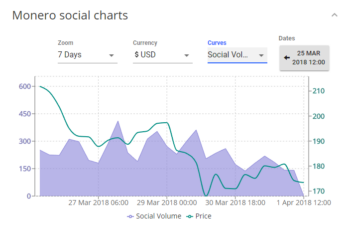
Source:
Solume also provides other options which include comparing the price of the cryptocurrency about sources that mention it. These sources include , , and bitcointalk.org.

Source:
Investors can also assess the levels of sentiment associated with the cryptocurrency. When there are high levels of negative press as seen here, it often has a direct influence on the price of the coin.

Source:
Aside from these informative graphs, Solume also lists the most recent Reddit and Twitter social posts. Solume is a handy tool for investors who want to gauge the general social buzz and have a clear understanding of the social volume concerning a specific coin.
An alternative website is Cryptometrics. Upon quick inspection, Cryptometrics appears very complicated. However, it’s very simple for investors to use. Unlike Solume, Cryptometrics only focuses on two social media platforms: Reddit and Twitter. Cryptometrics helps investors understand how well their coin has been performing in the last 1,7,30, and 90 days.
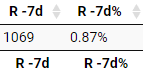
To use an example, the chart below demonstrates that in the last seven days, Monero has 1069 Reddit posts with an increase of 0.87 percent in posts during the previous seven days.
Source:
As for Twitter, the chart below demonstrates that in the last seven days Monero had 1820 tweets with an increase of 0.65 percent in posts over the previous seven days.

Source:
Social media platforms will continue to play a significant role in the development of cryptocurrency community. It’s therefore wise for investors to leverage existing tools to continuously assess the social volume and buzz when it comes to predicting the future value and cryptocurrency coins.
has reported on a study which explains while social media has some influence to cause large demand shocks, known as the ‘buzz factor,’ however, such social media impact, in essence, is not substantial enough to stimulate price. Instead, the technological innovation factor is more important for explaining price changes.
The post appeared first on .
From September 2017 all the way up to the first two months of 2018, the Asian bitcoin arbitrage market was booming. With and online trading platforms and South Korea initially taking a on crypto, the market had no choice but to go underground.
As a result, bitcoin trading could be carried out in an environment far removed from the watchful of the government and financial regulators. The move underground led to the emergence of varied buying and selling rates as a traditionally unregulated market became even more unregulated.
The Rise of the Mules, OTC, and P2P Platforms
Many Chinese residents with no access to online bitcoin trading platforms have had to resort to bitcoin mules, other-the-counter (OTC) and peer-to-peer (P2P) platforms. As the began to soar astronomically during the latter part of 2017, the demand for bitcoin became even more frenzied as these underground trading platforms began to charge large premiums to sell bitcoin to desperate investors looking to make overnight gains.
At the height of the arbitrage market boom, investors were willing to pay up to a 30 percent premium in order to buy . These mules, OTC and P2P platforms took advantage of the situation making huge profits.
According to , Chinese cryptocurrency platforms unable to operate in the country began to create P2P and OTC platforms where Chinese residents could purchase bitcoin. According to Christian Grewell, a business professor at NYU in Shanghai, many bitcoin traders in China make use of CoinCola, an OTC platform created by Huobi and OKCoin, two Chinese cryptocurrency exchange platforms. Some traders would even make the trip to other countries with wads of cash, in order to buy bitcoin and return to China and sell on a P2P basis to willing buyers.
Market Saturation
In no time, institutional investors such as hedge funds made their way onto the scene causing the market to become saturated. This has caused a significant downturn in the market, according to John DeCleene, an assistant fund manager at Overseas Chinese Investment Management. According to DeCleene, the mass entry of institutional investors and a decline in the hype surrounding bitcoin has contributed to the current of the profits in the Asian bitcoin arbitrage market. Despite this, DeCleene is positive that profits are still being made especially by hedge funds who can execute trades swiftly thereby taking advantage of arbitrage opportunities.
Speaking on the issue, Peter Kim, the manager of a $10 million crypto arbitrage operation says that at the height of the hype, there was a 30 percent arbitrage. He went to say that the arbitrage percentage has reduced considerably but it is still a lot larger than can be obtained for conventional assets.
Even on much smaller spreads, hedge funds are still reportedly making a decent profit while the smaller traders are finding it a lot more difficult to compete in the market. With price decline currently affecting bitcoin, much of the arbitrage attention is being shifted to , which trades at an approximate two to three percent premium in China. Nevertheless, the easy arbitrage opportunities are going to be much less frequent.
The post appeared first on .