polarizing effect has people on either proclaiming it is going to the moon or it is going to zero. The volatile, unprecedented, and revolutionary monetary system that is cryptocurrency has a future that not many can accurately predict, but as time has gone on, the idea that bitcoin is going to zero seems more and more far fetched.
A , just recently — when bitcoin has been booming — have come forward with predictions of doom and gloom, warning investors that this new system of money — and investment opportunities — will fall to complete worthlessness.
bitcoin is barely 10 years old, and has gone from being worth zero to . So, as we sit with the price lower than many would have hoped, is it feeble to think it can reach as low as zero?
‘It’s going down’
It doesn't matter if it is skeptical friends around a dinner table, or , the prediction that bitcoin will go to zero often comes up as a counter punch to all the positive strides that cryptocurrencies are making.
Being a new and unprecedented ecosystem, which operates in such established ecosystems as finance and money, it is advances. One day it is up, and one day it is down — but what makes people think it will fail all together?
In early February, when , the chairman of Roubini Macro Associates, Nouriel Roubini — also for his pessimistic economic outlooks — made a bold claim:
As expected bitcoin now crashes below $6000. Now the $5K handle is reached. And the US Congressional Hearing on Crypto-Scams is still a day away. HODL nuts will hold their melting Bitcoins all the way down to ZERO while scammers and whales dump and run…
— Nouriel Roubini (@Nouriel)
Dr Doom had some backup at this low point for bitcoin as and the head of its investment strategy group — weighed in. He :
“I see a decent probability that its price goes to zero.”
He also chimed in that he is optimistic about blockchain, however. But this separation of blockchain and bitcoin by investors and institutionalized money movers is flawed, and wrongly brought up over and over again as .
Goldman Sachs has also had their say on cryptocurrencies and the possibility of going to zero, but with the caveat that the bigger — and therefore stronger ones — will evolve and survive. Head of investment research, :
“Whether any of today’s cryptocurrencies will survive over the long run seems unlikely to me, although parts of them may evolve and survive. Because of the lack of intrinsic value, the currencies that don’t survive will most likely trade to zero.”
The reasons given by these men for bitcoin going to zero, — or, in Strongin's case, other cryptocurrencies — range from to asset to lack of . All of these instances and reasons, however, are starting to feel a little outdated.
The fast moving cryptocurrency world has outgrown a number of detractions, most notably the Tulip comparison, which is one of . In recent months, even with the market being so low, there has been a big wave of in the use of blockchain, as well as cryptocurrency.
The blockchain revolution
While bitcoin and cryptocurrencies are a financial and monetary phenomenon, they are also classed as a technological advancement, thanks to the underlying blockchain technology. This means that there is a whole wave of adoption that can take place across different sectors which can use blockchain and cryptocurrencies.
The adoption that has happened recently has been seen at the top level in a few sectors, namely , and .
There have been big moves by some major global banks to try to get an effective , and that they can be party to offering, up and running. Banks are looking to jump on the cryptocurrency bandwagon because demand from customers is so high.
Farzam Ehsani, a former blockchain lead at Rand Merchant Bank and now co-founder and CEO of VALR, told Cointelegraph:
“All banks are realizing they need to get onto this blockchain boat, I don’t think many banks necessarily understand where the boat is going, but they realize that this is a development that is taking off and that, if they want to be on this journey that everyone is going on, they need to be on the boat.”
Furthermore, Companies on the scale of are also racing to start providing customer-facing blockchain solutions — often tied to cryptocurrencies — in order to be the first to market with an effective and revolutionary product.
Finally, the governments, so often the handbrake of bitcoin and cryptocurrency adoption, are starting to come around, with the Dutch government being a good example of how this is happening. Just last month, it was reported that the Dutch Ministry of Economic Affairs and Climate Policy had created a unit tasked with researching the .
So, what does this all mean for bitcoin and the idea that it can go to zero?
A lot of this hinges on the belief that cryptocurrencies and blockchain can be separated. There is a big push for blockchain adoption — as described above — but the same cannot be said to be as strong for bitcoin and cryptocurrency adoption.
However, the argument is that the two are definitely linked. Those outside of the blockchain and cryptocurrency space are arguing that the two facets cannot be separated, and thus, if there is an adoption in blockchain, there must be a correlation of benefit to the cryptocurrency space.
With so many faculties as large and dominate as global banks, major corporations and even governments, entering the blockchain space, it would seem hard to see them going on without the cryptocurrency aspect of it.
CEO of Lightning Labs — the developer of the blockchain-scaling Lightning protocol — Elizabeth Stark has spoken out to challenge the Wall Street and traditional financial sector narrative that puts its faith in blockchain, not bitcoin, in trying to seperate the two so distinctly.
“When we first pitched my company Lightning Labs, we actually took the word ‘bitcoin’ out of our deck and our marketing material because it was so much about blockchain. Now, I feel like we’ve entered into a ‘bitcoin, not blockchain’ world, where people understand the value of cryptocurrency technology and what these can bring. You also have proof-of-work in bitcoin, you have the public/private key cryptography. There are other things that make bitcoin special. Somehow, the blockchain part got separated and became a thing.”
Adaptable cryptocurrency
, an associate professor at Cornell University, shared some light on the robustness of cryptocurrencies with Cointelegraph and just how difficult it is for them to completely disappear.
“We have seen that these technologies are quite robust. Chains do not just disappear, they are resilient and stick around. Many of us spent years proselytizing for these technologies in general and bitcoin in particular. As a result, it had immense goodwill and brand recognition built around it. So there will always be a community around the brand that will ensure that that chain makes progress.”
Gün Sirer’s point — about bitcoin in particular — is somewhat tied to blockchain technology and where it now stands. The adoption of bitcoin and blockchain has almost reached a critical mass, where it is difficult for it to suddenly lose total support.
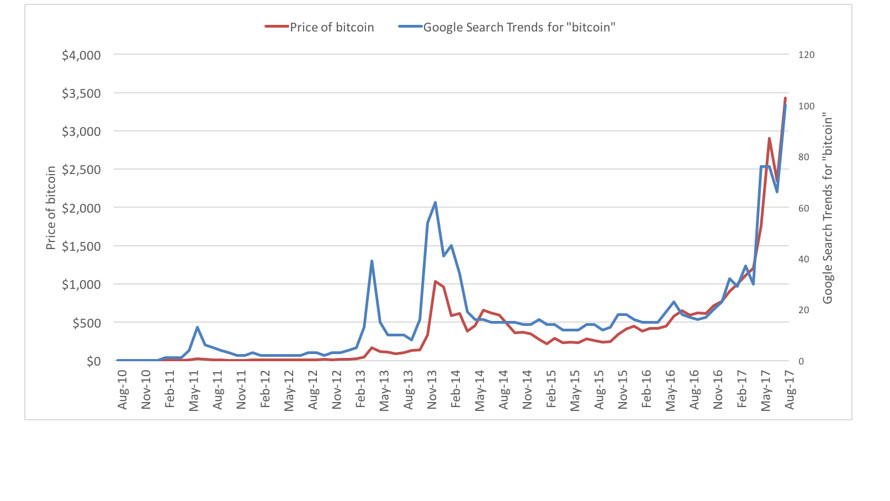
bitcoin’s brand has exploded recently, and there is evidence both to back up its popularity and just how important that popularity is to its growth and survival.
Source: Google Trends
There is a correlation between Google search trends for bitcoin and the price of bitcoin, which shows that higher interest in and popularity of the coin is intrinsically tied to its price, and thus, in many respects, its success.
This has been noted before in what is called
However, Gün Sirer does add:
“They might need to hard fork it to breathe new life into it after a chain death spiral, and it might serve a niche function, its medium of transfer and store of value functionality having been usurped by others. But still, I suspect there will always be a bitcoin brand and a niche community around it.”
Intrinsically unstoppable
While its adoption continues to grow and become more entrenched as a technology and a financial system in everyday life, bitcoin and cryptocurrencies — as well as blockchain — becomes harder and harder to simply move on from.
But even more than that, now that it is becoming established, it is also showing that it is harder to kill than, say, a stock, a technological fad or countless other comparisons which can die.
Many will compare bitcoin to a company or stock, which can go to zero, as a reason not to invest in it. However, bitcoin is decentralized and autonomous. There is not one man, group or board of directors that can run it into the ground.
On that same note, it is also — as regulators are finding out. With the likes of China and others trying to ban bitcoin outright, they are discovering that they are not .
But bitcoin is also adept at evolving and adapting — again, based on its intrinsic values. It is governed by a majority vote, and as things change and challenge it, the community chooses a path that is best for its survival. There may be battles and along the way, but ultimately, the advancements of bitcoin are for its survival.
Finally, even the biggest detractors of bitcoin and the cryptocurrency space are finding it hard to fault the potential of blockchain technology. Some like to try and differentiate cryptocurrency from blockchain, but they are mistaken in that sense.
Jehan Chu, co-founder of Kenetic Capital — a firm working towards spreading the adoption of blockchain technology — is also of the opinion that this new system is something that is fixing the problems of the past. Chu told Cointelegraph:
"bitcoin will never go to zero because it is a hedge against falling currencies, inefficient economies and increasingly systemic inequality. bitcoin represents the currency of a better future for society, and people will always invest in their future."
Too many vested parties
bitcoin, cryptocurrencies, blockchain, all these interlinked parts are slowly spreading through society into all different ecosystems. And, as they entrench themselves, their very makeup means it is hard for them to be eliminated.
Regulators have tried, and also come to a realization that they can’t totally oust cryptocurrencies, so now they are trying to work with them. This has opened the door for the traditional sectors of the globe to enter the market and make cryptocurrencies more part of the everyday.
This system of decentralized, adaptive, autonomous and democratic money has too many vested parties and too many strong characteristics, making it hard to eliminate totally in its current form.
Published at Sun, 01 Jul 2018 21:42:00 +0000