April 29, 2026

Capitalizations Index – B ∞/21M

End Excerpt -->

MyEtherWallet (MEW) has reportedly been the victim of a DNS hack on a day when Google appears to be having some issues. Social media and online crypto forums are awash with reports that reveal funds have been stolen from the wallet of some users. Other users who might have logged into the service during the period of the hack may have also been compromised.


Users Report Stolen Funds

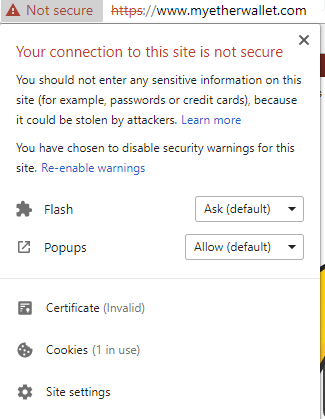
A MEW user broke the news on Reddit saying that 0.09 ETH (about $65) had been stolen from his/her account. The user had apparently fallen victim to a phishing scam based on a DNS exploit. The affected user also reported that upon visiting the site, the notification appeared that the connected was not secured. This is an anomaly for a service like MEW and an indication that all was not well. The user ignored the warning, entered his/her details and in 10 seconds, the coins were stolen.
Myetherwallet users lose funds to dns hack

Image showing warning message ignored by MEW user

MEW isn’t the only Ethereum-based service to have been hacked via a DNS exploit. Etherdelta was also hacked in December 2017. Many experts believe this phenomenon is due to the vulnerability created by the presence of a single point of failure in such services.

MEW and MyCrypto Confirm the Hack

MEW has since confirmed the hack via Twitter. An Ethereum address possibly linked to the hack has been identified. The address has already been tagged on Etherscan under suspicions of being involved in the hack. According to Etherscan, the tagged address conducted 180 transactions during the hack, stealing 215 ETH ($150,000) in the process. Comments on another Reddit post claim that MEW has traced the hack to a Russian IP address.

MyCrypto, a MEW rival service has also confirmed the DNS hack. The platform posted a tweet announcing that MEW user accounts have been compromised. In what seems can be seen less than subtle schadenfreude, the MyCrypto team is giving out all the details of the problem. It will be recalled that a bitter feud between MEW founders is what led to the breakaway of MyCrypto from MEW.

Google DNS Issues

There have been reports of problems with the Google DNS service today, April 24. Binance posted a tweet in the early hours of the day, telling users that Google DNS was experiencing problems. Apparently, users of the platform had been affected by service disruptions. There is no indication of a connection between the Google DNS disruption and the MEW DNS hack. However, a tweet posted by CobraBitcoin alluded to a possible link between the two incidents.

Edit: While writing this article, MEW posted a tweet saying that the issue had been resolved.

What are your views on the MEW DNS hack? Were you affected? Let us know in the comment section below.


Images courtesy of Reddit, Twitter, AdobeStock, MyEtherWallet

CryptocurrencyDNS hackEthereumMyEtherWalletphishing Show comments

Published at Tue, 24 Apr 2018 22:30:24 +0000

Altcoin News

Previous Article

EOS Hype Builds as Over 50 Candidates Vie for 21 Supernodes

Next Article

Nekonium (NUKO) FAUCET

You might be interested in …

After Second Hack This Year, South Korean Exchange Youbit Closes Down

After Second Hack This Year, South Korean Exchange Youbit Closes Down

South Korean exchange Youbit announced on its website today that it is closing down after a hack early Tuesday, December 19, 2017, that resulted in the loss of 17 percent of its assets.

The exchange, previously known as Yapizon, did not indicate how many bitcoins or other cryptocurrencies were stolen or what the total fiat value of the attack amounted to, but it was enough to lead to bankruptcy.

This was the second hack the exchange suffered this year. A prior attack in April 2017, resulted in the loss of 3,816 bitcoins, worth around $5 million at the time.

Youbit said hackers broke into its hot wallet, the online account used to pay out cryptocurrencies instantly. While hot wallets offer greater convenience, they also put funds at greater risk because they are connected to the internet.

The remaining coins were kept offline in a cold wallet, the exchange said, resulting in no additional losses. The exchange indicated that customers could withdraw up to 75 percent of their balances, and the rest would be tallied out after the final settlement.

Korea Internet & Security Agency (KISA), the state agency that responds to cyberattacks, is investigating the incident, as reported in Reuters. KISA has maintained that North Korean hackers were behind the first hack.

Chris Doman, threat engineer at software security company AlienVault, told bitcoin Magazine, he suspects BlueNoroff, a subgroup of North Korea’s cyber crime group Lazarus is responsible for the second Youbit attack. Lazarus is known for the November 2014 hack on Sony Pictures Entertainment, one of the biggest corporate breaches in history.

While attacks by Lazarus have mainly been aimed at social disruption, recent reports indicate the group is increasingly going after money. With the value of bitcoin surging to all-time highs, exchanges are becoming a lucrative target.

“The first time I saw them target a bitcoin company was in May this year — the same month they unleashed WannaCry,” Doman said in a statement shared with bitcoin Magazine.

The exchange that Doman was refering to is South Korean bitcoin exchange Bithumb. Around that same time, WannaCry ransomware attacks were encrypting user’s computers and offering to de-encrypt them in exchange for bitcoin. Analysis of the techniques used in the WannaCry attacks show strong links to Lazarus.  

Doman added, “They’ve also used related malware to opportunistically mine Monero coins on compromised servers. Clearly they have a large interest in cryptocurrencies as an easy method for economic gain, as well as an opportunity to economically weaken their enemies.”

Although Youbit is one of the smaller bitcoin exchanges, the hack underscores the risk involved in leaving funds on an exchange, where control of those funds is handed over to a third party and is only as safe as whatever security measures that exchange chooses to use.

Throughout the history of bitcoin, hacks have amounted to painful losses. When bitcoin exchange Mt. Gox began liquidation proceedings in April 2014, the company announced that approximately 850,000 bitcoins were missing, an amount valued at more than $450 million at the time. In August 2016, the bitcoin exchange Bitfinex announced hackers stole approximately 120,000 BTC, worth $72 million at the time.

The post After Second Hack This Year, South Korean Exchange Youbit Closes Down appeared first on Bitcoin Magazine.

How to deposit and withdraw coins on dc-ex

How to deposit and withdraw coins on DC-EX

How to deposit and withdraw coins on DC-EX This video is for educational purposes Cryptocurrency If you open open a wallet with BITX use my promotional code to make something extra Bitx promotional code: JYCXY