Key Highlights:
may break $97 price level downside;
XMR price may increase above $111 this week;
ranging is ongoing.
XMR/USD Price Long-term Trend: Ranging
Distribution Territories: $111, $119, $126,
Accumulation Territories: $97, $86, $76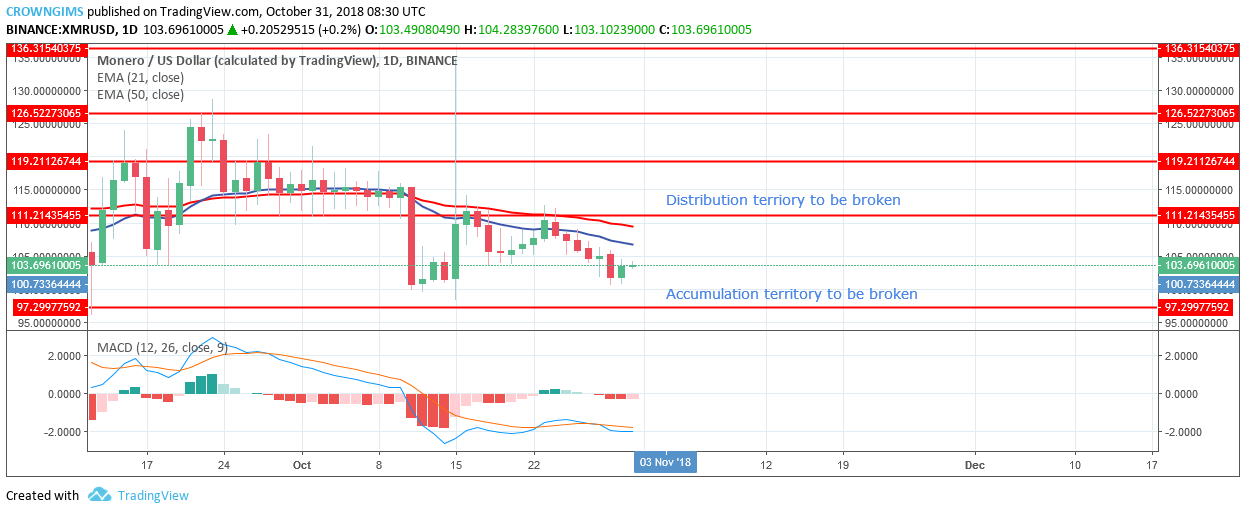 XMR/USD continues its ranging movement in its long-term outlook. Last week, the market still maintains the ranging movement within the bound range of distribution territory of $111 and the accumulation territory of $97. The bulls have no enough pressure to pull the XMR price above the distribution territory of $111, also the bears could not push the XMR price below the accumulation territory of $97.
On October 23, the bulls made an attempt to break out the distribution territory of $111 upside but the bears prevented it by forming bearish candles that brought down the XMR price to $97 accumulation area. XMR price was bearish within the bound range last week.
Currently, XMR price is above the accumulation territory of $97. For XMR price to break out from this bound range zone, a radical fundamental event is needed. XMR price is below the 21-day EMA and 50-day EMA with the two EMAs fan apart and MACD with its histogram below zero level and the signal lines parallel without showing direction indicates ranging within the channel is ongoing.
There is a probability that the coin will break the accumulation territory of $97 downside and the coin may have the low accumulation territory of $86 as its target.
XMR/USD Price Medium-term Trend: Bearish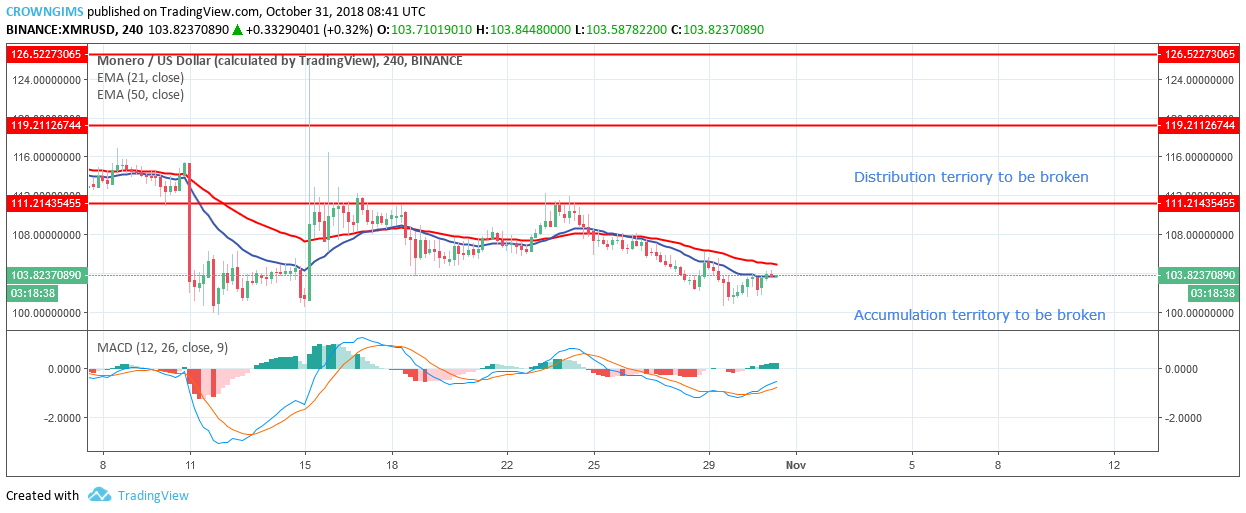
XMR is in bearish trend in its short-term outlook. XMR price continues falling within the bound range of distribution territory of $111 and accumulation territory of $97. In case the distribution territory of $111 hold and the bears increase their pressure, the accumulation territory of $97 will be broken and the coin will be exposed to the $86 price level.
The 21-day EMA crossed 50-day EMA downside which connotes downtrend. XMR price is on 21-day EMA while 50-day EMA is above the 21-day EMA which indicates that there is a probability for the bulls to take over and upward movement may occur this week should the bulls increase their momentum. MACD with its histogram and its signal lines are above the zero level with the signal lines point to the north indicate buy signal.
Following a security breach, , has announced the forking of its TIO tokens to protect holders. The 1:1 fork will replace existing TIO tokens with TIOx, a new token retaining the same functions as the old one. The fork will further contain the breach, ensuring that the integrity of the token ecosystem cannot be compromised or contaminated.
Recently, trade.io has announced the formation of a world-class cybersecurity unit lead by a team of security experts to monitor and counter threats. On the 20th of October, 2018, the team was alerted to the usual movement of tokens from a wallet reserved for the platform’s liquidity pool.
50 million TIO tokens held in the wallet was transferred to external exchanges, setting off abnormal trades. The exchanges were immediately contacted to disable the depositing, withdrawal, and trading of TIO tokens, while the team launched an investigation into the source of the breach and its reach.
TIO trading on all affected exchanges was immediately stopped, quarantining the situation and preventing it from deteriorating. Working with the management team, exchanges including KuCoin and Bancor have assisted trade.io in identifying the transactions associated with the breach and isolating them.
Preliminary investigation by the trade.io security team revealed that at no point was the liquidity pool or exchange affected or accessed by the breach. They also found no hint of internal collusion in the breach. Rather, the issue emanated from a particular hardware wallet acquired directly from the manufacturer. No customer account was directly affected by the breach, nor were any funds lost. trade.io management reiterated its commitment to resolving the situation, saying:
“We are actively taking steps to further lock down the situation, and prevent any other potential impact.”
The management also thanked its community for their support and understanding, saying:
“While this security breach has been an inconvenience, we are happy to report again that no client assets were lost and we’re pleased with how efficient and responsive our entire team acted following the breach. We’ve been overwhelmed with the positive response from our clients which we affectionately call TIOnauts, and can’t thank them enough for their support and well wishes as we continue this special movement.”
To further contain the breach and ensure that the token ecosystem cannot be tainted by any compromised TIO tokens, trade.io Management has announced the 1:1 fork of existing TIO tokens. The new tokens, called Trade Token X, or TIOx, will also be an ERC20 token with the same functions and utility as TIO. Details of the fork are expected to be released soon.