bitcoin, the world’s largest cryptocurrency by , was brought into the world by a person/s with the moniker ‘Satoshi Nakamoto,’ a Japanese name. Yet, it still has to be proved if bitcoin is really of Japanese origin. Nonetheless, this may be a reason why Japan has a soft corner for – or maybe just a hint of patriotism.
is Japan’s meme equivalent of but rivals bitcoin in popularity and use. The venture started out as a joke in December 2013 but in recent times, has become a dependable, serious commodity. But the question lingers; is it really worthy of an investment?
Source: Flickr
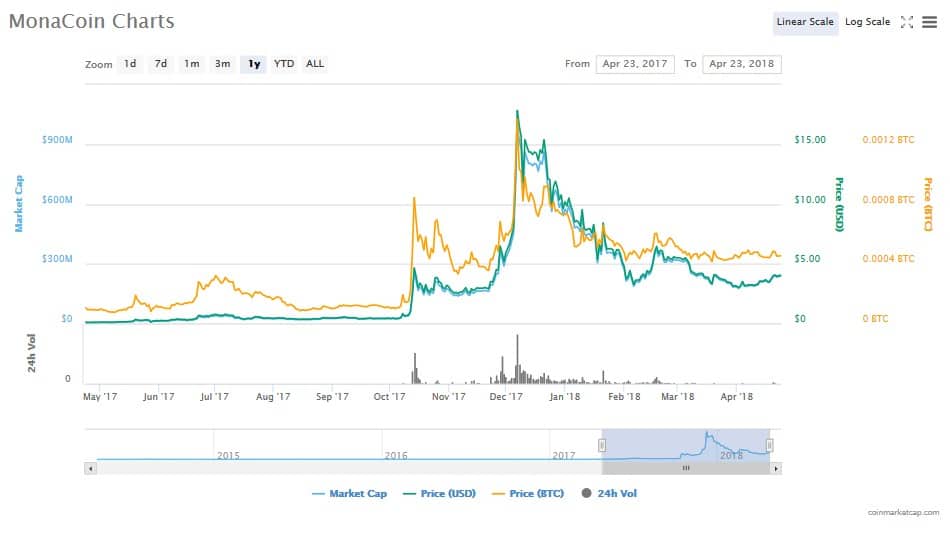
At the time of writing, Monacoin stands at a $238 million market capitalization, which pegs it at . However, 2017 saw its value exceed a billion dollars, valuing one Monacoin above $17 in December 2017. However, like every cryptocurrency, the price is prone to instability.
Source:
“Meme” Coin Beginnings
The Monacoin was created through a post on a pervasive Japanese Internet bulletin board , which was the stimulus for the popular and controversial bulletin. The 2channel still stands strong as a preferred platform for hackers and rebels to post controversial content and breaking news. This cryptocurrency was created by a “Mr. Watanbe,” a yet undisclosed figure who went the “Satoshi Nakamoto” path.
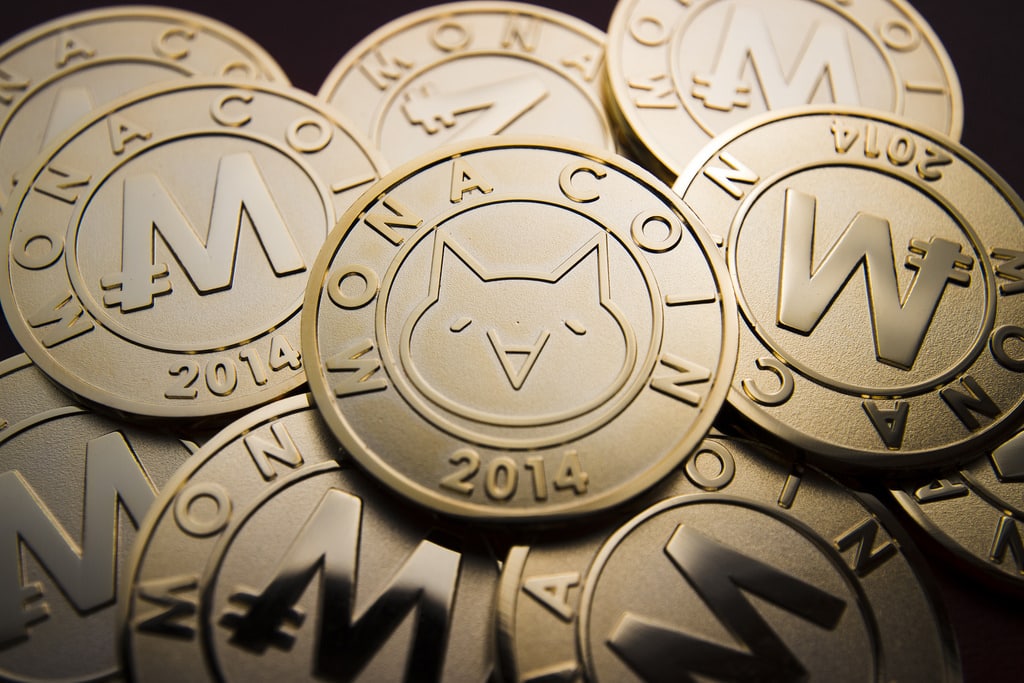
It was named ‘Mona’ after an ASCII art drawn entity which closely mimics a cat emoji famous on the bulletin board. The altcoin is based on ‘s technology and the volunteers who have contributed to Monacoin’s code have developed it further, making it a faster form of payment.
The digital currency was incepted on January 1, 2014; with a dedicated Bitcointalk detailing its launch along with all features.
Growing Fanbase
After the fall of the world’s most popular bitcoin exchange – Mt. Gox in Tokyo in 2014 – began the rise of the Monacoin, with it gaining positive publicity and favorable media space. It was put forth as being “safe” and “made in Japan.”
Monacoin is now traded on four big currency exchanges in Japan, such as ZAIF, and some internet stores and physical ones are open to the use of Monacoin. ATMs in Japan have also started making use of Monacoins and deal in them. This new craze has acquired a humongous following owing to being the first of its kind in .
An apparent millennial move describes “tipping” or giving people Monacoins as gifts through the medium of social networking sites, mainly Twitter. Another announcement by the Japanese government states that Monacoin can be used to purchase real estate. It declared itself to be the first ever company in Japan to have bagged this deal and is positive to extend it abroad too. The coin has such a following in the country, even one of the represents Monacoin.
Keiichi Hida, a cryptocurrency enthusiast based in Japan, stated that the Monacoin is more of a mode of transaction than a source of speculation and that the audience makes it user-friendly. The fact that it can be used on Twitter to “tip” people makes it internet-friendly too. He also added that the handling fees are a whole lot lower than others in comparison.
Much like dogecoin, monacoin is a popular method for tipping in Japan. Source: Pixabay
Monacoin No Stranger To Criticisms
Maurice, Director of Wiz K.K. in Tokyo, does not seem too impressed with Monacoin. He argues that it is not very different than other than a few minor changes. Furthermore, he states that once bitcoin launches its new system all altcoins may become a thing of the past!
So, as it can be conferred, the Monacoin has varied opinions and experts at war. But one thing remains constant, the people’s love for it and its broad fan base, albeit in Japan!
The post appeared first on .
Cryptocurrency mining often requires a lot of computation power. Therefore people who want to try their hand at mining must purchase specialized equipment. Not everyone can afford to buy expensive hardware. It usually takes a big mining farm consisting of numerous video cards to get the bang for one’s buck. The electricity bills tend to be discouraging, too. Some individuals, though, have found a way to circumvent these obstacles by parasitizing in their work environment. These people’s foul play is all about the exploitation of enterprise networks to mine digital funds beyond employers’ awareness. Here’s a lowdown on the most defiant incidents of that kind reported to date.
Crafty Miners’ Fiasco in the Crimea
Two employees of the Crimean Council of Ministers harnessed the processing power of the government agency’s computer network to mine . These activities remained below the radar of local authorities for five months on end – from September 2016 to January 2017. The ne’er-do-wells were able to earn 15,000 rubles ($260) worth of bitcoin this way. Meanwhile, the cost of electric energy that was consumed along the way amounted to 57,000 rubles, the equivalent of $1,000. When the violation was uncovered, the two friends had to pay a fine of 30,000 rubles ($525) each. This undertaking, obviously, didn’t end well for the resourceful entrepreneurs.
Australian Government Agency’s IT Resources Abused
Another story of surreptitious mining at work in February 2018. Two IT staffers of the Bureau of Meteorology, the country’s official weather reporting agency, leveraged the internal computer network to their advantage. Neither the government agency nor law enforcement officials have gotten into detail about the incident. The only reported fact is that the police interrogated the unscrupulous employees. It remains unclear how big the damage is and what the legal action the two are going to face. Interestingly, this weather agency had gained some notoriety a few weeks earlier due to about a fake cryptocurrency startup by Elon Musk.
Russian Nuclear Facility Employees Breaking Bad
In yet another case that hit the headlines in February 2018, Russian police working at a nuclear research center. The top-secret facility is located in Sarov area, western Russia, and specializes in nuclear warhead development for the government.
The adventurous individuals had allegedly used the organization’s supercomputer for unauthorized cryptocurrency mining. The exploited machine has an immense processing power of 1 trillion calculations per second. It is supposed to operate exclusively within the research environment and never go online. However, the mining process per se implies a connection to the Internet, and that was a dead giveaway.
It didn’t take the facility’s internal security department long to identify the misdemeanor. The culprits were handed over to the FSB (Russia’s Federal Security Service) for further investigation. Given the vast capacity of the supercomputer mentioned above, the amount of bitcoin that the employees were able to mine using it must have been sizeable.
Scandalous Exposure in Florida’s Citrus Agency
One more story has to do with an working at Florida’s Department of Citrus. The ill-minded staffer named Matthew McDermott ventured into using the agency’s computers to mine bitcoin, litecoin and other cryptocurrencies over a time span of October 2017 – January 2018. He covertly tethered various machines within the organization to a mining pool.
According to the findings of the Florida Department of Law Enforcement, the unsanctioned mining at the workplace wasn’t the only misconduct that McDermott perpetrated. He reportedly also used the credit card of the government entity to purchase 24 graphics cards for $22,000 and thus give some extra momentum to his questionable business. Although that’s, obviously, pretty poor OPSEC, the threat actor’s activity lasted for months undetected.
One of the things that raised a red flag was a substantial increase in the agency’s electric bills. The numbers grew by 41 percent during the crook’s furtive mining campaign and made Citrus officials delve into the cause. The evidence led to McDermott who got arrested and is being charged with grand theft.
An Intricate Plot in Louisiana Attorney General’s Office?
It turns out that the employees of the Louisiana Department of Justice might not be the most law-abiding citizens, to put it mildly. The state’s Attorney General Jeff Landry regarding a purported case of abusing government computers for sneaky cryptocurrency mining. The story most likely began last September when Landry’s office fired several information technology section staffers, although there were no official statements on the reasons back then. It’s not until late February 2018 that the authorities acknowledged an ongoing investigation.
Most details remain a mystery at the time of this writing. The only public allegation boils down to the discovery of some suspicious equipment and that the staffers, including the former director of the IT division, might have used. The fired employees deny the charges, though. They claim they couldn’t have harnessed agency workstations for mining because they are simply not powerful enough, and the spike in electricity consumption would have attracted too much attention.
Conclusion
Cryptocurrencies might appear to be low-hanging fruit when an employee has access to the enterprise computer network. It is indeed tempting to go ahead and create a crypto mining farm without having to pay the utility bills and spend a fortune on CPUs or GPUs. However, as the incidents above demonstrate, such shenanigans usually leave plenty of breadcrumbs that lead to the culprit at the end of the day.
The post appeared first on .


 Die vergangene Woche bescherte uns nicht nur vielerorts sommerliche Temperaturen, sondern auch Sonnenschein am Kryptomarkt. Der Chart für bitcoin gibt positive Signale, auch kürzliche Events tragen zu einer guten Stimmung bei. Betrachtet man das Big Picture von bitcoin, so könnte man zuversichtlich werden. Nachdem die Unterstützung aus Februar, aktuell bei ca. 5.500 Euro, nun mehrmals…
Der Beitrag erschien zuerst auf .