Originally written March 18th, 2018. Kept internal until publishing date today.
Structure of Analysis
Brief OverviewTakeawayDescription of the tZero PlatformDescription of the tZero TokenCompeting ProjectsBull CaseBear CaseWhere I’d like More ClarityOverview
The , a subsidiary of Overstock, is looking to build a blockchain based SEC compliant security token exchange. The target market for this platform are companies that are looking to launch tokenized securities and provide liquidity and smart trading through a regulated exchange. tZero also launched an ICO for the tZero platform, aiming to raise $250 million to fund the development of the infrastructure.
Takeaway
There are 3 key areas to look at when evaluating the tZero project.
The tZero PlatformThe tZero TokenRegulatory Environment
Dive briefly into my takeaway section here, expanding on each later in the document.
The Platform
The tZero platform is an ambitious idea using a token sale to raise funding. The ramp of providing legal advisory and a legally compliant trading platform for new tokenized securities is a niche that will need to be filled if tokenized securities become a popular theme for companies. As of now, the only publicly announced tokenized security they have planned to be on their platform is . The success of the platform depends on the increased interest of tokenized securities by established firms.
I do not envision tokenized securities becoming a large trend for companies in the short term (2+ years), as potential benefits are outweighed by regulatory overhang for the time being.
The ICO
The $250 million ICO raise through the tZero token raises some eyebrows. Whenever one sees a token sale, the first question must be “why a token?”. Digging deeper, it is clear the tZero token is not a core aspect of its trading system. The token’s main use case seems to be as a fundraising mechanism, with the value to holders being 10% of revenues in dividends distributed quarterly with potential additional “utility benefits” down the line at the discretion of management.
Overstock plans to raise $250 million for their platform, a number management claimed they could easily reach in January. As of their February 23rd , however, they have only raised ~$65 million (of which $30 million may be from Overstock itself). The CEO Patrick Byrne on March 1st did claim they have crossed the , and we will have to wait for the Form D for a more specific number.
This token sale was entirely fundraising driven, which I believe could be representative of Overstock’s short-term vision on raising capital during this speculative craze instead of provide long-term value.
Regulatory Environment
Regulatory uncertainty surrounding these new tokenized assets is another serious consideration. The SEC in early March subpoenaed tZero and other raising money through a token sale. The SAFT is a broad concept that explains how token issuers could remain on the right side of securities laws when issuing what basically amounts to coupons for tokens at a future date when the platform they are used on is complete. The fear here is that the SEC will say that many of the SAFT agreements are invalid and didn’t abide by securities laws, which would be detrimental to many projects (Note that tZERO used a SAFE agreement, not SAFT).
I believe this overhang will likely dampen excitement over ICOs and tokenized offerings for the short term, until there is clarity for the SEC as to what the exact regulations are.
Summary
Tokenized securities may have a bright future, and if tZero can succeed in becoming industry leader of this area, it could become an incredibly profitable business. That being said, the market is very immature from a technological and regulatory standpoint; an explosion of tokenized securities that will ramp into the tZero platform seems more like a dream than a revenue generating business.
Even as a long-term bull on this space, the value that’s been assigned by the market to the unproven tZero platform is, in my opinion, too high. I credit some of this to investors wanting exposure to the crypto-asset market without buying the crypto-assets themselves, and Overstock having positioned itself as the .
Lastly, the raising of an $250 million through an ICO speaks loudly about management. In my experience, these types of cash raises demonstrate a team that is blurred by the short-term and not focused on creating long-term value from the project.
Description of the tZero Platform
tZero is a blockchain-based trading system specifically focused on being a regulatory compliant platform for tokenized securities. The key differentiator between this platform and a classic stock trading business is the support for tokenized securities, creating a more liquid and accessible trading platform.
The tZero blockchain based trading has been live for some time, but only a handful of preferred equities trade on it. The key value driver for the tZero platform will be onboarding and supporting tokenized securities from established companies, and Kodak Coin is the only one planned as of now.
To understand why this platform may succeed, it’s important to understand the strengths that a security token can provide to an issuer over the more traditional avenues of financing.
Security Tokens Benefits in General:
Lower Fees — Many fees associated with financial transactions are derived from payments owed to middlemen (bankers, etc). Security Tokens remove the need for most bankers which reduces fees, and smart contracts may one day decrease the reliance on lawyers as well. These smart contracts will reduce the complexity, costs and paperwork with managing securities (collecting signatures, wiring of funds, mailing of distribution checks, collection of W-2s, Sending K-9s, etc).Faster deal execution — The more people involved in a deal, the longer it usually takes to execute. Security tokens remove middlemen from investment transactions, enabling an accelerated timeline for issuers to successfully offer their security. Additionally, immediate trade settlement on the secondary market for Security Tokens will become an attractive advantage for issuers & investors too.Free market exposure — Most investment transactions today lack exposure to a global investor base. For example, it is hard for investors in Asia to invest in private US companies or real estate. With Security Tokens, asset owners simply market their deals to anyone with an internet connection (within regulatory limits). This free market exposure should lead to a significant change in asset valuations since any asset that is not exposed to a free market is mispriced.Larger investor base — When asset owners can present deals to anyone with an internet connection, the potential investor base is drastically increased. For example, would you rather show your investment opportunity to only US accredited investors & institutions or every potential investor in the world? Competition is healthy and a long-term net good for financial markets.Automated service functions — Lawyers are less middlemen and more service providers in most transactions. With Security Tokens, issuers will begin to use smart contracts to automate the service provider function through software. This doesn’t mean that lawyers will disappear, but rather that their role will be more advisory based.Lack of financial institution manipulation — This is a complex topic that is sure to be controversial. The short explanation is the likelihood for corruption and manipulation by financial institutions is decreased if those institutions are removed from the investment transaction process. The utilized by the tZero platform attempts to address this.
If these benefits begin to hold enough weight for tokenized securities to become a popular method for companies to raise funding, tZero could position itself as the go-to platform for regulatory compliant trading of tokenized securities
Description of the tZero Token
The Token Raise
The recent tZero ICO launch aimed to raise $250 million to fund the development of the tZero platform. This token used a SAFE agreement with accredited investors, making it conceptually similar to a “preferred stock security token”. The offering was structured such that earlier investors got free ‘bonus’ tokens at the tranches of 100% bonus on the first $10 million purchased, 50% bonus on the next $40 million, and 25% bonus on the following $50 million. This method of bonus tranches sales is commonly seen in ICO’s to garner early interest.
Although the CEO Patrick Byrne has claimed astounding interest and success on the token raise, some of the numbers indicate otherwise. The day after announcing the ICO in December, Patrick said they had and that . The most recent files from February 23rd contradict this, as it states that they have sold roughly $65 million worth of tokens. It should also be noted that a sizeable chunk of this investment could be from Overstock themselves, who reportedly were looking to purchase $30 million. On March 1st, Patrick Byrne said in an interview they had crossed , but will need to wait for next Form D filing for an exact number. There has likely not been a significant cash raise since ths announcement, given the being given out and uncertainty around the ICOs in general.
The Value
According to the offering documents, the Tzero token pays “10% adjusted gross revenue to token holders on a quarterly basis”. This is, for all intents and purposes, a dividend on revenues that the tZero platform generates. The company also stated they will attempt to incorporate some utility benefits, but have made no disclosure on that, and these are entirely up to the discretion of the management.
“Nevertheless, the Company expects to endeavor to provide certain additional benefits to holders of the Tokens in the future (the “Discretionary Benefits”). These will not be a part of the terms and conditions of the Tokens, but rather benefits voluntarily provided by the Company to Token holders. These Discretionary Benefits may be withdrawn or changed at any time at management’s discretion.” —
The value of the token to investors is entirely in the revenues the tZero platform will be able to generate, with potentially other unnamed benefits down the line; which I would urge not to give any value to for the time being.
Use Case of Token
The tZero token is not necessary for trading on the platform. In these new tokenized offerings, it’s important to ask what the token’s purpose is. The primary use case of tZero’s token sale was to monetize the platform, allowing for proceeds to be used to develop out the platform in different ways. Below is a screenshot of the listed by the team itself.
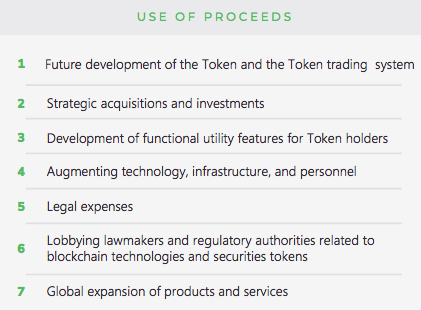
This is confirmed by their , where they describe the primary goal of the token sale as “Is to raise capital to support tZERO’s business”. Capital raising is a legitimate reason for a token launch, but it’s still important to note that as of now, the token has no specific use in the platform.
Regulatory Concerns
On March 1, the SEC revealed that they had tZero (and many other ICOs). Although this was not a surprise to many involved in the space, it did rattle investors quite a bit. These subpoenas are likely just information gathering, with the SEC likely to pursue action against the worst offenders. Where the SEC will go with regards to determining the legality of the token sales is yet to be seen. Companies have been utilizing the SAFT or SAFE agreements, which are often criticized as simple regulatory arbitrage to not have them called securities. If the SEC does deem these offerings securities, the platforms that have sold them that has been underway will be deemed illegal securities trading/offerings. That being said, tZero sold their tokens exclusively to accredited investors and this method of sale through the SAFE agreement makes them slightly less vulnerable to such a drastic determination by the SEC. I do not believe the SEC deeming many ICOs securities, as as well as ramping up regulations around new launches, would impact the tZero token directly, however it may dampen the interest in launching these types of tokenized securities and reduce the appetite for companies to utilize the tZero platform; at least until the dust has settled and the regulatory framework is in place.
Summary
It’s clear the token was used as a fundraising mechanism for their tZero platform. The benefits to the owner will be in the form of dividends on revenues generated (10%). The demand for the offering seems to have been overstated by management, claiming they could have sold out in December, but are at the $100 million as of March 1st. At the moment this token provides real utility to the platform and the sale’s primary motivation was fundraising.
Competing Projects
tZero is not the only platform attempting to be a regulated security token trading system. Below are a couple of high quality projects.
: Raised $2.7 million in funding from Raptor Group, Galaxy Investment Partners, Blockchain Capital, and firstminute.capital. Notice the far smaller size of raise here compared to tZero ICO.: Main backer is Blockchain Capital. Polymath has a token that is worth ~$140 million as of this writing. Actually took an advisory role to tZero on their ICO.Bull CaseSecurity token offerings become a popular method for companies to fundraise projects, and the tZero platform is the go to exchange to on-board many of them.SEC regulation produces lax guidelines that need to be followed for security tokens. Having this will force the offerings to professionalize themselves and tZero may become one of the few legally compliant exchanges to launch these new tokens on.tZero token raises the expected $250 million (not just the $65 million according to , $100 million according to CEO Patrick Byrne on March 1st)Bear CaseSecuritized token offerings do not catch on in the near term, leading to few and far between launches. Only KodakCoin so far is expected to onboard to the platform.Token sale will not raise the full $250 million, leading investors to feeling duped by the bullish claims made my management.SEC regulatory crackdown on tokenized securities will diminish appetite for these securities by both investors and companies. If the regulations are harsh enough, the need for a securitized token may not be there.tZero does not become the go to liquidity platform and will be in a space with many other competitors.Overstock positioning itself as a “proxy” for crypto investing by Wall Street firms who directly invest in the tokens will diminish as they realize this is a flawed way of gaining exposure to the crypto-asset market.Where I Would Like More ClarityIs there interest from securities to use the tZero platform outside of tokenized ones such as Kodak Coin?Are there other companies that are in the pipeline to launch their tokenized securities on the tZero platform?Does the ~$65 million of tZero tokens sold (according to Feb 23rd Form D) include the ~$30 million Overstock was planning on investing.Would they ever list “Utility Tokens” as well?
Big thanks to and for feedback on this piece.


The markets are still shaky with bitcoin (BTC) once again attempting to touch $7,000. Ethereum (ETH) might have found its footing above $400 and is currently trading at $421. Ripple (XRP) is also at the brink of passing $0.50 at the moment of writing this. Our precious Stellar (XLM) has not been left behind and is currently trading at $0.204, up 2.27% in 24 hours.
It is Stellar (XLM) that we want to focus on. And in particular, a few price predictions available on the world wide web.
The first price prediction puts by the end of the year. This price prediction is based purely on Technical Analysis by the team at WalletInvestor.com. This is a very conservative price prediction. They go ahead and advise that if you are looking for virtual currencies with good return, XLM can be a profitable investment option.
The second price prediction was done by and puts XLM at a good $1 price very soon. Considering that XLM had touched $0.92 levels on January 3rd this year, this is a more plausible prediction since the article was written in December, 2017. This price prediction is based on the technical capabilities of the Stellar platform that has attracted numerous partnerships from IBM, SatoshiPay, EXCH.ONE, Klick Ex, Mobius and Hashcash. Of worthy mentioning, are the 9 current IBM Stellar Nodes being used for cross border payment settlements that could lead to a few global Central Banks opting for the Stellar Platform for their own National Cryptocurrencies.
A third price prediction is ambitious and range by the end of the year. This is also based on the banking improvements around the globe due to Stellar. The nations that have benefited from the Stellar network are from India, Philippines, Nigeria and several African Countries. Of noteworthy mentioning, is the IBM partnership once again in this price prediction.
A fourth and not necessarily last price prediction on the web, puts XLM at an ambitious $6.41 by the end of the year. This price prediction is courtesy of . The site states that the XLM price predictions are updated every 5 minutes and that they wrote a custom algorithm to hopefully predict future prices for all of our listed digital crypto currencies similar to Stellar. And with it, they have identified that XLM could potentially be very profitable.
All in all, Stellar (XLM) is pretty much a Dark Horse as we head down 2018. Perhaps what many Crypto traders are not aware, are . They include companies in over 40 countries in industries such as money remittance (TEMPO), mobile financial services (coins.ph), asset management (Stronghold), Crypto exchanges (NaoBTC), digital commerce (cellulant), financial consulting (Deloitte), technology (IBM)…just to name a few.
What then remains to be seen, is the upward increase in value of XLM in the markets as the market gets some much needed stability above the total $250 Billion crypto market cap.
TO THE MOON!
The post appeared first on .