May 20, 2026

Capitalizations Index – B ∞/21M

Mobile Crypto Mining Democratizes Cryptocurrency for Everyone

Mobile crypto mining democratizes cryptocurrency for everyone

Mobile Crypto Mining Democratizes Cryptocurrency for Everyone

Caleb Simmons · April 20, 2018 · 4:30 am

Of all extant cryptocurrencies – over 1,500 – those restricted to mobile platforms, wallets, and exchanges comprise a fairly small portion. Yet despite ERC20 and utility tokens’ dominance in the ICO landscape, there is a high potential for mobile-only cryptocurrencies to democratize mining and dramatically decrease transaction costs. Potentially, this makes mobile-based cryptocurrencies, in aggregate, a foundation for tangible and tractable work to reverse the remaining and foundational problems seen with dominant cryptocurrencies today.


The Problem

The problem

Today’s dominant cryptocurrencies are used mostly by highly tech-savvy users, blockchain companies, and their staff, and accredited investors participating in ICOs. Moreover, they – especially bitcoin, Ether, Litecoin, and Ripple – are increasingly referred to as stores of value instead of high-frequency and high-volume transactive material like fiat currency. Yet this trend is slowly beginning to fade as more people realize the transactive value inherent in cryptocurrency.

The problem most people have when attempting to use cryptocurrency, however, is that it currently requires a large amount of technical expertise and money to contribute to mining costs to actually obtain and use, making it prohibitive for the average person. This includes the millions of unbanked people in the Global South who use nontraditional transactive and earning mediums that fall outside of the banking system.

For most of them, though disconnected in terms of not owning a laptop or desktop computer, their disproportionate ownership of mobile phones is a central entry point into crypto, giving them the potential to add mining revenues to the money they use to live every day. Mobilizing mobile app development to democratize crypto exchange and p2p utilization, as well as distribute mining operations across mobile networks, is one possible solution for this problem.

The Solution
The solution

Mobile-only cryptocurrencies represent a growing niche being developed to allow everyday individuals to mine and transact with cryptocurrency, with tech-savvy Millennials in traditionally nontech-hub areas around the world developing these to allow more people take advantage of the value they hold. Mining incentivization algorithms tied to mobile outsourcing, as well as open-source inter-bank payment networking protocols, are among the dominant and most attractive use cases in this niche field. They are just a few examples of how blockchain technology, combined with mobile as a transaction and exchange medium, are already breaking down price barriers to mining and profiting off of cryptocurrency, and consumers and developers in every country alike are paying attention.

Together, such use cases could do an excellent job of democratizing mining by taking electricity costs out of the equation, allowing anyone anywhere to mine and earn cryptocurrency. Plus, incentivizing this by using Proof-of-Time protocols to allow people on such platforms to gain cryptocurrency just by using it would increase the volume of coins mined, transacted, and traded—as well as the number of miners confirming transactions, undergirding the strength of both the total worldwide cryptocurrency user base and the associated consensus ecosystem, and providing public motivation towards mainstream usage.

Evidence and Potential
Evidence and potential

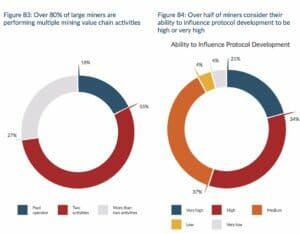
The extent of the mining value chain’s evolution bears out the value of these use cases to the worldwide general public. According to theCambridge Center for Alternative Finance, remote hosting and cloud mining services emerged as early as 2016 to offer customers the possibility to participate in the mining process without having to run their own equipment. bitcoin miners alone have earned over $2 billion to date, with over 80% of miners performing multiple mining value chain activities, half of those able to influence protocol development at high levels across all mining operations. 82% of large miners are performing a single mining activity, and 27% are engaged in more than two. These statistics cover only bitcoin.

Mobile-based democratization of mining activity would simultaneously drive down mining costs dramatically by distributing mining activities across a widening array of mobile phones globally, and increase cryptocurrency legitimization given the huge swaths of people previously disengaged from mining whose activity would produce entirely new value for more cryptocurrencies, increasing investment into cryptocurrency as a whole.Among the cryptocurrenciesleading in this regard, Phoneum andMobileCoin stand out.

Doubling Down: The How and the Why

Evidence and potential

The former uses a consensus algorithm combining Proof-of-Work and Proof-of-Time protocols alongside a point-of-sale network facilitating free p2p transactions. Along with its simplified UX platform interface and 2.1 billion smart mobile devices extant worldwide, Phoneum has created a unique algorithm differentiating computers and ASIC miners from mobile devices, allowing the platform to create a mobile-only blockchain solution. All miners on the platform operate across a flat hierarchy, allowing everyone to benefit equally from the mobile app and facilitating equality among all mining devices on the network.

The latter company uses theStellar Consensus Protocol to facilitate a federated system of sub-second p2p transactions across mobile networks over a synchronized distributed ledger, sealed from access by both node operators and potential attackers. Both are examples of a growing generation of blockchain companies using secure, smart mobile-driven distributed ledger technology to both incentivize users to use and transact with cryptocurrency, as well as accelerate crypto transactions and secure them from improper access or attack.

Progress, and Moving Forward

Progress, and moving forward

These use cases are excelling. In particular, Phoneum’s alpha stage secured 15,000 unique downloads overall, with 26,000 accounts actively mining. Having just launched their beta app last week, Phoneum has secured an additional 2,000 new accounts in less than 48 hours. They are currently in high-level conversations with mobile manufacturers to have their app pre-installed on their devices for shipping.

Ivan Likov, Chief Executive Officer at Phoneum, says:

Because we have worked to overcome the challenges of storage, overheating, and power processing, we have realized that the network is stable and devices are continuing to work normally with Phoneum in the back-end. All this allows us to focus on bringing it to the masses rather than adapting the platform for mobile devices.

How do you feel about mobile-based cryptocurrency mining platforms opening up crypto for everyone? Could it possibly remove some of the final barriers to mainstream adoption? Post in the comments below to let us know!


Images courtesy of Shutterstock, AdobeStock, Pexels, YouTube

blockchain technologycryptocurrenciesmobile miningMobileCoinPhoneum Show comments

Published at Fri, 20 Apr 2018 08:30:21 +0000

Altcoin News

Previous Article

British Petroleum teste la technologie blockchain

Next Article

PayPal Policy Change Forces Consumers to Take Cryptocurrency More Seriously

You might be interested in …

Australia is Exploring the Blockchain for Welfare Payment Distribution

Altcoin Today Australia is Exploring the Blockchain for Welfare Payment Distribution Australia is Exploring the Blockchain for Welfare Payment Distribution Australia’s Digital Transformation Agency (DTA), which works with government agencies, users, and private sector partners to […]

Crypto Trading and Traditional Assets: New Options for Investors

cryptotrading.jpg

While trading of crypto-assets is booming, some investors are looking for options to trade traditional assets like stocks via cryptocurrencies. Three new operators are among those developing trading platforms to meet this need, with blockchain-based tokens pegged to the underlying assets.

Ankorus

Ankorus is establishing a platform that will permit trading traditional assets, including stocks, bonds, futures, options, gold, silver, commodities, ETFs, FX and bitcoin futures with cryptocurrency.

“Ankorus will establish an online exchange populated by any financial asset currently available worldwide,” reads the Ankorus white paper. “Various auditing measures will be taken to establish transparency, and customers will be able to validate that tokenised assets are fully backed and held by Ankorus.”

To enable cryptocurrency holders to buy real-world financial assets, Ankorus will create and allocate tokens that are exactly value-pegged to the underlying assets in exchange for cryptocurrency.

Ankorus will hold its “fundraising contribution” or “Token Generation Event” (TGE) between November 25 and December 25. The ANK token will be distributed to contributors during the TGE.

“The ANK is a utility token, used for commissions, for datafeeds, professional technical charting software, webinars, financial education materials and also membership for those who wish,” Ankorus CEO John Cruz told bitcoin Magazine. “The ANK token will be allocated during our TGE and later listed on exchanges, beginning with EtherDelta. It is an ERC20 token.”

Another token, the Anchor Token, will be the asset value-pegged token, separately created to tokenize specific securities using a yet-to-be-determined technology.

“Anchor Tokens will come later, after we receive the requisite regulatory approval,” said Cruz. “Anchor Tokens will be created for our customers when they wish to tokenize specific assets. For example, if a customer wishes to purchase and tokenize Apple stock, we create an Apple Anchor Token (known as AAPL.A) or simply credit the customer with them if we created one earlier.”

One of the most interesting asset classes that Ankorus is targeting is that of traditional financial instruments based on cryptocurrencies, such as futures and derivatives. A few weeks ago bitcoin Magazine reported that CME Group, one of the world’s largest derivatives exchanges, will launch a bitcoin futures product before the end of Q4 2017. In a video, Cruz explains why he considers CME bitcoin futures as a breakthrough that could soon push bitcoin’s price up to $50,000, and expresses confidence in Ankorus’s ability to offer CME bitcoin futures trading soon.

It’s worth noting that Ankorus’s offering can be seen as the reverse of CME bitcoin futures: while CME will offer a traditional financial instrument tied to cryptocurrencies to investors that prefer not to hold and trade cryptocurrencies directly, Ankorus wants to make CME bitcoin futures and other traditional financial instruments available to cryptocurrency holders.

One is left to wonder how Ankorus will navigate the compliance minefield, which has blocked similar initiatives before. The Ankorus team insists that they will be totally SEC-compliant and follow all KYC (Know Your Customer), AML (Anti-Money Laundering) and CTF (Counter-Terrorist Financing) regulations. According to the white paper, Ankorus intends to become a fully registered broker-dealer, acquire membership on a large and reputable exchange, follow best practices for insurance and auditing on a regular basis, and establish a compliant trading platform that will bridge the crypto and finance worlds.

“By becoming a broker-dealer entity, we will get SEC blessing,” said Cruz. “Everyone else is trying to tokenize assets by not being a broker-dealer entity; this is where they run into trouble with the SEC.”

“Within the team we have experience of complying with different market regulators’ KYC, AML and CTF requirements for an FX remittance company,” Ankorus COO Haldane Marnoch told bitcoin Magazine. “PEP [Politically Exposed Persons] lists are vetted and we check against a suite of sanctions lists too. Documents supplied by our customers for proof of identity or proof of address expire and need to be renewed on a regular basis. Source of funds also needs to be proven for larger transactions.

“Our team is familiar with all the provisions required for operating across multiple jurisdictions,” continued Marnoch. “We’ll use as our primary reference the standards set by the SEC and the CFTC, but naturally we’ll be implementing processes to comply with each and every market we trade in, for instance the FCA in the U.K.”

“We will become a division of a Futures Commissions Merchant (FCM), expected early March, and will be able to fill orders for CME bitcoin futures at that time,” added Cruz.

LAToken and Jibrel Network

LAToken (LAT), which recently raised $19.6 million in a token sale, wants to broaden the use of cryptocurrencies in the real economy and allow cryptocurrency holders to diversify their portfolio by getting access to tokens linked to the price of real assets.

The LAT platform is already operational: asset tokens can be created, listed for sale and traded on the LAT platform. At this time, tokens linked to the price of stocks (e.g., Apple, Amazon, Tesla), commodities (oil, gold, silver) and real estate are already being traded on the LAT platform. Tokens linked to artwork are soon to follow.

According to the white paper, the LAT platform provides cryptocurrency holders with transparent price discovery and diversification across multiple asset classes, allowing for the creation or listing of third-party asset tokens compliant with LAToken disclosure and legal structure rules.

Jibrel Network wants to provide currencies, equities, commodities and other financial assets and instruments as standard ERC20 tokens on the Ethereum blockchain.

Jibrel Network’s draft white paper explains that the platform will support tokens, dubbed Crypto Depository Receipts (CryDRs), which represent ownership of an underlying traditional asset held by Jibrel. On release, Jibrel will support six fiat currencies (USD, CNY, EUR, GBP, RUB, AED) and two money-market instruments.

In the future, Jibrel plans offer CryDRs pegged to a wide range of currencies, commodities, securities and derivatives. The project will hold a token pre-sale between November 27 and January 27.

Both LAToken and Jibrel Network expect to be fully compliant with applicable regulations, including KYC/AML rules, and apply for relevant licenses where needed. Full compliance may prevent the companies from targeting customers in certain jurisdictions. For example, the Jibrel token sale will not be available to U.S., Chinese and Singaporean residents.

The post Crypto Trading and Traditional Assets: New Options for Investors appeared first on Bitcoin Magazine.

Irish Auctioneer to Sell Seized Belgian Bitcoins Online

Irish Auctioneer to Sell Seized Belgian Bitcoins Online On February 20, 2019, The Irish Times reported that Wilsons Auctions will auction 315 seized Belgian bitcoin in an online public sale. The Auction Wilson Auctions announced that […]