Estonia-based startup , the creator of Minexcoin, has announced public testing of their web wallet for Minexpay Crypto Cards. With no clear solution for crypto banking solutions available, this is MinexPay’s shot at providing MinexCoin holders with features that outshine the competition.
Crypto payment solutions often profess to allowing users to “be their own bank” – but without the ability to hold funds in cryptocurrency-enabled bank accounts, users are left to making their own solutions through software or hardware wallets which are publicly available.
Realizing that there is no old solution which could work here, MinexCoin has decided to make their own web wallet and crypto card combo service to be one of the most seamless, fast, smooth, and secure to win over a huge market segment of crypto users, while keeping operations scalable to providing the level of excellent service users of the service expect.
Critical functions of the rollout will include: sending and receiving fiat/crypto, converting fiat to crypto and vice versa, and securely storing funds. The web wallet will perform most of the heavy lifting for the above functions, but the plastic crypto card will operate in a POS setting, allowing for users to use their crypto in a staggering number of real-world transactional situations.
The team working on Minex Systems have designed the wallet with efficiency in mind to make payments as fast as possible, as well as allowing the entire ecosystem to work with any kind of bank payment. The Minex Web Wallet is card issuer agnostic, which lets users of Mastercard, VISA, AMEX and others work with the system.
As Boris Shulyaev, CEO of MinexSystems, has commented:
“We want to provide a seamless service for any customer, wherever he or she is. MinexPay is the only solution designed to work globally. We believe that cryptocurrency holders want to use their crypto funds as ordinary money. This is why we focused on the MinexPay Web Wallet service first, with the card as a financial management instrument.”
To ensure users will experience a bug-free and smooth onboarding process when the platform goes live, cards issued by Ukraine’s PrivatBank have been circulated for a public beta test. At this time, they are not cryptocurrency cards, as crypto is not being sent to user bank accounts, rather, liquidity providers for MinexSystems will help make the exchange from cryptocurrency to fiat, allowing for Minex to truly field test their system while maintaining full legal compliance.
Data will be gathered during this process, and any necessary fixes or improvements will be implemented before issuing Minex-branded cards for users in the full release of the platform.
In the recent years, blockchain technology has been successfully implemented in a wide range of industries. Online gambling is not an exception. While being a promising industry, which, according to the forecasts, is likely to be valued at $525 billion by 2023, global online gambling sector demonstrates really high stakes.
represents itself a decentralized betting platform based on EOS’s blockchain which enables users to enjoy their favorite casino games via a fair ecosystem and claims to be the ‘first open-source casino to obtain an online gambling license’. The platform has announced its official certification this week in Willemstad, Curacao.
EOSBet allows for instant and free betting via the EOS.io blockchain and has already won the title of ‘the world’s largest decentralized application by volume and transactions.’ The platform is based on a third-generation blockchain network and offers its users the chance to bet EOS tokens on either throwing game or a unique baccarat game.
The platform’s betting volumes already exceed $5 million USD, making it one of the highest-rated decentralized application on the EOS network. According to its developers, the platform was initially designed as a solution to three major problems of traditional centralized gambling platforms – low speed of gameplay, expensive fees and unfair house advantage.
By marrying EOSBet to the EOS.io blockchain, the system is able to to offer instant transactions with almost no latency and zero fees. EOSBet calls itself the first ‘community-driven online casino’. Holders of the platform’s native BET utility token receive instant dividends in EOS, with these dividends collected from all profits made on EOSBet. The payouts are calculated and shared out according to the number of BET a token holder owns.
In only two months after the platform’s official launch, EOSBet had reportedly paid out dividends totalling $1 million USD. The company has been working on expanding its team as well as on the platform’s structuring and licensing. EOSBet has also successfully collaborated with a few other strong players that complement the team’s vision for the future.
EOSBet has recently announced that it had gained official certification from one of the world’s longest-established and most trusted online gambling regulators, Curaçao eGaming. The license is the first one ever granted to such a company and means EOSBet is allowed to run all forms of interactive gambling. As Frej from Marketing at EOSBet commented on the project:
“We’ve worked relentlessly to make this license succeed and we will continue to strive to be the standard for smart casinos”.
To incentivize the growth of the user base, EOSBet is running a friend referral scheme by which players earn 0.5% of their referral’s bets and the referred friend is paid a 0.5% bonus on their winnings.
If EOSBet lives up to expectations, capitalizes on its early success and continues to evolve and offer online gamblers what they want, it has the potential to become a household name in the world of digital casinos. Therefore, if the platform plays its cards right, the future payout could be significant for all involved.

With cyberattacks on the rise, Gibraltar Blockchain Exchange (GBX) has announced an insurance policy to cover its digital assets in partnership with Gibraltar-based Callaghan Insurance. Cryptocurrencies held in both the hot and cold wallets of the trading platform will be insured.
Also read:
Cyber Insurance for Cryptocurrencies
“We are delighted to announce the introduction of insurance coverage … this represents an important step in attracting users who require strict assurances around the security of their assets,” Nick Cowan, chief executive officer of , said in a statement on Dec. 10.

Cowan said his exchange, licensed by the Gibraltar Financial Services Commission only last month, was “committed to building a platform focused on the highest regulatory standards and the strictest due diligence processes.”
The insurance cover ensures that assets in the custody of the GBX are insured. It also means digital currencies held by the exchange for investors will be covered, “providing additional reassurance to a wide variety of traders around security and transparency,” stated the CEO.
Cyber Attacks on the Rise
Attacks by hackers on exchanges are not uncommon in the fledgling cryptocurrency industry. Estimated losses from cyber crime have topped $930 million so far this year, to data by U.S. security firm Ciphertrace.
As thefts have rocked exchanges worldwide, some platforms have woken up to the need to not only strengthen their security to safeguard investor funds, but also to buy insurance to cover potential losses. This is particularly crucial in an industry that has drawn its share of unsophisticated investors who trade with a certain degree of naivety in many cases, lured by the promise of quick riches.

Incidents of fraud and stolen funds can smear a market struggling to build confidence in the absence of regulatory oversight. Exchanges will also have to worry about the costs associated with investigating and closing a breach in the event of a hack, loss of business, public relations to repair confidence and other issues. Given these factors, it is of little surprise that GBX has opted to invest in cyber insurance.
Gibraltar Developing Into a Cryptocurrency Hub
Bruno Callaghan, managing director of said: “I am delighted that Callaghan have been able to procure, after much research and collaboration with the London insurance market, a bespoke, fit for purpose coverage option that affords our clients and the jurisdiction the necessary protection to move forward confidently in the distributed ledger technology arena.”
GBX, a unit of the GSX Group, owners of the Gibraltar Stock Exchange, was recently granted a full license to operate by the country’s financial regulator. In the past 24 hours, about $6.5 million worth of BTC had been traded on the platform, according to Coingecko.

Gibraltar is positioning itself to be a major center for cryptocurrency development. Earlier this year, the European territory introduced a purpose-built distributed ledger regulatory framework. GBX chief executive officer Nick Cowan said the partnership with Callaghan Insurance “highlights the relentless efforts being made by businesses and regulators in Gibraltar to provide a sustainable environment for blockchain development.”
What do you think about cyber insurance cover for cryptocurrency exchanges? Let us know in the comments section below.
Images courtesy of Shutterstock.
Need to calculate your bitcoin holdings? Check our section.
The post appeared first on .
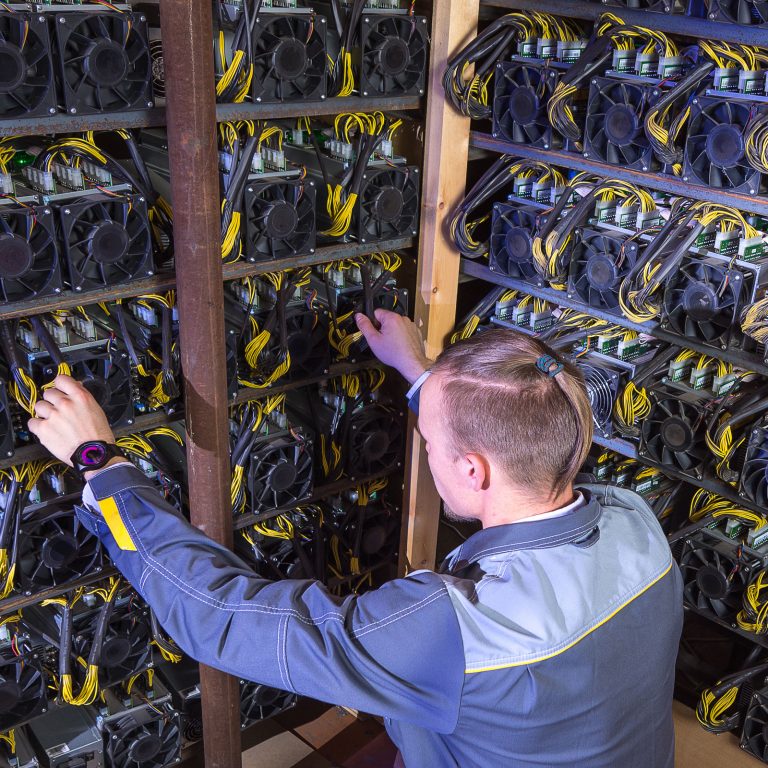
There has been a slew of bitcoin mining rigs announced during the last 12 months that claim to process more terahash per second while consuming less energy. However, with cryptocurrency prices so low, lots of newly launched machines are not profitable and many of them haven’t even shipped yet.
Also read:
The Five Profitable Mining Rigs
have seen better days as cryptocurrency markets throughout the entire 2018 calendar year have been riding a long bearish trend. Many coins with the SHA-256 mining algorithm such as bitcoin cash (BCH), bitcoin core (BTC), and peercoin (PPC) have lost considerable value. Because cryptocurrency prices are so low, many mining devices announced this year are failing to bring a profit and some machines cannot be purchased on the open market. According to real-time statistics from at the time of publication, only five mining devices make a profit and two machines are not yet available on the market. The data website uses a combination of electrical costs, current network difficulty, block reward, and exchange rates to figure out whether or not certain ASIC machines are profitable.
Machines With Significant Terrahash Pull Small Profits
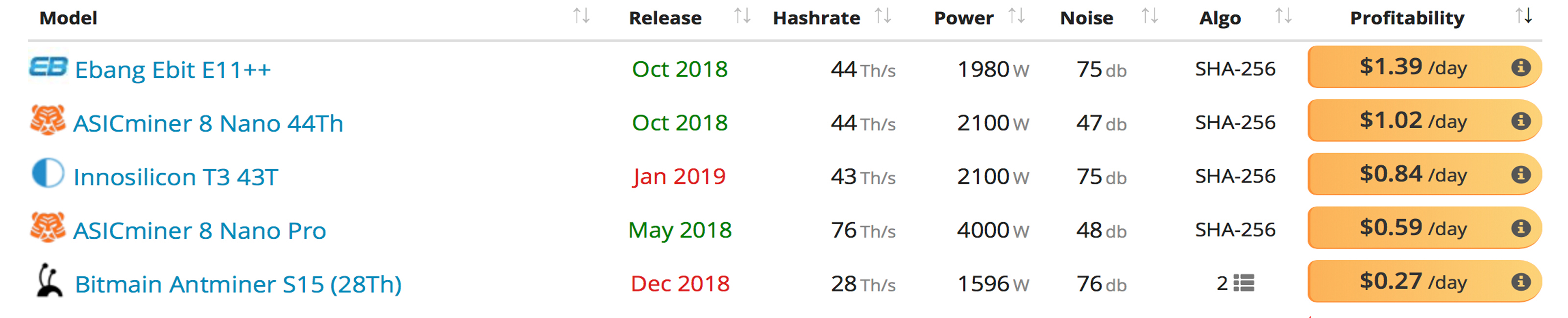
The most profitable machines on Monday, Dec. 10, 2018, three weeks before the new year, are manufactured by the corporations Ebang, Asicminer, Innosilicon, and Bitmain. The Ebang Ebit E11++ is currently the most profitable mining device on the market with 44 terrahash per second (TH/s) and it consumes 1,980W. The Ebang mining rig priced at $2,500 makes about $1.39 per day profit with current BTC prices. The E11++ is currently available on the open market from two companies but one vendor is only taking pre-order right now. The Asicminer 8 Nano is another machine that processes 44TH/s but pulls 2,100W from the wall. The machine created by Asicminer was launched in October and pulls a profitability of about $1.02 per day, at the time of writing. The company’s 8 Nano is available for purchase through the Canadian dealer Mining Cave for $2,045.
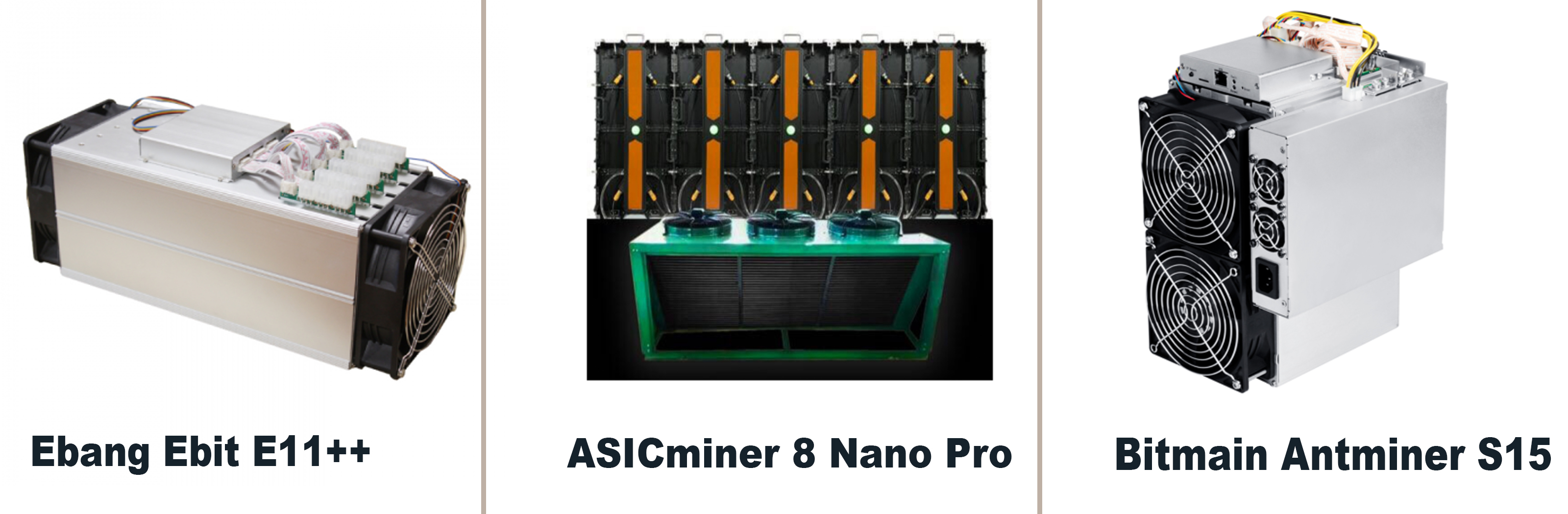
Then there’s the new Innosilicon T3 model, which also claims to boast roughly 43TH/s but the rig is not available to the public just yet. The T3 will be released in January 2019, according to the company, at a price of $2,500 per machine. With current market statistics, this gives the T3 a profitability of about $0.84 per day for a machine you cannot obtain. The next most profitable miner, Asicminer 8 Nano Pro, is obtainable according to Asicminervalue. The Nano Pro claims to process a whopping 76TH/s but consumes over 4,000W in electricity. These metrics make the $11,600 machine only profitable by $0.59 per day. Lastly, Bitmain contends the Antminer S15 machine produces about 28TH/s, pulling 1,596W from the wall, giving the device a profitability of $0.27 every 24 hours.
Operating at a Loss
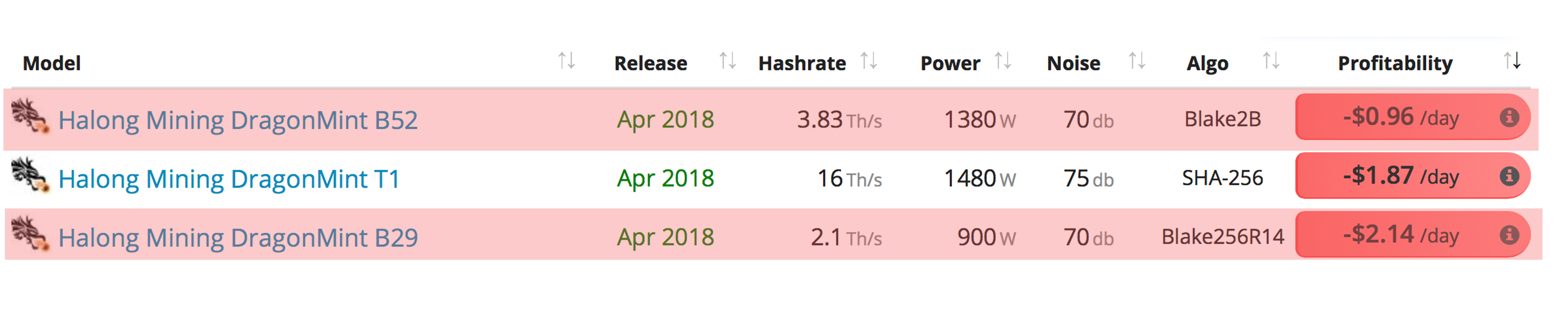
Many other machines that were announced this year are not showing profits and consume more energy cost if the companies continue to operate them. GMO’s B2 and B3, which boast 24-33TH/s, can lose between $1.90-4.98 per day at current BTC prices. The infamous Halong Mining Dragonmint T1 model sees a loss of around $1.87 per day.
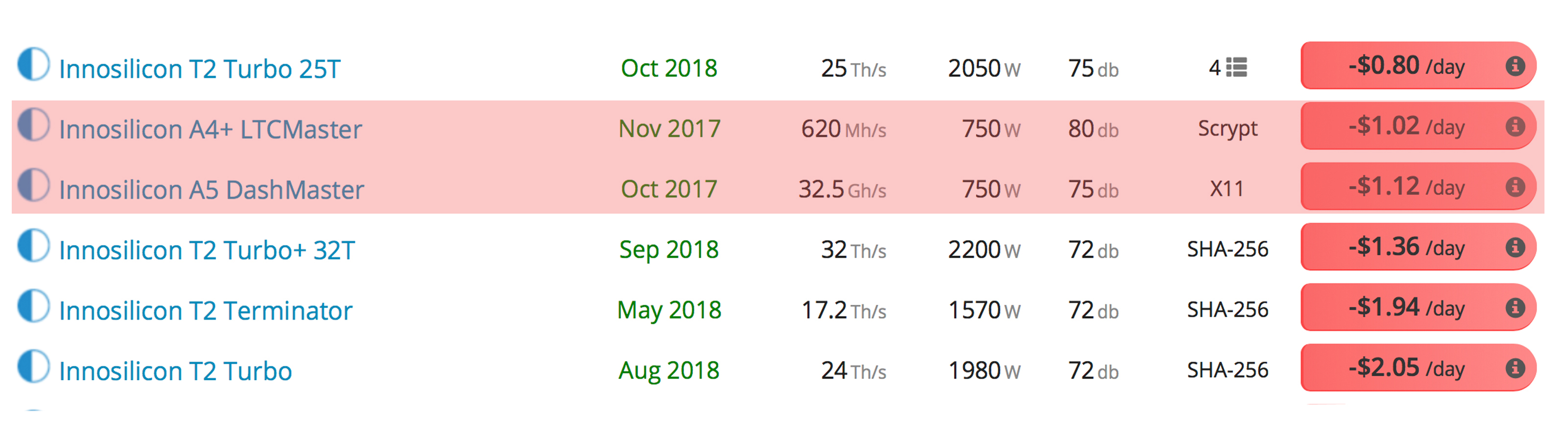
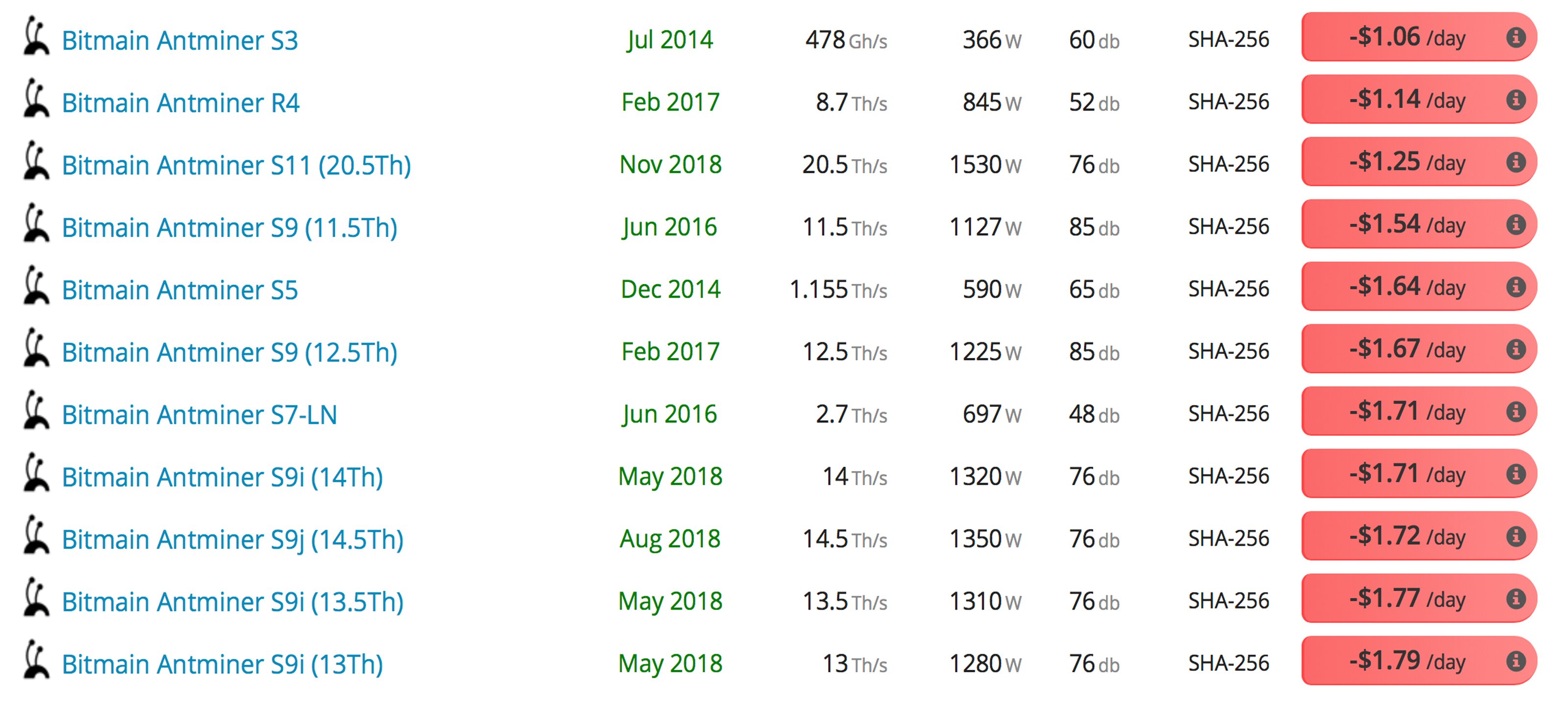
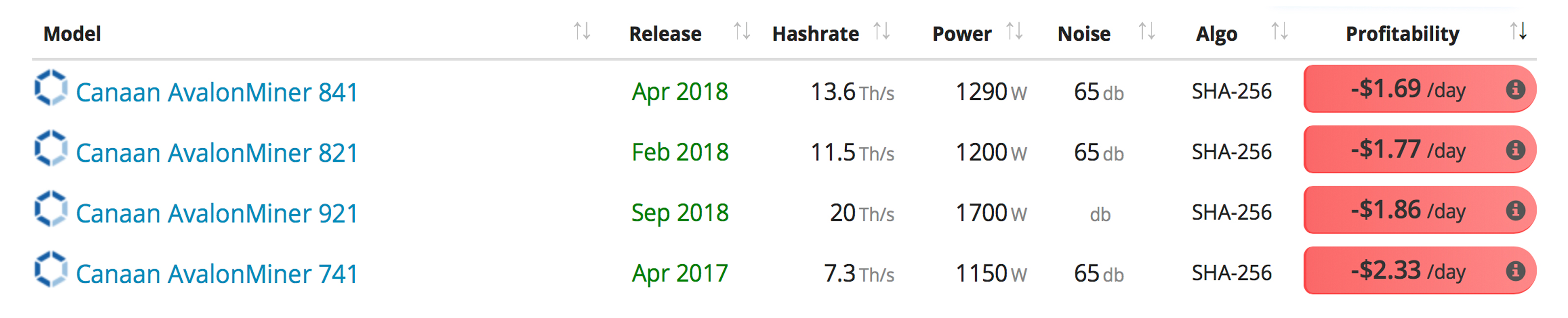
Innosilicon’s previous models, besides the unobtainable T3, are all seeing losses at the time of publication. The top four Whatsminer models (M10, M10s, M3, and M3X) lose $1-4.25 every 24 hours, according to the statistics. A large variety of SHA-256 Bitmain models, including the S9, R4, S11, and many other series, are unprofitable. The Canaan Avalon series is in the same boat as the 841, 821, and 921, losing about $1.69-1.86 per day with current BTC prices at $3,500 per coin.
Bearish SHA-256 algorithm coin prices have affected network hashrate considerably over the last few months. For instance, the bitcoin core (BTC) hashrate per second (EH/s) during the last week of August, but this month the BTC hashrate is only 35 EH/s. However, there may be many facilities which are still making a profit with older machines if their electric cost is highly subsidized or nearly free.
Many flashy machines announced this year have touted 7 and 10 nm chips and much bigger processing power, but cryptocurrency market prices have made it so only a few machines are profitable. But if markets push higher again turning from a bearish-to-bullish trend, then a great majority of the newly released 2018 mining rigs should become profitable again.
What do you think about these mining rigs and their profitability rates with current prices? Let us know what you think about this subject in the comments section below.
Disclaimer: bitcoin.com does not endorse these products/services. Readers should do their own due diligence before taking any actions related to the mentioned companies or any of its affiliates or services. This editorial is intended for informational purposes only. bitcoin.com and the author are not responsible, directly or indirectly, for any damage or loss caused or alleged to be caused by or in connection with the use of or reliance on any content, goods or services mentioned in this article.
Images via Shutterstock, Ebang, Asicminer Nano, Bitmain, and Asicvalue.com.
Need to calculate your bitcoin holdings? Check our section.
The post appeared first on .