
July 6, 2026

Capitalizations Index – B ∞/21M

Meet the Rouge Project: a Game-Changer in the Coupon Market

Meet the rouge project: a game-changer in the coupon market

Meet the Rouge Project: a Game-Changer in the Coupon Market

Bitcoinist.net · February 23, 2018 · 1:00 am

The coupon market came out in the early twentieth century, mostly in the US and Europe, and since then has grown exponentially. The internet boom allowed companies to provide their clients with all kinds of discounts and rebate on various goods.


Today, we’re living in another technology revolution, lead by the blockchain, so the concept of coupons might transform by corresponding to the security and transparency of the emerging technology. One particular startup, called the Rouge Project, has already made a step ahead of the competition and came with a brilliant idea to create a blockchain-based coupon ecosystem.

What the Rouge Project Has to Offer?

The Rouge Project wants to create an Ethereum-based blockchain network that would streamline the operation with coupons, cut costs by eliminating the need for intermediaries, and reduce the frauds and errors, which are so present in the coupon market.

The network will favor three key sides:

  • The brands or the issuers – companies, online shops, manufacturers, and all kind of entities will be able to issue coupons that are easy to monitor and resistant to frauds. Each voucher will be used one single time so that no double redemption could be allowed.
  • The publishers/advertisers – they can generate a profit by monetizing on the coupon campaigns.
  • The customers – they will benefit from real and verifiable coupons that can be used or resold in the secondary markets.

The Rouge Network will be driven by an ERC20 compatible token with the ticker RGE. The token will be used by all three mentioned parties – it will give them the right to operate within the Rouge Network system.

The Rouge Project aims to make its network accessible worldwide. It should be a trustless and decentralized system that wouldn’t give a specific preference to any party involved, thus keeping neutrality.

Each coupon on the network will be used only once, and will be in one of the three possible forms:

  • Free – the coupon was issued by a brand, but hasn’t been purchased
  • Acquired – the coupon is owned by a customer.
  • Redeemed – the voucher has been already consumed by the customer.

Can I Buy RGE Tokens?

As of today, you can buy RGE Token in the pre-sale period. First, let’s check the project’s roadmap:

  • Phase I – this was the inception period that ended in 2017. The project reviewed the reactions from the Ethereum community members and started its token pre-sale.
  • Phase II – the second phase is planned for the first quarter of 2018. We’re currently at this stage. The pre-sale goes on, and the Rouge Network shows its demo version. At the end of this period, the token sale period will end.
  • Phase III – the third phase is scheduled for the second quarter of this year. We’ll see the full implementation of the network.
  • Phase IV – finally, the last stage will continue until the end of 2018, focusing on the expansion of the project.

Since we’re currently in the second phase of the project, you can buy RGE tokens at a discount price. Today RGEX9 tokens are available, which means you can enjoy a discount of almost 80%.

The RGEX12, RGEX15, and RGEX20 tokens are already sold, with a total distribution of 290,000 tokens. If you’re late for the RGEX9 token presale event, there is enough time until the RGEX8, RGEX7, and RGEX6 get distributed, so don’t hesitate to look into those ones.

Given that the token presale is conducted in a private mode, you’ll have to follow specific steps on the official website and share your email address to get approved for the purchase. Currently, you should spend at least 2 Ether tokens for a sale transaction, which translates into about $1,750. Otherwise, wait for the public crowdsale to spend less, but you won’t enjoy the high discount available today.

Does the Project Have Potential?

Yes – the main reason for the affirmative answer is that the market is growing at a fast pace. Moreover, it seems that the overwhelming majority of the coupons will become digital soon.

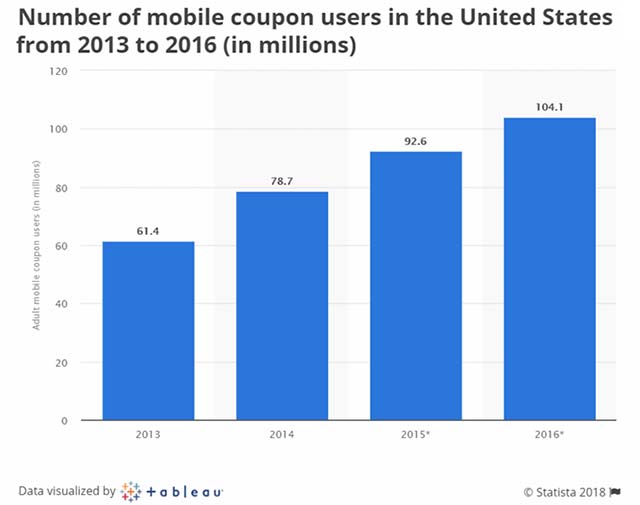
According to Statista, the number of mobile coupon users in the US rose from 61.4 million in 2013 to about 104 million in 2016. This is a growth of about 70% in three years.
Does the project have potential?

The blockchain revolution can push the coupon market to new levels, by ensuring its security, transparency, convenience, and accessibility.

According to an infographic from Invesp, the number of e-coupons redeemed worldwide in 2019 will reach 31 billion, from 16 million in 2014. As we can see, the volume of digital coupons is almost doubling in a five-year period.

When you mix a growing market with a great project, the result is always positive. In addition, the Rouge Project is backed by an ambitious team, which is led by entrepreneur Naira d’Arcollières.

You can check the project’s whitepaper here.

What are your thoughts on the Rouge Project? What will its impact be on the coupon industry? Tell us your thoughts in the comments below.


Images courtesy of Rouge Project

Bitcoinist does not endorse and is not responsible for or liable for any content, accuracy, quality, advertising, products or other materials on this page. Readers should do their own research before taking any actions related to the company.

couponsICOsRouge Projecttoken salesTokens Show comments

Published at Fri, 23 Feb 2018 06:00:47 +0000

Altcoin News

Previous Article

Tommy Lee Sparta – Team Up (Tsunami Remix) – February 2017

Next Article

Ethereum Creator Vitalik Buterin Donates $763,000 to Machine Intelligence Institute

You might be interested in …

A Bitcoin Social Media Storm Hit BitPay This Week: Here's Why

Everyone’s Mad at BitPay. Here’s Why.

The bitcoin community is not taking kindly to BitPay this week. Influential developers are accusing the major payment processor of fraud, bitcoin users on social media are calling for boycots, bitcoin.org is removing recommendations of the company’s products, and NBitcoin developer Nicolas Dorier has launched an initiative to fork some of BitPay’s projects altogether.

Here’s why.

Bitcore

The controversial issue has to do with Bitcore.

Bitcore is a type of bitcoin node developed by BitPay. It is specifically designed to offer a development platform, on top of which it is easy to build all kinds of bitcoin applications. Anyone can use this open-source tool; some of the better-known applications that utilize it include video-streaming service Streamium, Trezor’s web interface and BitPay’s own Copay wallet.

Within the next a couple of days, most likely on August 23, the long-awaited bitcoin protocol upgrade Segregated Witness (SegWit) will activate. Seemingly in response to this upgrade, BitPay published a blog post titled What Bitcore Users Need to Know to Be Ready for SegWit Activation

But not everyone is happy with the contents of this blog post…

The “Major Risk” That Is (or Isn’t) SegWit

The first problem is not the most important problem, but it is worth mentioning, regardless. It concerns the topic of the blog post itself: Segregated Witness.

In the blog post, BitPay states:

Nodes which fail to upgrade to support SegWit will face major security risks, including the risk of double-spend transaction fraud.

This appears to be a bit of an exaggeration.

Segregated Witness is specifically designed to be backwards compatible. Regular nodes that do not upgrade remain part of the bitcoin network. And importantly, since SegWit was activated by a unanimous hash-power majority, all miners should be enforcing the new rules. As such, transactions that are invalid according the new rules should never be accepted in any bitcoin blocks at all. Even non-upgraded nodes should never see these invalid transactions confirm.

It is true that — like every other soft fork before SegWit — there are some increased risks for non-upgraded nodes. And in an additional blog post, BitPay does provide more details and nuance regarding the situation.

But the somewhat alarmist tone of the first blog post seems a bit unnecessary. Therefore, to many it appears to have had the specific goal of pushing users toward a software upgrade for very different reasons.

Which brings us to the next point…

The “Upgrade” That Is (or Isn’t) bitcoin

While BitPay’s alarmist tone seemed like an unnecessary means, it’s the end that really ticked so many people off.

As per the “New York Agreement,” a significant group of bitcoin companies, mining pools and individuals plans to adopt an incompatible set of protocol rules by November. Dubbed “SegWit2x,” and implemented in the BTC1 software developed by former bitcoin Core contributor Jeff Garzik, this project would “hard fork” an increase of bitcoin’s block weight limit, allowing for blocks of up to eight megabytes. (Whether this should technically be called a hard fork or an altcoin is debatable, but never mind that for now.)

The problem is that, while a significant group of bitcoin companies — including, indeed, BitPay — signed on to the New York Agreement, this agreement currently does not have industry-wide consensus. Most notably, bitcoin’s development community has almost unanimously rejected the proposal. There is also a long list of companies that never signed onto the initiative in the first place; in fact, some of them are actively opposed to it. And more informal metrics, like social media sentiment, opinion polls and network node count generally also show limited support for SegWit2x.

As such, it is likely that SegWit2x would split off to create a new blockchain and currency, not unlike what bitcoin Cash (Bcash) did. Unlike Bcash, however, SegWit2x currently has no intention of picking a new name, nor does it plan to implement safety precautions like replay protection. (Replay protection would prevent the “same” coin from accidentally being spent on both chains.) For all intents and purposes, the companies behind SegWit2x appear to be set to claim this coin is the “real” bitcoin, while the coin that follows the current bitcoin protocol won’t be.

This approach is controversial. Many bitcoin users that do not support the hard fork may prefer to keep using bitcoin as is, without worrying about added (replay) risks or other inconveniences caused by SegWit2x. And if two different coins claim the name “bitcoin,” it could lead to much confusion, for obvious reasons.

Regardless, in BitPay’s blog post, which speaks of an “upgrade” for Bitcore users in preparation for SegWit, the payment processor actually directs readers to download the BTC1 software; that is, the software that embeds the SegWit2x protocol, rather than the current bitcoin protocol. It therefore appeared that the company was really trying to get Bitcore users to switch to a whole new coin, which BitPay will consider “bitcoin.” And the payment processor initially did so without so much as warning Bitcore users that following these instructions would make them incompatible with the current bitcoin protocol by November.

Herein lies the concern: BitPay must have known that this advice is controversial. Failing to mention the risks or consequences made the blog post seem deceptive.

The Hash Power That Supports (or Doesn’t Support) SegWit2x

Finally, after BitPay faced initial blowback for its blog post for reasons described, it included an addendum. In it, the payment processor writes:

[O]ur instructions follow this version of bitcoin because over 95% of bitcoin miners have adopted Segwit2x.

While this addendum provides a little bit more clarity, it is once again a bit of a questionable statement.

Perhaps most importantly: If BTC1 indeed hard forks in November, BitPay right now has no way of knowing how much hash power will really be mining on the SegWit2x chain.

While it is true that mining pools currently representing a supermajority of hash power signed on to the New York Agreement, mining pools usually don’t have full control over the hash power that is pointed toward their pools. Much of this hash power actually belongs to individual miners (“hashers”), who could switch to a new pool with the click of a few buttons. (For example, when another mining pool, Ghash.io, reached over 50 percent of total hash power on the network a couple of years ago, hashers were also urged to move to different pools.)

Furthermore, even if a specific mining pool does control its hash power, nothing in the New York Agreement says these pools should mine on the SegWit2x chain exclusively. Since miners typically dedicate their hash power to maximize profit, it is very possible that this hash power will be attributed to different chains according to the value of the coins on these chains. (This is what usually happens between altcoins. Similarly, just over the past couple of weeks, some signatories to the New York Agreement have already begun directing some hash power to the Bcash chain.)

In its addendum, BitPay appears to be ignoring these dynamics. Once again, this has an air of deceptiveness.

In BitPay’s Defense…

All that said, it should be noted that the risks are still limited, even if users follow BitPay’s instructions.

This is because BitPay is not (currently) suggesting that users run BTC1 software to send and receive transactions. Rather, BitPay is advising users to connect their Bitcore nodes to a BTC1 node as a “border node.” This means that the BTC1 node will essentially act as a network filter to reject all transactions invalid under the new SegWit rules.

Until the hard fork in November, using BTC1 as a border node shouldn’t do any harm whatsoever. BTC1 is compatible with the bitcoin network until that point in time, and indeed enforces the new SegWit rules.

If no further action is taken, the BTC1 border node would switch to the SegWit2x blockchain by November. But even then, the current Bitcore nodes that are used to send and receive transactions will not make that switch. As such, BTC1 nodes would only let SegWit2x transactions through, which would then, in turn, be rejected by Bitcore nodes. This incompatibility between the two nodes actually means that no blocks would come through at all.

As such, no one would send or accept (confirmed) payments in a different coin than they mean to. In a worst case scenario, the whole setup essentially shuts down.

While the blog post appears deceptive in some ways, BitPay’s advice shouldn’t, in itself, cause a of loss funds.

Shortly before publication of this article, BitPay CEO Stephen Pair said in statement to bitcoin Magazine:

This was unfortunately not the way I had intended this conversation to begin. I will have more to say on this topic in the near future, and feel I owe it to the community to say something. Unfortunately, it may take a little while for that communication to happen as I have other matters demanding my attention at the moment.

The post A Bitcoin Social Media Storm Hit BitPay This Week: Here's Why appeared first on Bitcoin Magazine.

Blockchain music startup raises $5. 5 million in series a funding

Blockchain Music Startup Raises $5.5 Million in Series A Funding

Blockchain Music Startup Raises $5.5 Million in Series A Funding Advertisement Audius, a decentralised, community-owned music sharing platform billed as the blockchain’s answer to Soundcloud has announced the successful completion of a $5.5 million Series […]

“Cloud with Me” Announces Cloud Token ICO, as It Works on Decentralized Cloud Solutions

The internet, which started as an internal network of the defense sector has grown into one of the basic necessities of today’s life. As the revolutionary technology of yesteryears continued to progress, it gave rise to cloud computing. However, cloud computing has a lot of room for improvement, especially when it comes to the centralized … Continue reading “Cloud with Me” Announces Cloud Token ICO, as It Works on Decentralized Cloud Solutions

The post “Cloud with Me” Announces Cloud Token ICO, as It Works on Decentralized Cloud Solutions appeared first on NEWSBTC.